
The Artemis 2 crew — Victor Glover, Christina Koch, Reid Wiseman and Jeremy Hansen — landed at Kennedy Space Center on March 27 and revealed their zero‑gravity indicator, Rise. Rise is a smiling moon plush wearing an Earth‑themed cap, designed by second‑grader Lucas Ye and inspired by the Apollo 8 Earthrise image. NASA received more than 2,600 submissions from over 50 countries for the Artemis 2 zero‑g indicator. Artemis 2 will be the first crewed mission to lunar space since 1972 and is currently slated to launch as early as April 1 to test the Orion spacecraft and conduct preparatory experiments for future Artemis missions.
Artemis 2 Crew Reveal Adorable Zero‑G Indicator “Rise” Ahead Of Lunar Flight
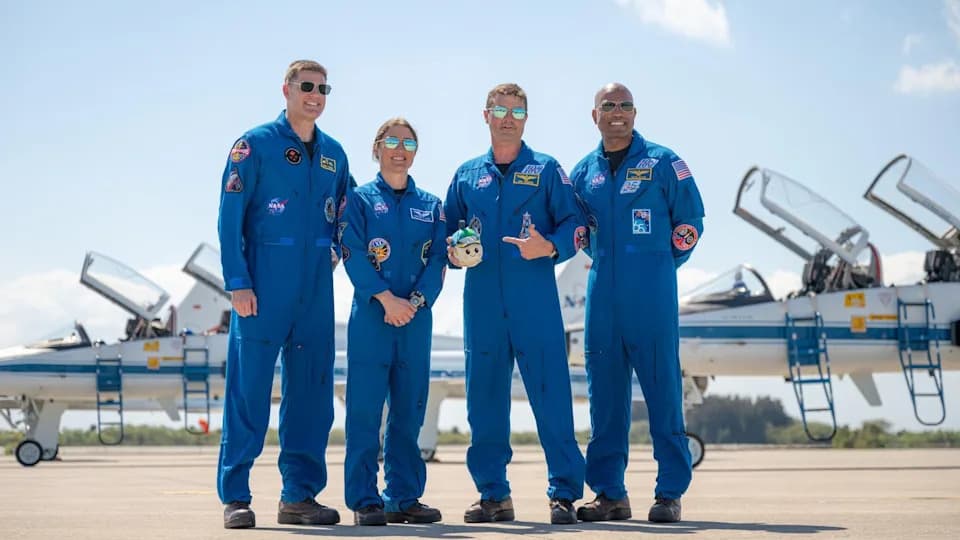
The Artemis 2 astronauts pose for a photograph alongside their zero gravity indicator on March 27, 2026 after arriving at NASA's Kennedy Space Center in Florida. | Credit: NASA/John Kraus
NASA's Artemis 2 astronauts — Victor Glover, Christina Koch, Reid Wiseman and Canadian Space Agency astronaut Jeremy Hansen — touched down at the Launch and Landing Facility at Kennedy Space Center in Florida on Friday, March 27, ahead of their planned trip into lunar space.
Soon after landing, the crew unveiled their mission's zero‑gravity indicator: a plush called “Rise.” Zero‑g indicators are small stuffed toys flown on crewed missions to give crews a clear visual cue when they experience weightlessness and begin to float inside their spacecraft.
What Is Rise?
Rise is a smiling moon character wearing a cap designed to resemble Earth, with a brim patterned in stars. The plush was designed by second‑grader Lucas Ye of Mountain View, California. NASA says Lucas’s concept was inspired by the iconic Earthrise photograph taken during the Apollo 8 mission.

NASA astronauts Reid Wiseman and Victor Glover arrive at Kennedy Space Center on March 27, 2026, carrying "Rise," the zero-gravity indicator they will be taking with them on their journey to the moon. | Credit: NASA/Brandon Hancock
NASA opened a public call for Artemis 2 zero‑g indicator designs last year and received more than 2,600 submissions from over 50 countries. Rise was selected from that global pool and will ride along with the crew as a lighthearted, symbolic reminder of the mission’s ties to lunar exploration history.
Why Artemis 2 Matters
Artemis 2 will be the first crewed mission to travel to lunar space in more than 50 years (the last was Apollo 17 in 1972). The flight is designed to test the Orion spacecraft with a human crew aboard and to carry out experiments that will prepare NASA for future Artemis missions, which aim to establish a sustained human presence on and around the Moon.
NASA is currently "go" to launch Artemis 2 as early as Wednesday, April 1, at 6:24 p.m. EDT (22:24 GMT). The mission will help validate systems, operations and crew procedures ahead of subsequent missions that will return humans to the lunar surface and build long‑term infrastructure.
"Rise is a cheerful reminder that exploration can be scientific and playful—connecting a young designer’s imagination to humanity’s next steps to the Moon," NASA said in a statement.
Help us improve.





















