
April offers several standout sky events: a full Pink Moon that is also a micromoon reaches peak illumination at 10:12 p.m. EDT on April 1. Comet C/2025 R3 may be the brightest comet of 2025, with the evening of April 17 a promising time to observe ahead of its closest approach on April 27. A thin lunar crescent will appear near the Pleiades and Venus on April 19, and the Lyrid meteor shower runs April 15–29, peaking on April 22 with typical rates of 10–15 meteors per hour and possible short surges. Seek dark skies and allow your eyes to adapt for the best experience.
April Skywatch: Pink Micromoon, Comet C/2025 R3, and the Lyrid Meteor Shower
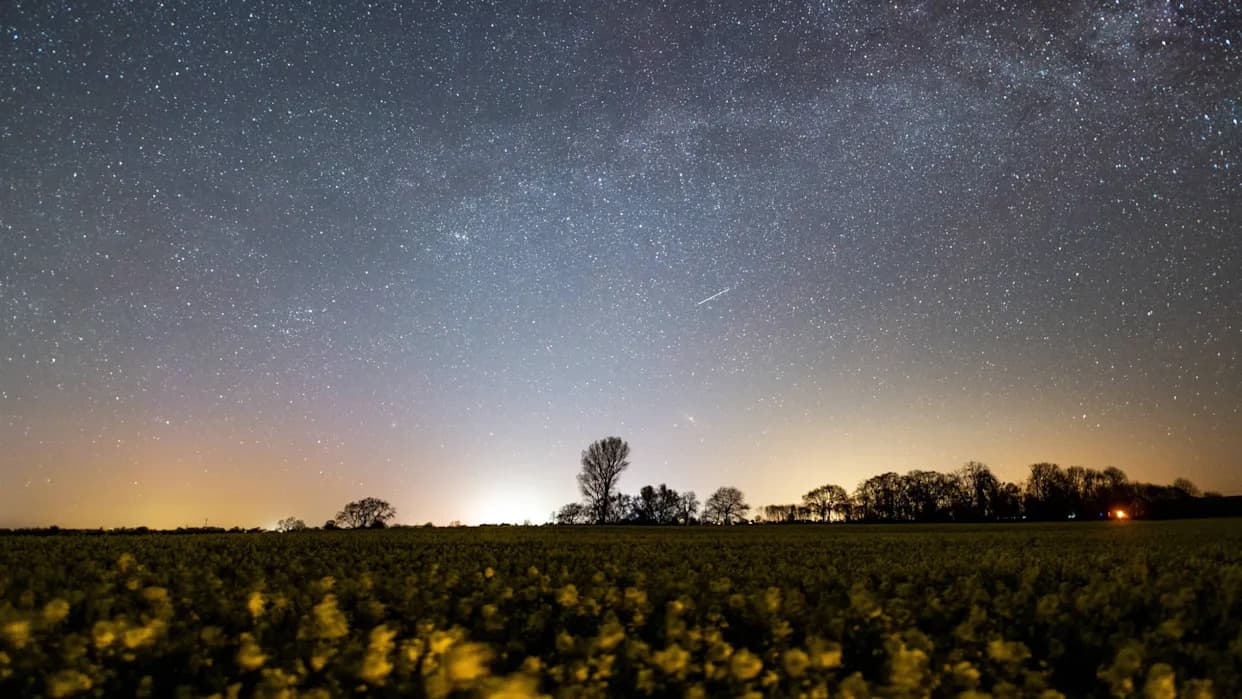
A starry sky shines over a field of flowers in Germany during the annual Lyrid meteor shower in April 2020.
Spring has arrived and the nights are getting richer for stargazing. April brings a compact but rewarding lineup of sky events: an early full moon that’s also a micromoon, a potentially bright comet, a delicate lunar-planet conjunction, and the annual Lyrid meteor shower. If the weather cooperates, skywatchers have several memorable views to look forward to.
Full Moon — The Pink Micromoon
The month opens with a full moon on April 1. Traditionally called the Pink Moon for the spring wildflowers that appear at this time, the Moon itself will not look pink — the name is seasonal, not chromatic. This full Moon is also a micromoon, meaning it occurs while the Moon is near apogee (its farthest point from Earth) and will appear slightly smaller than a typical full Moon. Peak illumination occurs at 10:12 p.m. EDT on April 1.
Comet C/2025 R3 — A Visitor to Watch
Comet C/2025 R3 is a promising visitor this year. NASA notes it could be the brightest comet visible in 2025. While its closest approach to Earth is expected on April 27, the evening of April 17 may offer the best viewing window because the Moon will be dim enough not to wash out the view. Binoculars or a small telescope are recommended. Scan the eastern sky near the constellations Pisces and Pegasus; charts from a reliable astronomy app will help you pinpoint the comet’s location on the chosen night.
Lunar Crescent Near the Pleiades and Venus
On the evening of April 19, the Moon will be a slim crescent and will appear to slip out from the Pleiades cluster, just above the brilliant Venus low in the western sky. Jupiter will sit higher above the pair, creating a lovely multi-object scene for low-horizon observing or photography. Look shortly after sunset while the sky is still deep blue for the best contrast.
The Lyrid Meteor Shower
The Lyrid meteor shower runs from April 15 to April 29, with a predicted peak on April 22. For observers in the Northern Hemisphere the shower’s radiant (in the constellation Lyra) will be well placed in the northern sky. Expect a typical rate of 10–15 meteors per hour, though the Lyrids are known for occasional brief surges of activity that can temporarily increase counts. Peak viewing is best after midnight local time, when the radiant is higher.
How To Get the Best Views
- Find a dark location away from city lights; even modest light pollution can hide fainter meteors and the comet’s faint tail.
- Give your eyes at least 20–30 minutes to adapt to the dark; avoid bright screens or use a red filter.
- Bring binoculars or a small telescope for the comet and for enhanced views of the Moon and planets.
- Check local weather and use a sky-charting app to confirm the Moon, comet, and planet positions for your location and time zone.
With a micromoon, a potential comet, and the Lyrids on the calendar, April offers several rewarding nights for observers. Clear skies and happy watching!
Help us improve.





















