
United Launch Alliance will launch an Atlas V rocket with five solid rocket boosters from Cape Canaveral at 3:53 a.m. EDT on March 29, 2026, carrying Amazon Leo broadband satellites. ULA’s visibility map indicates the predawn ascent could be visible across much of Florida and northward along the Eastern Seaboard, weather permitting. Live coverage begins about 90 minutes before liftoff at floridatoday.com/space and via the FLORIDA TODAY app.
Predawn Atlas V Launch From Cape Canaveral Could Be Seen Across Florida — How and Where to Watch
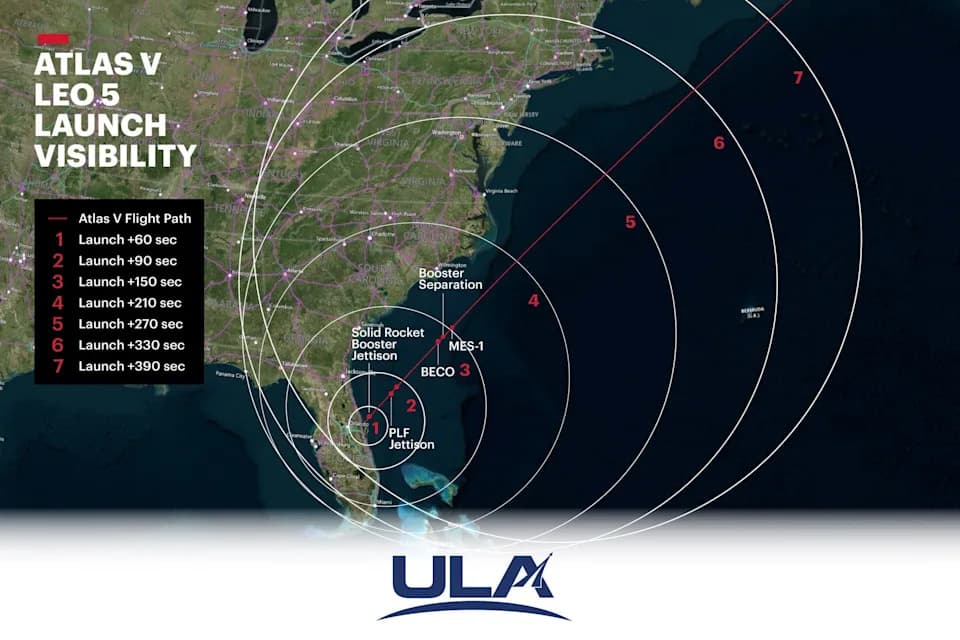
ULA launch of Atlas V, the fifth Amazon Leo constellation mission: Liftoff is planned at 3:53 a.m. EDT Sunday, March 29, 2026, from Cape Canaveral, Florida. The predawn launch will be visible from Florida to New England, if weather conditions in your area permit. This visibility map shows when and where your best chances are to see the rocket as it streaks northeasterly into space.
United Launch Alliance (ULA) is preparing an Atlas V rocket — a roughly 20‑story, 1.3 million‑pound vehicle with five solid rocket boosters — for liftoff from Cape Canaveral Space Force Station on Sunday, March 29, 2026. The mission will carry a batch of Amazon Leo broadband satellites (formerly Project Kuiper) into low‑Earth orbit. Weather permitting, ULA’s visibility map indicates the predawn ascent could be visible across much of Florida and up the Eastern Seaboard.
Launch Details
Liftoff: 3:53 a.m. EDT on Sunday, March 29, 2026 (29‑minute window)
Vehicle: Atlas V with five solid rocket boosters
Payload: Amazon Leo broadband satellites
Launch Site: Launch Complex 41, Cape Canaveral Space Force Station
Note: ULA says sonic booms are not expected for the Space Coast area.
Where You Might See It
Rockets launching from Cape Canaveral can be visible far from the pad under clear skies. ULA’s visibility graphic breaks the ascent into time windows after liftoff, showing where the vehicle and its plume are most likely to be seen as it climbs and discards hardware:
- Launch + 60 seconds: Space Coast and nearby central Florida communities (for example, areas near Orlando and the University of Central Florida).
- Launch + 90 seconds: Wider Central Florida corridor, including Daytona Beach and toward Jacksonville, around the time the payload fairing is jettisoned.
- Launch + 150 seconds: Most of Florida (excluding much of the Panhandle) — cities listed include Cape Coral, Fort Myers, Naples, Tampa, St. Petersburg and the Miami–Fort Lauderdale corridor; parts of coastal Georgia and southern South Carolina may also see the ascent.
- Launch + 210 to +390 seconds: The visibility corridor can extend through the Southeast and up the Eastern Seaboard into New England and, at the outermost estimates, inland to parts of the Midwest and southern Ontario, Canada. Exact sightlines depend on trajectory, time after launch and local weather.
Viewing Tips
- Check local weather and cloud cover before heading out — clear skies and low haze give the best chance to see the rocket.
- Use ULA’s published visibility map to confirm whether your town falls inside the estimated sightline for a given time after launch.
- If you plan to view from Florida, popular spots include the Space Coast (Brevard County), the Fun Coast (Daytona Beach area) and the Treasure Coast (Vero Beach, Jensen Beach and Fort Pierce).
- Bring a camera with a tripod and a wide field of view; predawn light and the rocket’s plume can make for dramatic photos.
Watch Online
Full live coverage and a webcast begin about 90 minutes before liftoff at floridatoday.com/space and via the FLORIDA TODAY app (App Store and Google Play). The FLORIDA TODAY space team will provide real‑time updates, social coverage and viewer Q&A during the broadcast.
Godspeed to the Atlas V and Amazon Leo teams.
Reporting note: This story is based on ULA information and original reporting that appeared on Fort Myers News‑Press and Florida Today. Visibility estimates are based on ULA’s graphic and assume clear skies and minimal cloud cover.
Help us improve.





















