
Since a daytime fireball on March 8, astronomers have recorded an unusual cluster of bright meteors across Europe and the U.S., including multiple sonic booms and recovered fragments. The American Meteor Society reports at least eight major fireballs and notes 2026 has a higher-than-average rate of notable events. Analysis links much of the activity to the Anthelion sporadic source, while recovered samples are achondritic eucrites from differentiated asteroids. Scientists rule out artificial causes and say continued monitoring is needed.
Why Fireball Sightings Have Spiked Across the US and Europe — What's Driving the Surge?
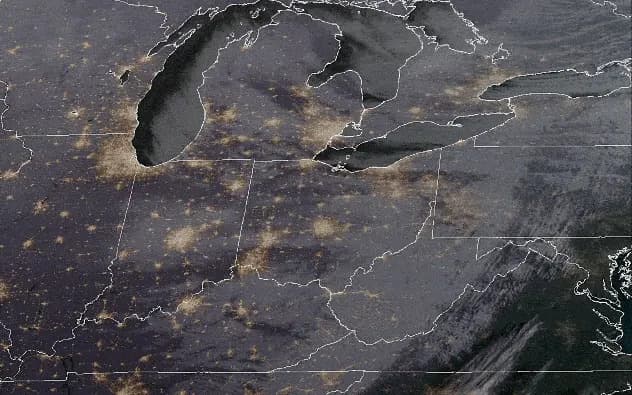
A fireball meteor seen over Cleveland, Ohio, on NOAA's GOES lightning mapper on Tuesday, March 17, 2026. (Image: NOAA GOES EAST)
On March 8 a daytime fireball over western Europe kicked off an unusual run of bright meteor sightings across Europe and the United States. Over the following three weeks astronomers logged multiple high-profile events — including audible sonic booms and recovered meteorite fragments — and are now working to understand why.
Recent Events and Reports
The American Meteor Society (AMS) reports at least eight notable fireballs recorded across more than a dozen U.S. states and parts of Europe since early March. Key events include:
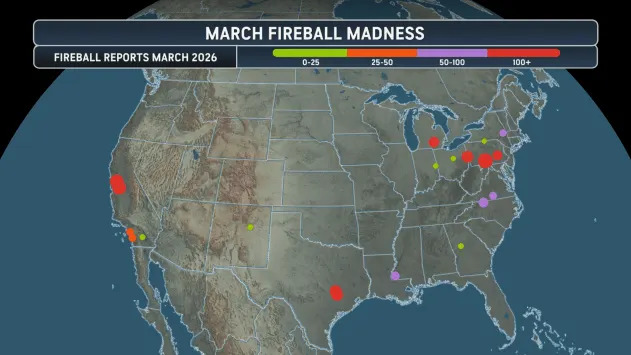
Fireball reports in March 2026 with American Meteor Society data.
- March 17: A daytime meteor produced a sonic boom heard across Ohio and Pennsylvania, generating more than 200 witness reports submitted to the AMS.
- March 21: A daytime fireball streaked over Houston, Texas.
- March 23: Two fireballs were observed across California, Oregon, Washington and Nevada.
- March 24: Two fireballs were seen over the Great Lakes and Ontario, with an additional event reported later that night in the Southeast.
What the Data Show
While Earth is constantly hit by small space rocks, 2026 is producing a higher-than-average number of widely observed fireball events. "In 2026, both the rate and the absolute count are high. Thirty large fireball events producing audible booms in a single quarter mean roughly one every three days," said Mike Hankey of the American Meteor Society.
An AMS analysis of trajectories and radiant points from 2021 onward identified a meaningful clustering in two regions of the sky, with a dominant contribution from the Anthelion sporadic source — a region opposite the sun. However, trajectory reconstructions show that some prominent daytime events (for example, the fireballs over Germany and Ohio) came from different parts of the sky on unrelated orbits, indicating they are not fragments of a single parent body.

A bright daytime fireball seen over the Houston, Texas area on Saturday, March 21, 2026. (Image credit: Rafe Borne)
Composition And Origins
"It's not aliens," Hankey said. "Every fireball in the AMS database with sufficient trajectory data is consistent with objects on heliocentric orbits — material orbiting the sun that intersects Earth's path."
Recovered fragments from the Ohio and Germany events have been identified as achondritic eucrites. These are igneous meteorites formed billions of years ago on differentiated asteroids in the inner solar system, consistent with natural, rocky origins.
Possible Explanations And Next Steps
Scientists consider several factors: an increased contribution from the Anthelion sporadic source, natural variability in small-body flux, and higher rates of detection and reporting driven by improved cameras and AI tools. While broader reporting likely increases the number of logged sightings, researchers note that it does not fully explain the uptick in audible sonic booms or the number of recovered meteorites.
For now, the cluster of events represents a noticeable shift in recent meteor activity. Researchers emphasize continued observation, trajectory reconstruction and laboratory analysis of recovered samples to determine whether the surge reflects a short-term fluctuation or a more significant change in near-Earth small-body encounters.
Help us improve.





















