Iraq will summon the US and Iranian envoys and lodge a complaint at the UN after a string of deadly strikes, including attacks on PMF headquarters in Anbar and on Kurdish forces in Erbil. The Anbar strike killed at least 15 people, while Kurdish authorities reported six killed and about 30 wounded. Baghdad's National Security Council authorized measures to "confront and respond" to attacks, saying the strikes violate Iraqi sovereignty and risk widening the conflict.
Iraq To Summon US And Iranian Envoys After Deadly Strikes, Warns Of Possible Escalation
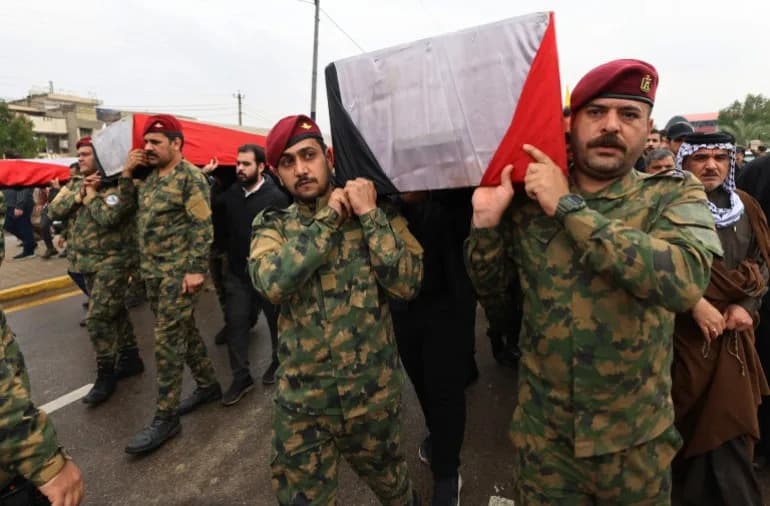
Members of the PMF carry the coffin of the operations commander for Anbar province, Saad Dawai, during a mass funeral in Baghdad on March 24, 2026 [Ahmad Al-Rubaye/AFP]
Iraq announced plans to summon the US and Iranian envoys to formally protest a series of deadly strikes on Iraqi soil that officials say have increasingly pulled the country into the wider US‑Israeli campaign targeting Iran.
The office of Prime Minister Mohammed Shia al‑Sudani said on Tuesday the Ministry of Foreign Affairs will "deliver formal notes of protest" to the US chargé d'affaires in Baghdad and to the Iranian ambassador over recent attacks. The government also plans to lodge a formal complaint with the United Nations Security Council "concerning acts of aggression and their consequences."
The statement listed several strikes, including an attack on the headquarters of the Popular Mobilisation Forces (PMF) in Anbar province and strikes on the Kurdistan Regional Guard headquarters in Erbil, the capital of the semi‑autonomous Kurdish region.
Earlier on Tuesday, Iraq's presidency condemned the strike on the PMF command in Anbar, saying it killed at least 15 people, including the regional operations commander. The PMF, also known as al‑Hashd al‑Shaabi, is a component of Iraq's armed forces that includes some Iran‑aligned groups.
Separately, Kurdish regional authorities accused Iran of launching two ballistic missile strikes against Kurdish forces in and around Erbil, reporting six dead and about 30 wounded. The Kurdistan Regional Government's Ministry of Peshmerga Affairs said in a statement:
"We strongly condemn this attack, as well as all terrorist acts against the Kurdistan Region. At the same time, we reaffirm our inherent right to respond to any aggression against our people and our land."
Iraq's presidency also denounced the attacks on Kurdish forces, calling them a "fundamental pillar of the national defence system." Iran has not issued a formal comment on the strikes.
Reporting from Baghdad, Al Jazeera's Assed Baig described the incidents as a "significant escalation," saying they appear less sporadic and more like a sustained campaign that risks spreading conflict inside the Kurdish region. Kurdish authorities have repeatedly said they do not want to be drawn into a wider military escalation.
Following a National Security Council meeting, al‑Sudani's office said the council agreed "to confront and respond to military attacks" targeting the PMF and other branches of the Iraqi armed forces, citing the right to self‑defence. The government said the decision was made in light of what it called "unjustified attacks and grave violations of Iraqi sovereignty, including the targeting of official security headquarters."
Officials warned the developments could open a new front in the broader US‑Israeli campaign against Iran, which entered its fourth week with no clear sign of de‑escalation despite international calls to calm tensions.
Help us improve.