Key takeaway: A pyramid-like formation in Candor Chasma is a natural erosional knob, not an artificial structure. Orbital images (MGS and HiRISE) show a roughly 290 m by 145 m mound surrounded by aeolian ripples. Geologists classify such features as "positive relief knobs" — erosion-resistant rock left standing after softer material erodes — and point to irregular slopes and contextual geology as evidence of a natural origin.
Viral 'Pyramid' on Mars Explained — Natural Rock, Not An Ancient Monument
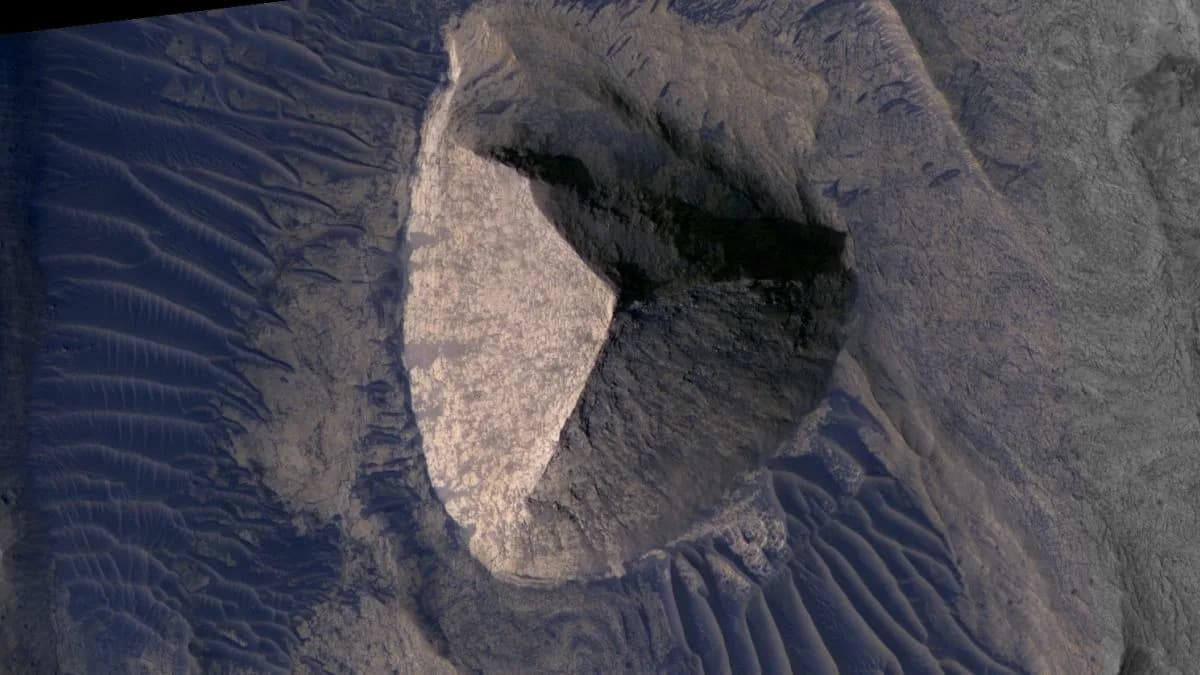
The so-called Candor Tetrahedron. (NASA/JPL-Caltech/UArizona)
Mars continues to surprise with its rugged, wind-sculpted terrain, and sometimes those features trick our eyes into seeing familiar shapes. A striking formation in Candor Chasma that looks like a three-sided pyramid has circulated widely online — but closer inspection shows it is a natural geologic feature, not an artificial structure.
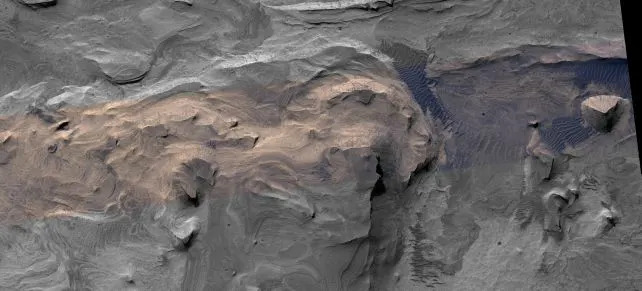
The geological context in which the feature appears. You can see it at the far right. (NASA/JPL-Caltech/UArizona)
Origin of the Claim
The formation drew attention after cropped NASA images were reshared on social media. The orbital photographs are real and date back to early 2000s missions: initial coverage came from the Mars Global Surveyor (MGS) in 2001 and was publicly noted in 2002, when independent researcher Wilmer Faust pointed out the unusual shape in MGS image E06-00269. More recent, higher-resolution views have been provided by HiRISE aboard NASA's Mars Reconnaissance Orbiter.
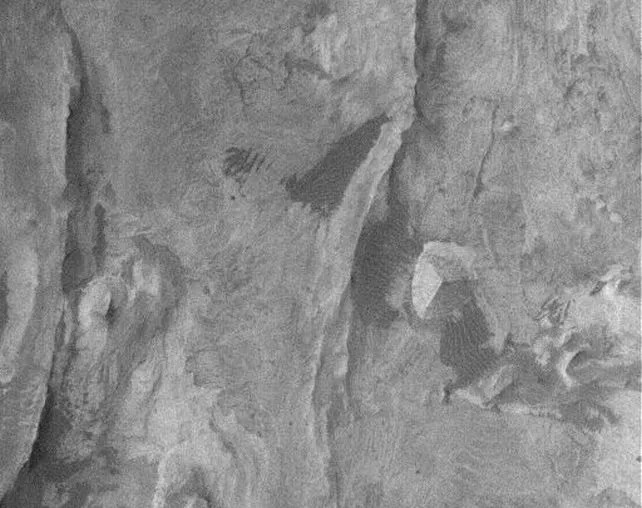
The Mars Global Surveyor image obtained in 2001. (M. C. Malin, K. S. Edgett, S. D. Davis, M. A. Caplinger, E. Jensen, K. D. Supulver, J. Sandoval, L. Posiolova, and R. Zimdar,E06-00269,Malin Space Science Systems Mars Orbiter Camera Image Gallery, 2002)
What the Images Really Show
HiRISE’s detailed images reveal that the so-called Candor Tetrahedron is roughly 290 meters across and about 145 meters tall. When viewed in context, the feature fits the pattern of an erosional remnant — a lumped, layered hill carved by the same forces that formed surrounding canyons rather than a manmade pyramid.
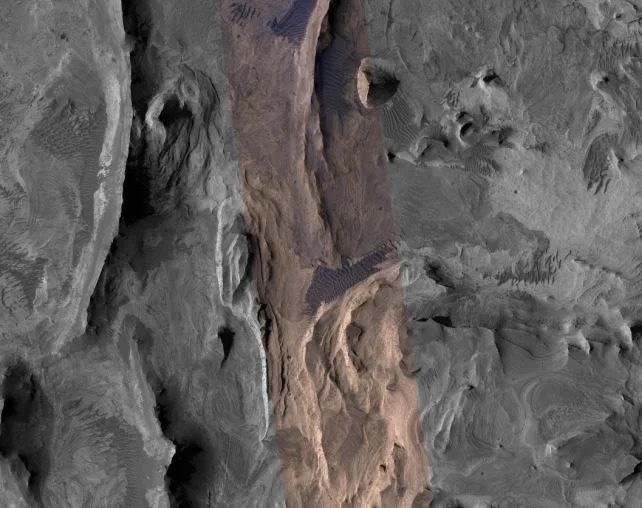
Another view of the geological context, showing nearby features of similar height. This image was taken by the Mars Reconnaissance Orbiter's HiRISE camera, which acquires colour infrared information along a central strip. (NASA/JPL-Caltech/UArizona)
Positive Relief Knobs
Geologists describe many such features in Candor Chasma as "positive relief knobs": formerly buried, erosion-resistant rock bodies that remain standing after softer surrounding material is worn away. These knobs can reach up to about one kilometer in diameter and stand tens of meters high. The Candor formation is within that natural size range, though on the larger side for local knobs.

Subscribe to ScienceAlert's free fact-checked newsletter
Signs of Natural Processes
Closer inspection shows the feature surrounded by aeolian ripples — wind-formed ridges — which indicate ongoing surface modification by Mars’ winds. The slopes are irregular and lumpy rather than geometrically precise, and the three faces differ in shape and size, unlike a constructed pyramid.
Pareidolia — the human tendency to see meaningful patterns in random data — helps explain why a natural mound can look like a deliberate shape. Our brains are tuned to spot faces and geometric forms, so striking natural shapes often trigger viral speculation.
Context And Comparison
Mars’ layered rocks, steep canyon walls and wind-swept surfaces produce landscapes that can feel both familiar and alien. Similar naturally pyramid-like peaks exist on Earth — for example, Cerro Tusain in Colombia and many peaks in China’s Guizhou province — yet their origins are fully geological.
In short, the viral 'pyramid' in Candor Chasma is an authentic Mars feature photographed by orbiters, but the balance of evidence from high-resolution imagery and regional geology points to a natural erosional origin rather than an artificial structure.
Further Reading
For more on Mars’ geology and HiRISE imagery, consult NASA mission pages and peer-reviewed studies on Martian canyon formation and erosional landforms.
Help us improve.