Summary: Iran's IRGC is reported to have rebuilt Hezbollah's military command after the group's heavy 2024 losses, deploying around 100 officers to retrain forces, supervise rearmament and redesign command structures. The IRGC pushed a decentralized, cell-based model and helped plan coordinated missile strikes launched from Iran and Lebanon. These changes have restored much of Hezbollah's battlefield capacity and complicate Lebanese and international efforts to disarm the group.
Inside Iran's Rebuild: How the IRGC Rewired Hezbollah’s Military Command for War
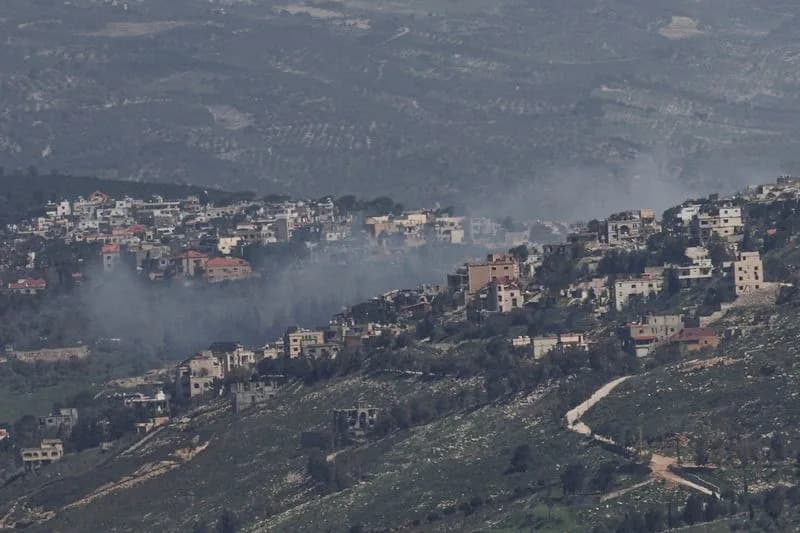
FILE PHOTO: Smoke rises from a Lebanese village near the border with Israel, amid escalation between Iran-backed Hezbollah and Israel, and amid the U.S.-Israeli conflict with Iran, as seen from northern Israel, March 19, 2026. REUTERS/Tyrone Siu/File Photo
BEIRUT, March 21 (Reuters) - Iran's Islamic Revolutionary Guard Corps (IRGC) played a direct role in reconstructing Hezbollah's military command after heavy losses to Israeli strikes in 2024, deploying officers to plug gaps, retrain fighters, oversee rearmament and redesign the group's battlefield structure, six sources and an expert told Reuters.
Background
Hezbollah, a Shi'ite group formed with IRGC support in 1982, suffered significant leadership and operational setbacks during the 2024 conflict. According to sources interviewed for this report, Tehran responded with a hands-on effort to restore the group's battlefield capabilities in anticipation of renewed regional fighting.
IRGC Intervention And Oversight
Sources said the IRGC sent roughly 100 officers to Lebanon shortly after a November 2024 ceasefire. Those officers conducted a post-war audit, embedded special advisers with Hezbollah's military wing, supervised rearmament and retrained fighters. The accounts emphasize the IRGC's operational oversight rather than routine diplomatic support.
Organizational And Tactical Changes
One of the most consequential changes was a shift away from a rigid hierarchical command toward a decentralized, cell-based model. Small, semi-autonomous units with limited knowledge of each other's operations were created to increase operational secrecy and resilience against intelligence penetration. Analysts describe this as a return to a 1980s-style, mosaic defence that makes leadership targeting harder.
Sources also said IRGC planners helped draft complex strike plans, including coordinated missile attacks launched simultaneously from Iran and Lebanon. Reuters reported that such coordinated strikes were carried out for the first time on March 11.
Casualties, Diplomatic Fallout And Evacuations
Officials and sources cited significant casualties attributed to Israeli strikes: roughly 500 people with IRGC links were reportedly killed in Lebanon between the 2024 ceasefire and the outbreak of the new war, and about a dozen more have been killed since the renewed fighting began. A March 7 flight reportedly took more than 150 Iranians — including some Guards officers — from Beirut to Russia after Lebanese authorities asked an estimated 100–150 Iranian nationals with links beyond routine diplomacy to leave.
Responses And Observations
Hezbollah's media office, Iran's Foreign Ministry and the office of Israeli Prime Minister Benjamin Netanyahu did not immediately respond to requests for comment. An Israeli military spokesperson said on March 12 that despite losses over recent years Hezbollah remains a relevant and dangerous force. Analysts and Lebanese security sources suggested Iran is helping Hezbollah manage the tempo of the conflict rather than micromanaging target selection.
What This Means
The IRGC's intervention illustrates Tehran's readiness to take a direct, operational role in shoring up an allied militia when strategic interests are at stake. The reorganization increases Hezbollah's survivability under strike conditions and complicates Lebanese and international efforts to disarm the group. How the reorganized, yet still degraded, Hezbollah would perform under a full-scale Israeli invasion remains uncertain.
Sources: This article is based on interviews with six unnamed sources familiar with IRGC activities, additional reporting from Reuters correspondents and commentary from security expert Andreas Krieg of King's College London.
Help us improve.