
Prime Minister Benjamin Netanyahu urged construction of oil and gas pipelines across the Arabian Peninsula to Israeli Mediterranean ports to reduce reliance on the Strait of Hormuz following strikes on Iran. He defended Israel's attack on Iran's South Pars gas field and claimed Iran can no longer enrich uranium or produce missiles—claims the IAEA says are not supported by available evidence. Netanyahu said President Trump asked Israel to pause further strikes and warned a ground component could be required to topple Iran's government.
Netanyahu Proposes Rerouting Gulf Oil and Gas to Israel After Strikes on Iran
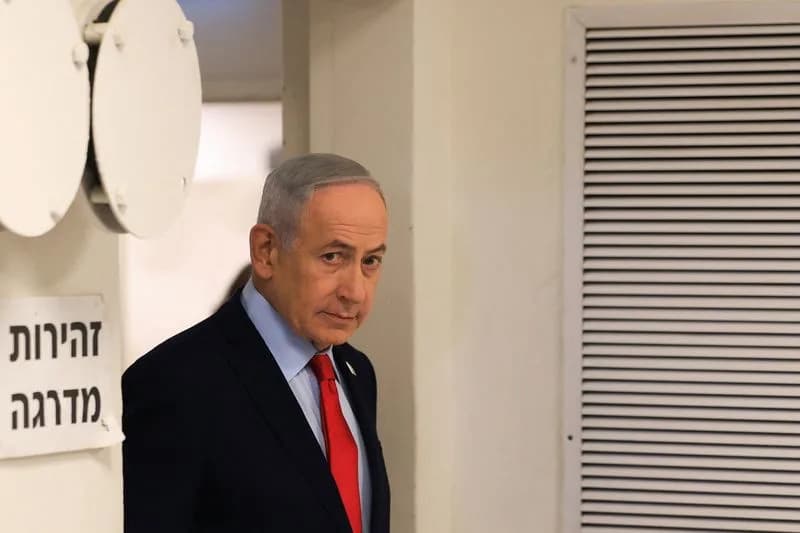
Israeli Prime Minister Benjamin Netanyahu attends a press conference, amid the U.S.-Israel conflict with Iran, in Jerusalem, March 19, 2026. REUTERS/Ronen Zvulun/Pool
JERUSALEM, March 19 (Reuters) - Prime Minister Benjamin Netanyahu on Thursday proposed building pipelines across the Arabian Peninsula to carry Middle East oil and gas to Israeli Mediterranean ports, saying such routes would reduce reliance on the Strait of Hormuz amid sustained tensions with Iran.
Pipelines Proposal
Speaking at a 45-minute press briefing, Netanyahu argued that overland pipelines running westward to Israel would remove dependence on vulnerable maritime choke points and could be a lasting strategic change following the current conflict.
Claims About Iran's Capabilities
A day after Israel struck Iran's South Pars gas field in a sharp escalation of its campaign against Tehran, Netanyahu told reporters he believed Iran "does not have the ability to enrich uranium and no possibility to produce missiles" after some 20 days of strikes. He offered no public evidence for those assertions.
International Reaction: Rafael Grossi, director general of the International Atomic Energy Agency (IAEA), told CBS News that "a lot has survived" of Iran's enrichment capacity and that Iran still retains the technical ability and industrial infrastructure to enrich uranium.
Military Campaign, U.S. Role and Possible Ground Action
Netanyahu defended Israel's military operations even as the assault on South Pars prompted tit-for-tat strikes on energy facilities across the Gulf and contributed to higher energy prices. He said Israel acted alone in the South Pars strike, and that, according to his account, U.S. President Donald Trump had asked Israel to refrain from additional attacks.
On the campaign's objectives, Netanyahu said Israeli strikes target remaining ballistic missiles, what is left of Iran's nuclear programme and the industrial capacities that enable those programmes. He also indicated that overthrowing the Iranian government could not be achieved by air strikes alone and that "there has to be a ground component as well," without detailing specific plans.
Context and Consequences
The Strait of Hormuz is a strategic maritime passage through which roughly a fifth of the world's oil transits; disruptions there have raised concern among energy markets and allied governments. Since the outbreak of the campaign in late February, Israel and several Gulf states have faced missile and drone attacks from Iran and its proxies.
(Reporting by Maayan Lubell and Steven Scheer; Editing by Rami Ayyub and Diane Craft)
Help us improve.





















