
On March 18, NASA astronauts Jessica Meir and Chris Williams performed a 7-hour, 2-minute spacewalk to install a mounting bracket for an upcoming iROSA roll-out solar array on the ISS. The iROSA panels unfurl to 63 feet (19 meters) without motors and will raise the station's power output by an estimated 20–30% once all are installed. Two noncritical tasks were deferred to a later EVA due to time constraints. The EVA was the 278th in support of the ISS and marked the first U.S. spacewalk from the station in about 10 months.
Astronauts Ready ISS for New Roll-Out Solar Array in First U.S. Spacewalk in 10 Months
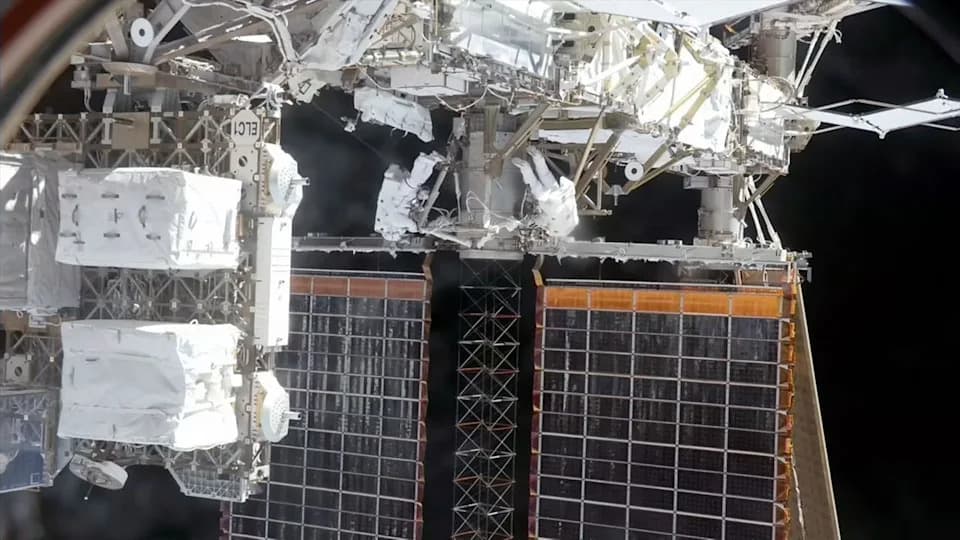
NASA astronauts Jessica Meir (at left) and Chris Williams prepare the International Space Station for the addition a new solar array during a spacewalk on Wednesday, March 18, 2026. | Credit: NASA
Two NASA astronauts conducted a spacewalk on March 18 to prepare the International Space Station (ISS) for a new roll-out solar array, marking the first U.S. extravehicular activity from the station in roughly 10 months.
What the Crew Did
Expedition 74 crewmembers Jessica Meir and Chris Williams exited the station's Quest airlock at 8:52 a.m. EDT (1252 GMT) to assemble and attach a mounting bracket on the port (left) side of the ISS backbone truss. That bracket will support an ISS Roll-Out Array (iROSA) to be installed on a future EVA.
Technical Details
The iROSA units are smaller than the original four U.S. solar wings and deploy by releasing stored energy in rolled carbon-composite booms rather than using motors. Each array unfurls to about 63 feet (19 meters) and can extend in roughly six minutes. Once all planned iROSA upgrades are in place, the arrays are expected to boost the station's power by about 20–30%, replacing degraded original arrays that have exceeded their 15-year design life.
About five hours into the EVA, Williams photographed and documented the gears of the port-side SARJ (Solar Array Rotating Joint), which lets the solar wings track the Sun. Meir installed an electrical jumper to enable robotic servicing of components in the station's 2A power channel. The pair then stowed tools, tidied their work areas and reentered the Quest airlock.
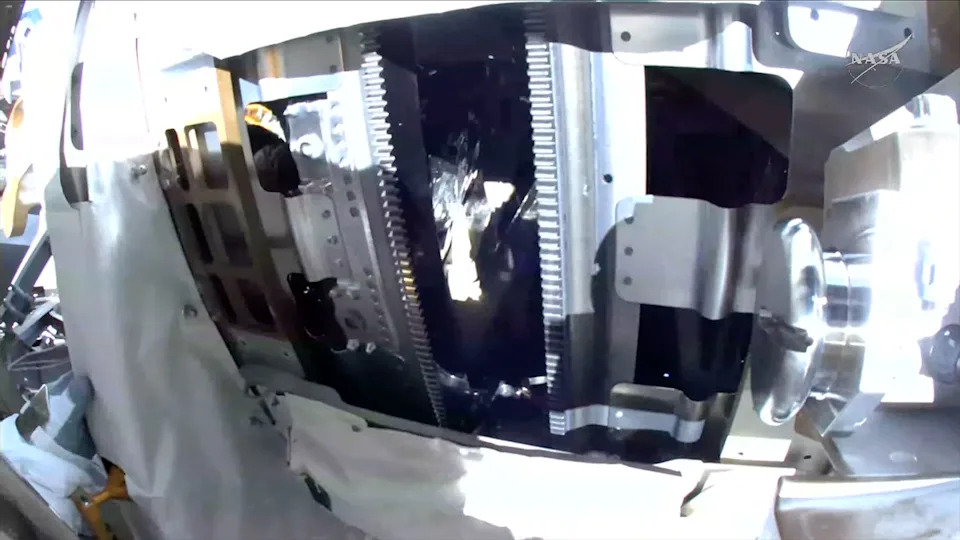
The view from NASA astronaut Chris Williams' spacesuit helmet-mounted camera shows the gears for one of the International Space Station's rotating solar array wings during a spacewalk on Wednesday, March 18, 2026. | Credit: NASA
Tasks Deferred And Timeline
The outing lasted 7 hours and 2 minutes, concluding at 3:54 p.m. EDT (1954 GMT). Because the EVA had been planned for about 6.5 hours and time ran short, mission managers deferred two noncritical tasks — swabbing exterior surfaces for microorganisms and fitting a lens cover on a camera mounted to the Canadarm2 robotic arm — to a later spacewalk.
NASA had originally scheduled the iROSA modification-kit installation for May 2025 but postponed it to relocate an antenna. A later attempt planned for January was canceled after assigned spacewalker Mike Fincke experienced an undisclosed medical issue that required him and some crewmates to return to Earth early.
Context And Crew Notes
This was Williams' first spacewalk and Meir's fourth, bringing Meir's total EVA time to 28 hours and 46 minutes. Meir also participated in the world's first all-female EVA in 2019. After closing the hatch, Meir reflected on the historical significance of the date — March 18 marked 61 years since Alexei Leonov became the first person to step into the vacuum of space — and on the value of training and mentoring the next generation of explorers.
“Well done!” Meir said to Williams before he reentered the station. “It was a lot of work and a lot of fun,” he replied.
Wednesday's EVA was the 278th performed in support of ISS assembly, maintenance and upgrades, bringing the cumulative EVA time for the station to 1,760 hours and 28 minutes. It was the first ISS spacewalk of 2026, the first by Expedition 74, and the first by American astronauts since May 1, 2025.
Help us improve.





















