
Acting President Delcy Rodríguez named Major General Gustavo González López as Venezuela's new defense minister, replacing long-serving General Vladimir Padrino. González López, who has led domestic intelligence and the presidential guard, has been sanctioned by the U.S. and EU for alleged rights abuses and corruption. Sources say the change is unlikely to shift Rodríguez's cooperative stance with U.S. demands on oil, mining and some political prisoners, and may centralize U.S. ties within a small group of officials.
Acting President Delcy Rodríguez Appoints Intelligence Chief Gustavo González López as Defense Minister
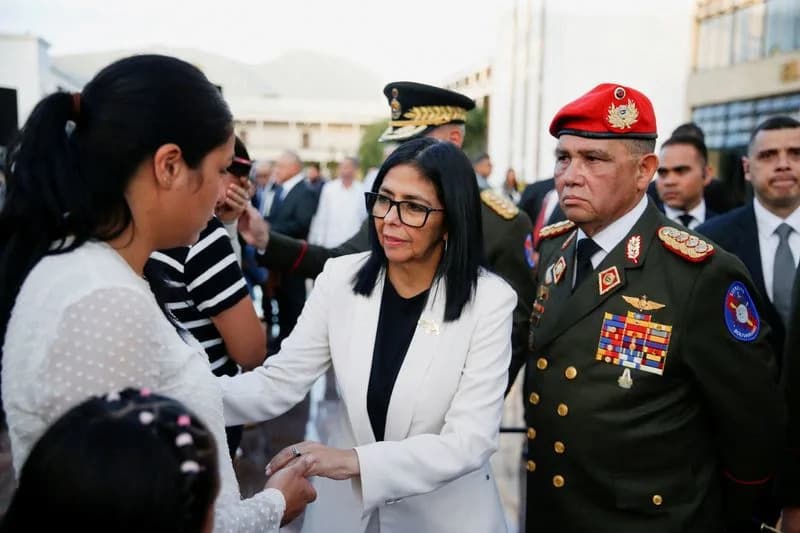
FILE PHOTO: Venezuela's interim president Delcy Rodriguez and General Gustavo Gonzalez Lopez at a ceremony honouring Venezuelan and Cuban military and security personnel who died during a U.S. operation to capture Venezuela’s President Nicolas Maduro and his wife Cilia Flores, in Caracas, Venezuela January 8, 2026. REUTERS/Leonardo Fernandez Viloria/File Photo
March 18 (Reuters) - Acting President Delcy Rodríguez announced on Wednesday that Major General Gustavo González López, 65, will replace General Vladimir Padrino, 62, as Venezuela's Minister of People’s Power for Defense. Rodríguez posted the appointment on Telegram, thanked Padrino for his service, and said he would be assigned new responsibilities.
Rodríguez previously named González López in January to lead the presidential guard and the General Directorate of Military Counterintelligence (DGCIM). González López served as the country's domestic intelligence chief until mid-2024 and later worked with Rodríguez at state oil company PDVSA as head of strategic affairs during her term as energy minister. He is a former interior minister and joined the armed forces in his early twenties.
Sanctions and Human Rights Concerns
González López has been sanctioned by the United States and the European Union over alleged human rights abuses and corruption. Padrino has also faced U.S. sanctions tied to alleged drug trafficking and his support for Nicolás Maduro. International observers and the United Nations have said Venezuela's repressive institutions remain intact, while the government continues to deny allegations of rights violations and corruption.
Political Context and U.S. Relations
A Reuters source said the personnel change is not expected to alter Rodríguez's policy of cooperating with U.S. demands on oil, mining and the release of certain people classified as political prisoners. The source described the move as concentrating relations with the United States among a small circle of trusted officials.
“I see it as a situation in which the entire relationship with the Americans is concentrated in a few people, and they are the ones they trust the most,” the source told Reuters. “I think it is simply about appointing someone who will deal with the United States.”
Internal Power Dynamics
Observers have interpreted Rodríguez’s earlier appointments of González López to the presidential guard and the DGCIM as a maneuver to counter internal rivals—most notably Diosdado Cabello, the hardline interior minister with deep ties to security services and to the feared "colectivo" motorcycle groups accused of violence against opposition supporters. Cabello has publicly backed Rodríguez and has appeared with her and her brother Jorge, the head of the legislature, at many events.
Sources told Reuters that Padrino had been kept in his post after a U.S. operation to seize Maduro—reported by some outlets—to help preserve military stability. Venezuela's armed forces are fragmented, with roughly 2,000 generals overseeing different units and significant economic interests, making any senior personnel change politically sensitive.
The Venezuelan communications ministry, which handles government press inquiries, did not immediately respond to requests for comment on the personnel change.
(Reporting by Reuters; Editing by Deepa Babington and Alistair Bell)
Help us improve.





















