
Johns Hopkins APL is building Dragonfly, a car-sized, nuclear-powered rotorcraft for NASA's New Frontiers Program that will explore Saturn's moon Titan. Launch is targeted for 2028 with arrival expected in 2034. Dragonfly will fly between dunes, lakes and river channels to conduct atmospheric, spectrometric, seismic and chemical measurements and search for signs of water- or hydrocarbon-based life. The craft will be powered by an MMRTG (Pu-238) because Titan's dense, hazy atmosphere makes solar power impractical.
NASA’s Nuclear-Powered ‘Dragonfly’ Rotorcraft Will Hunt for Signs of Life on Titan
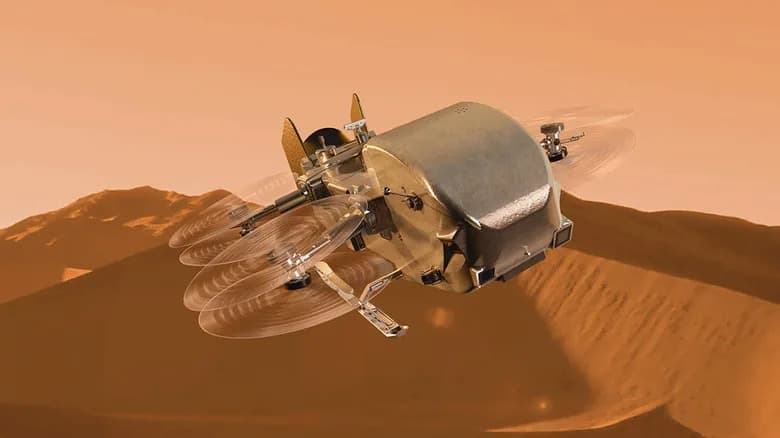
Artist's rendering of the Dragonfly rotorcraft flying over the surface of Titan - NASA/Johns Hopkins APL/Steve Gribben
The Johns Hopkins University Applied Physics Laboratory (APL), working for NASA's New Frontiers Program, is building Dragonfly — a car-sized, nuclear-powered rotorcraft designed to explore Saturn's largest moon, Titan. Slated for launch in 2028 and arrival in 2034, Dragonfly will fly across dunes, lakes and river channels to gather in situ measurements that past missions could not.
What Dragonfly Will Do
Dragonfly is a mobile science platform capable of covering vastly more ground than a traditional rover. Once on Titan, it will perform atmospheric sampling, spectrometry, seismic measurements and chemical analyses at multiple sites. Those data will help scientists search for chemical indicators of water-based or hydrocarbon-based life and study prebiotic chemistry in an environment that resembles early Earth in some ways.
Why Titan Is Special
Titan is unique among moons: it has a thick, nitrogen-rich atmosphere and stable surface liquids (lakes and seas of methane and ethane). Beneath its icy crust, scientists believe a subsurface saltwater ocean may exist, creating intriguing possibilities for chemistry and habitability. Titan's dense air also makes it easier for a rotorcraft to fly, while its low gravity and heavy atmosphere produce unusual weather — raindrops fall slowly and actual rainfall events may be separated by long intervals, even centuries.
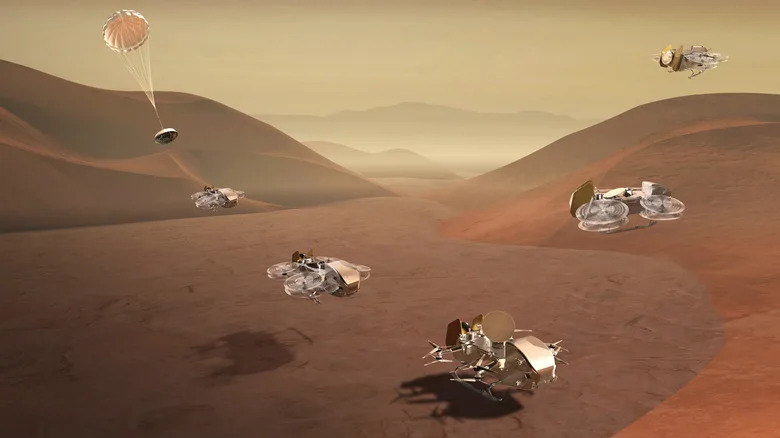
Artist's rendering of a composite image of the Dragonfly rotorcraft parachuting onto the surface of Titan, landing, and taking off again - NASA/Johns Hopkins APL/Steve Gribben
Power And Design
Because Titan’s hazy, dense atmosphere and distance from the Sun make solar power impractical, Dragonfly will be powered by a multi-mission radioisotope thermoelectric generator (MMRTG). The MMRTG converts heat from the decay of plutonium-238 into electricity — the same basic kind of radioisotope power used by recent Mars rovers — providing continuous, long-lived power for instruments, avionics and heaters.
Mission Context And Cost
Dragonfly builds on decades of reconnaissance, including the Cassini mission and the Huygens probe, which provided the first close observations of Titan’s surface but survived less than a day after landing in 2005. With an estimated budget of roughly $3 billion, Dragonfly aims to deliver humanity’s most extensive in situ exploration of Titan to date.
Fast Facts: Launch Vehicle: SpaceX Falcon Heavy (targeted 2028). Expected Arrival at Titan: 2034. Power Source: MMRTG (Pu-238). Estimated Cost: ~$3 billion.
Dragonfly is a mission that mixes bold engineering with high scientific payoff: a long-range, aircraft-like explorer traveling across an alien world to address fundamental questions about chemistry, habitability and the origins of life.
Help us improve.





















