
Venus is the brilliant object visible in the western sky after sunset in 2026, climbing higher and brighter through the year as it becomes the prominent "Evening Star." Look west about 30 minutes after sunset on March 19–21 to see Venus paired with a thin waxing crescent Moon. Venus reaches greatest elongation on Aug. 14, 2026 (≈47° from the Sun, mag −4.3), with peak altitude on June 5 and peak visual brightness around Sept. 22. The planet’s apparitions repeat every ~1.6 years and follow an 8‑year pattern; a Venus day is longer than its year.
That Brilliant 'Star' in the West After Sunset? It's Venus — When and How to See It
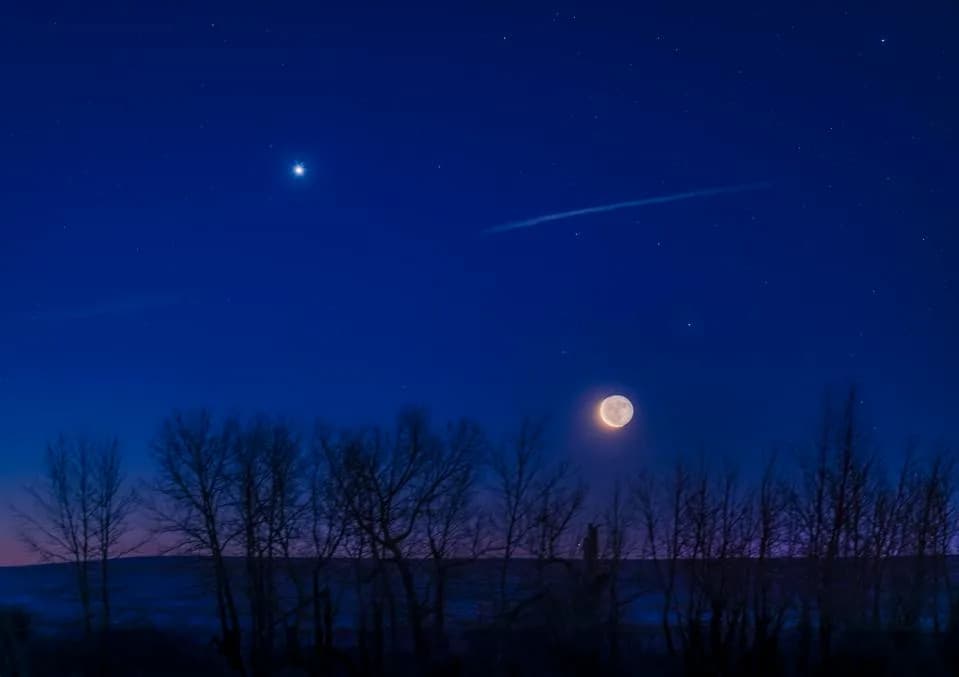
See a waxing crescent moon (lit by Earthshine) and Venus (as a 'morning star') during March 2026. (Photo by: Alan Dyer/VWPics/Universal Images Group via Getty Images)VWPics/Universal Images Group via Getty Images
That brilliant point of light you're seeing in the western sky after sunset is not a star at all but the planet Venus — the brightest object in our sky after the Sun and Moon. It moved from the pre-dawn sky into evening visibility earlier this year and will grow higher and more prominent through the coming months.
Venus often outshines everything else because of two factors: it can be relatively close to Earth (sometimes only tens of millions of miles away at closest approach) and its thick, reflective cloud cover returns a lot of sunlight. The planet’s surface is extremely hostile — with mean temperatures around ~460°C (≈860°F) and atmospheric pressure roughly 90–92 times that of Earth — conditions that make it sparkle but are far from Earthlike.
When To Look
For easy viewing, face west about 30 minutes after local sunset. Over the week of March 19–21, 2026, Venus pairs beautifully with a young waxing crescent Moon — excellent moments for casual skywatchers and photographers:
- Thursday, March 19, 2026: Venus with a 1%–lit waxing crescent Moon.
- Friday, March 20, 2026 (Vernal Equinox): Venus with a 5%–lit waxing crescent Moon.
- Saturday, March 21, 2026: A grouping of Venus, Jupiter and an ~11%–lit waxing crescent Moon.
What To Expect This Year
This apparition of Venus as the bright “Evening Star” will reach its greatest elongation east on Aug. 14, 2026, when it will sit roughly 47° from the Sun after sunset and shine near magnitude −4.3, making it conspicuously bright in a darker sky. According to observing forecasts, Venus will attain its highest altitude in the evening sky on June 5, 2026 and reach its greatest visual brilliance around Sept. 22, 2026.
Why Venus Behaves This Way
Venus is an inner planet (closer to the Sun than Earth), so it never strays far from the Sun in our sky and is visible only in twilight — shortly before sunrise or after sunset. Apparitions of Venus alternate between the morning and evening sky roughly every 1.6 years (its synodic period is about 584 days). Observers also notice an 8‑year cycle where Venus returns to nearly the same place in our sky after eight Earth years, during which it completes 13 orbits around the Sun from our perspective.
Venus rotates very slowly and in the opposite direction to most planets: one rotation takes about 243 Earth days, which is longer than its orbital period of about 225 Earth days, so a day on Venus is effectively longer than a Venusian year.
Quick Tip: If you (or friends) report a dazzling, stationary light in twilight, check whether it's Venus before assuming it’s something unusual — it’s a very common source of UFO reports.
Whether you're a casual observer or an avid skywatcher, the coming months offer repeated chances to see Venus dominate the western twilight. Wishing you clear skies and wide eyes.
Help us improve.





















