This study overturns the long-held view that lithium dendrites are soft and ductile, showing instead that they are rigid and brittle and fracture at stresses above 150 MPa. Air-free mechanical tests and cryo-TEM reveal a core–shell structure with a ~15 nm SEI layer that suppresses dislocation nucleation, causing catastrophic fracture and formation of "dead lithium." Modeling and experiments in both liquid and solid-state cells confirm the mechanism and point to fixes such as lithium alloys and redesigned electrolytes and separators to reduce brittle cracking and improve safety.
Hard Truth: Why Lithium Dendrites Snap — Not Bend — and How That Breaks Batteries
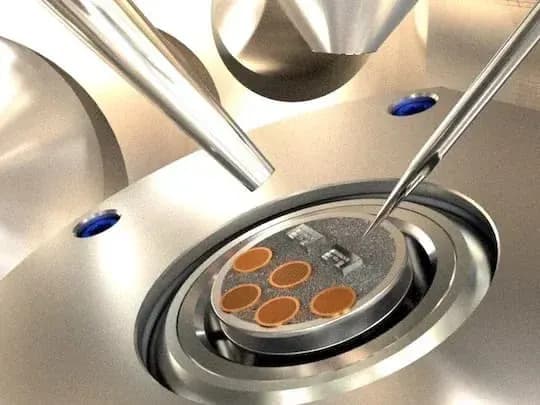
Close-up view of the top of the sample transfer box (top door open), showing that the lithium dendrite was transferred using a micromanipulator tip (a sharp silver needle) from the brown copper transmission electron microscopy grids to the Rice micromechanical devices (silver blocks), ready for subsequent testing and characterization. (CREDIT: Lou Group/Rice University)
Lithium metal in bulk is widely regarded as soft — it bends and stretches before failing. For decades researchers assumed the same behavior for the hairlike filaments that form inside lithium-based cells. A new study in the journal Science overturns that assumption: lithium dendrites are stiff, strong and brittle, snapping under stress rather than yielding.
What the researchers did
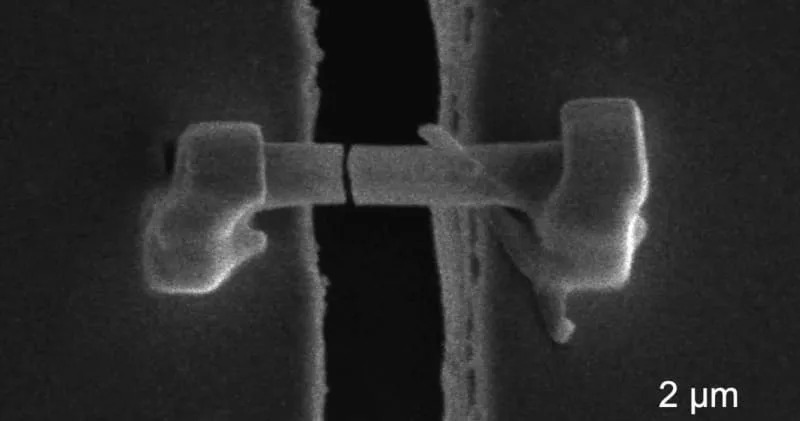
Brittle, microscopic structures called dendrites form in lithium-ion batteries and can disrupt battery performance. Unlike bulk lithium, which is pliant and supple, dendrites fracture under stress. (CREDIT: Lou Group/Rice University)
Teams from New Jersey Institute of Technology, Rice University, Georgia Tech, the University of Houston and Nanyang Technological University developed air-free methods to grow, extract and test individual dendrites inside sealed coin cells. Using a nanomanipulator inside a scanning electron microscope (SEM) and careful handling to avoid exposure to air or moisture, they performed tensile tests while avoiding beam-induced heating that could alter samples. Critical deformation tracking relied on tiny marker patterns, and cryo-transmission electron microscopy (cryo-TEM) preserved delicate structures for high-resolution imaging.
Key experimental findings
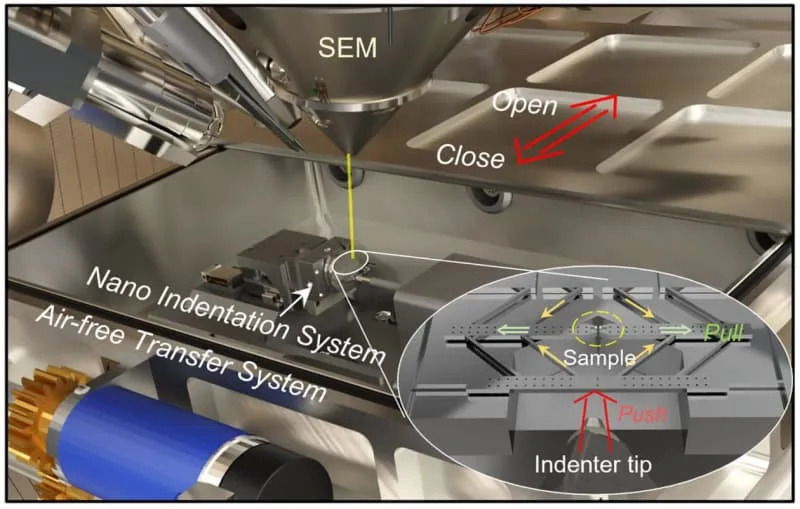
Schematic illustration of a Li dendrite tensile test conducted in SEM. (CREDIT: Science)
Bulk lithium typically yields at about 0.6 MPa and can elongate roughly 35% before breaking. Individual dendrites, however, fractured at stresses exceeding 150 MPa — more than 250 times stronger than the yield stress measured for bulk lithium — with no visible plastic deformation beforehand. Fractures were clean and perpendicular, without the necking expected for ductile metals.
Cryo-TEM revealed a core–shell architecture: a crystalline lithium core encased in a thin solid-electrolyte interphase (SEI) roughly 15 nanometers thick. The SEI forms naturally as electrolyte reacts with lithium during cycling.
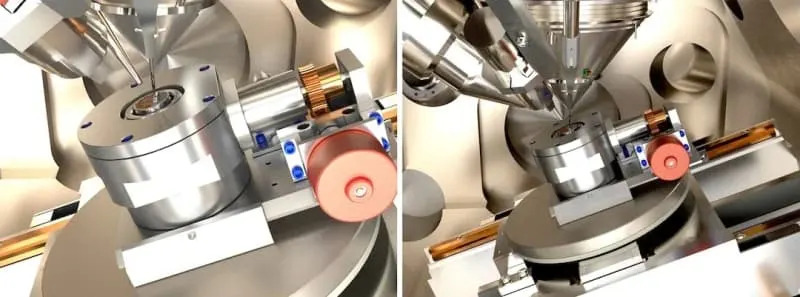
Views of the air-free sample transfer box inside the scanning electron microscope chamber with the lithium dendrite sample successfully transferred. (CREDIT: Lou Group/Rice University)
Why dendrites are brittle
The SEI shell suppresses surface sites that normally nucleate dislocations (tiny defects that enable plastic deformation). With those surface sources blocked, the lithium core cannot yield progressively; instead, stress accumulates until the structure fractures catastrophically. Scale-bridging simulations by NJIT and Georgia Tech estimated the dendrite core yield stress above ~115 MPa, supporting the experimental observations.
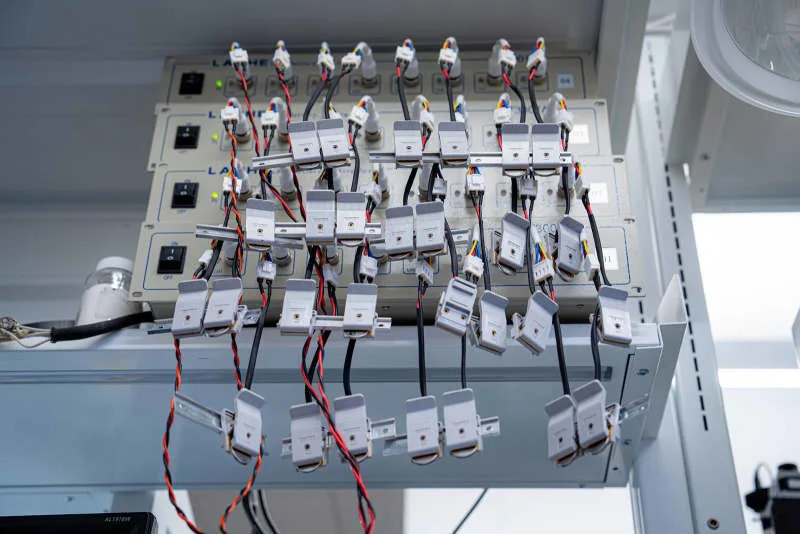
Study battery test array. Li dendrite preparation under realistic battery operation conditions. (CREDIT: Lou Group/Rice University)
Broad validation and implications
The brittle behavior was observed in both liquid-electrolyte and solid-state battery architectures. Real-time imaging inside operating solid-state cells captured dendrites cracking during plating and stripping cycles, linking brittle fracture directly to the creation of electrically isolated fragments known as "dead lithium." These fragments reduce capacity and, if large or sharp enough, can pierce separators to cause internal short circuits — a leading cause of dangerous battery failures.
Engineering paths forward
Recognizing dendrites as brittle rather than ductile reframes mitigation strategies. Potential approaches include: alloying lithium anodes to introduce dislocation sources and promote plastic deformation instead of fracture; redesigning electrolyte chemistry and SEI-forming additives to modify shell mechanics; and tailoring separator and solid-electrolyte microstructures to resist wedge-like cracking from brittle filaments. These mechanical insights add a new dimension to materials design for high-energy lithium-metal batteries.
Conclusion
This work changes how scientists and engineers should think about dendrite-driven capacity loss and failure modes. By combining air-free mechanical testing, cryo-TEM, real-time imaging and modeling, the study provides a clearer mechanical picture of why dendrites form dead lithium and how they can damage separators — and it points to concrete strategies to reduce these risks. The full report is available in Science.
Help us improve.