
Researchers led by Nicolás Yunes and Abhishek Hegade have developed a relativistic method to decode tidal imprints on gravitational waves from binary neutron stars. By modeling each star individually, dividing it into regions of differing gravity, and subtracting radiative losses, they show a neutron star's oscillation modes form a complete set that can alter gravitational-wave frequencies. Although current detectors lack the high-frequency sensitivity to see these signatures, next-generation observatories may be able to test whether quark-gluon plasma exists in neutron-star cores.
New Method Could Reveal Big Bang–Era Quark Matter Hidden in Neutron-Star Cores
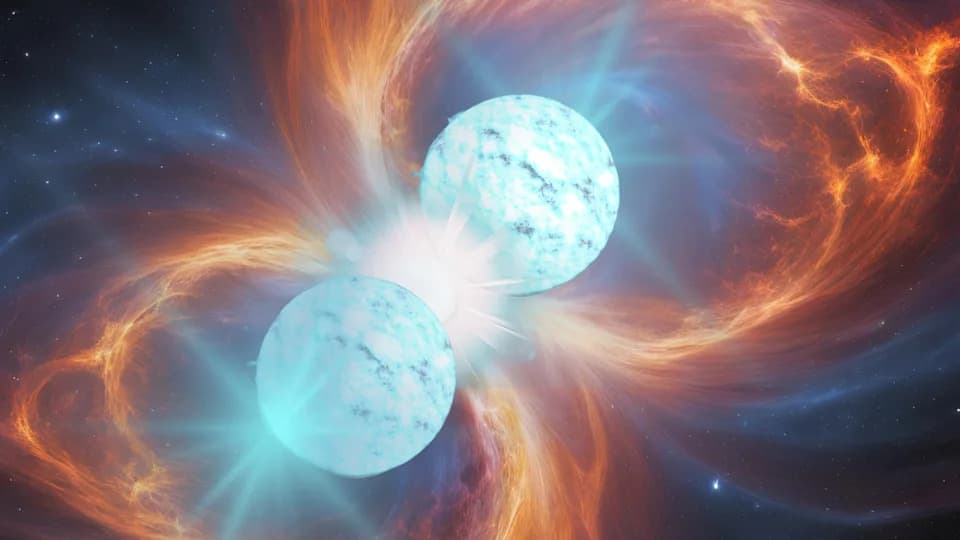
An illustration of two neutron stars colliding and merging. | Credit: Robert Lea (created with Canva)
Scientists may soon be able to "see" inside neutron stars and test whether the exotic quark-gluon plasma that existed just after the Big Bang still survives in their cores. A team led by Nicolás Yunes (University of Illinois) and Abhishek Hegade (Princeton University) has developed a relativistic method to decode how tidal interactions in binary neutron-star systems imprint the stars' internal oscillation modes onto the gravitational waves they emit.
Why This Matters
Neutron stars pack several times the mass of the Sun into a sphere roughly the size of a large city. Under such enormous pressure, ordinary atoms collapse into a dense sea of neutrons. Deeper inside, gravity may be strong enough to break neutrons into their constituent quarks and the gluons that bind them, producing a quark-gluon plasma — the same state of matter thought to have filled the universe a fraction of a second after the Big Bang. Reading a neutron star's interior would therefore offer a rare window into ultra-dense matter and early-universe physics.
How the New Method Works
Binary neutron stars orbiting each other produce gravitational tides that deform each star. Those tidal deformations excite oscillations — or modes — inside the stars, and the frequencies of those modes become encoded in the gravitational waves emitted as the pair spirals together. Accurately extracting that information requires Einstein's general relativity, because orbital velocities can approach ~40% of the speed of light and strong gravity dominates.
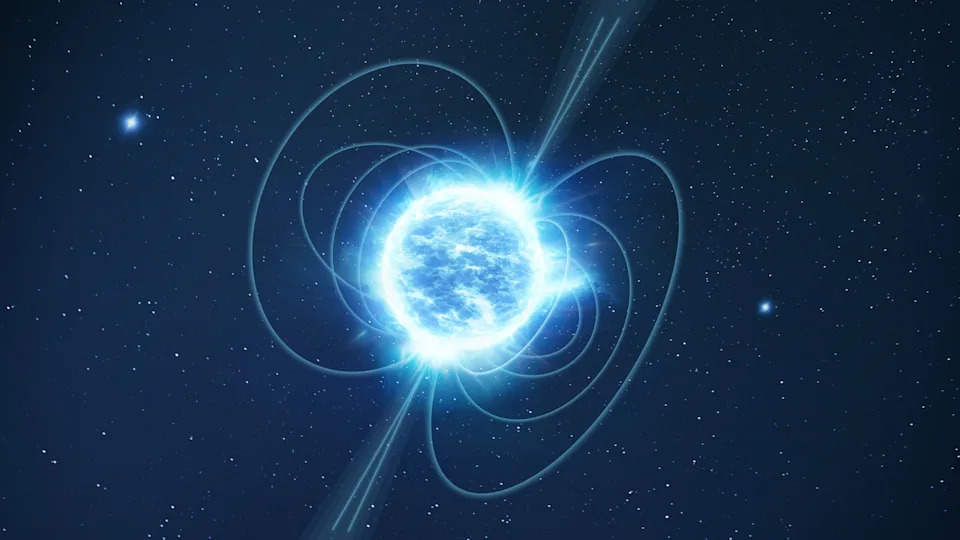
Neutron stars pack the mass of several suns into a city-sized sphere. | Credit: ESA
Yunes, Hegade and collaborators solved a longstanding problem: whether a complete set of oscillation modes can be defined in a relativistic, radiating system. They modeled each star separately while treating its companion as an external tidal source, divided the star into regions of differing gravitational strength, found approximate solutions in each region, and then matched those solutions. Crucially, they showed how the energy lost to gravitational-wave radiation can be subtracted in a controlled way so the remaining internal modes form a complete set that can be linked to observable wave-frequency features.
"We were able to subtract off radiation and show that a neutron star's modes do indeed form a complete set," Hegade said. "That means you can do in general relativity what you normally do in Newtonian theory — but consistently and correctly for these extreme objects."
Implications and Next Steps
The work is currently theoretical. Present gravitational-wave detectors have limited sensitivity at the higher frequencies where these mode imprints are strongest, so the signatures predicted by the team are not yet observable. However, the researchers are optimistic that next-generation observatories with improved high-frequency performance could test their predictions and potentially reveal whether quark matter exists in neutron-star cores.
The study by Yunes, Hegade and collaborators was published on Feb. 18 in Physical Review Letters.
Help us improve.





















