
Analysts say Iran's clerical leadership is determined to show that the regime can survive the killing of Supreme Leader Ayatollah Ali Khamenei and the subsequent conflict with the US and Israel. Mojtaba Khamenei, his low-profile son and designated successor, is expected to lean on the Islamic Revolutionary Guard Corps as institutions execute contingency plans. Despite rallies, retaliatory strikes and rising energy prices, experts describe the regime as resilient but facing heavy leadership and infrastructure losses. If it endures, Tehran may portray survival as a costly symbolic victory.
Iranian Leadership Seeks to Prove Regime's Resilience After Supreme Leader's Killing
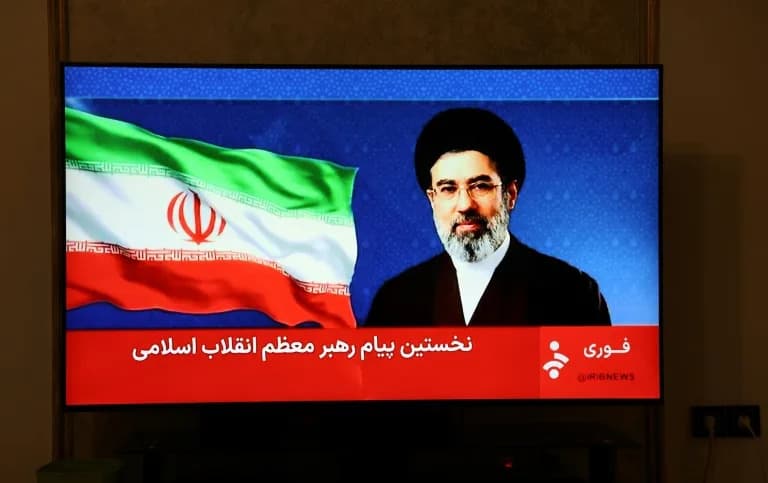
Mojtaba Khamenei has yet to appear in public (-)(-/AFP/AFP)
Iran's political leadership is working to demonstrate that the clerical system that has governed the country for nearly half a century can survive the assassination of its long-serving supreme leader and the ensuing conflict with the United States and Israel, analysts say.
Ayatollah Ali Khamenei, who had led the Islamic Republic since the 1989 death of founder Ruhollah Khomeini, was killed along with several relatives and senior security officials in air strikes that marked the beginning of a recent US-Israeli campaign. Despite the shock of his death, experts say the Shia-based system—founded on ideological opposition to the West—appears intact and poised to adapt under his designated successor, Mojtaba Khamenei.
Institutional Continuity and the Role of the Revolutionary Guards
Analysts expect the transition to strengthen the Islamic Revolutionary Guard Corps (IRGC), the ideological arm of Iran's armed forces created to safeguard the regime. The IRGC's influence already extends across political life and the economy, and observers say Mojtaba Khamenei is likely to rely heavily on its backing to consolidate power.
"The system is resilient and it remains able to implement well-developed contingency plans," said Thomas Juneau, a professor at the University of Ottawa. "Continuity is built into the system and its institutions and so far, there is no indication that the collapse of the Islamic Republic is imminent."
'Dangerous Pattern'
Mojtaba Khamenei, a previously low-profile figure rarely seen in public, is widely viewed by analysts as a hardliner who is close to the Revolutionary Guards and who played a prominent role in suppressing protests. "The selection of Mojtaba as his father's successor is an additional indication that the regime's leadership intends to remain defiant and does not plan to compromise on what it perceives as its core values and interests," Juneau said.
In a public show of defiance, several senior government and security figures attended a rally in Tehran even as explosions were reported nearby. National security chief Ali Larijani — sporting dark sunglasses despite heavy rain — told the crowd that foreign pressure would only strengthen national resolve. Judiciary chief Gholam Hossein Mohseni Ejei showed no visible reaction when an explosion shook an area close to the demonstration, scenes that were widely broadcast on state media.
Notably absent from the public events were Mojtaba Khamenei, who has not appeared in public since his appointment, and parliament speaker Mohammad Bagher Ghalibaf, a former Revolutionary Guards commander whom some observers see as central to Iran's war effort.
Torbjorn Soltvedt, associate director at risk analysis firm Verisk Maplecroft, warned that the conflict appears "locked in a dangerous pattern that's unlikely to change anytime soon," as Iran continues retaliatory strikes across the region that have helped push energy prices higher.
'Highly Resilient, But Costly'
Despite intense US and Israeli air campaigns, analysts say Iran has continued to strike shipping lanes and critical energy infrastructure with worrying regularity. That operational resilience, they argue, reflects the concentrated influence of the supreme leader's office and hardline factions within the political and security establishments.
Barbara Slavin of the Stimson Center noted that Mojtaba Khamenei's authority will depend heavily on sustained IRGC support. Given the scale of the recent strikes and their toll on personnel and infrastructure, she said it is unlikely that he will be predisposed to make concessions to the United States or Israel.
If the Islamic Republic endures the current war, analysts say the leadership could adopt a narrative similar to the one that followed the 1980–1988 war with Iraq: a costly, symbolic victory that emphasizes survival and national resilience. "Such a victory would be expensive: leadership decapitation, degraded military capabilities and damaged economic infrastructure," Juneau cautioned.
Outlook
For now, the balance between continued military pressure, domestic stability, and the IRGC's expanding role will shape Iran's trajectory. The immediate priority for Tehran appears to be demonstrating continuity and control—projecting an image that the regime can absorb shocks, adapt leadership, and remain operational despite significant losses.
Reporting contributions: sjw/dcp/ceg
Help us improve.





















