
Residents of Arab towns in northern Israel, led by Sakhnin, say they face repeated rocket attacks but lack adequate public shelters. Local officials describe makeshift measures — open schools and small 3×6 metre concrete "mini-bunkers" — many of which are reported to be dirty or overcrowded. A 2025 State Comptroller report found 33% of Israelis lack compliant shelters, rising to 70% in northern Arab localities, and rights groups have called the disparity unconstitutional.
‘No Safe Havens’: Arab Towns in Northern Israel Say They Lack Public Shelters as Rockets Fall
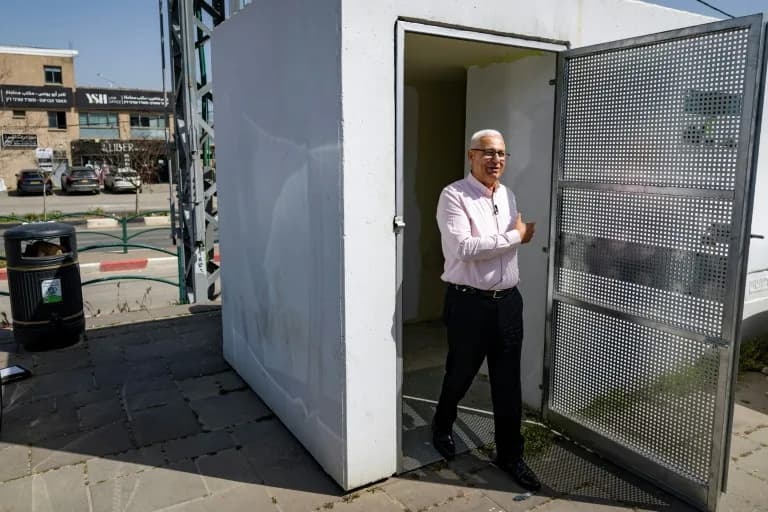
Mayor Mazen Ghanayem complained about the lack of shelters in his Arab town in northern Israel (Odd ANDERSEN)(Odd ANDERSEN/AFP/AFP)
Residents of Arab towns in northern Israel say repeated rocket and missile fire from Hezbollah and Iran-backed forces has exposed serious gaps in public shelter provision. Local officials and residents describe makeshift responses — open schools and small concrete "mini-bunkers" — that many call inadequate, unsanitary or unsafe.
Local Testimony From Sakhnin
"The state is obliged to build public shelters so that the entire population has access to safe havens," Sakhnin Mayor Mazen Ghanayem told AFP. "Yet our town doesn't have a single public shelter worthy of the name." Located about 20 kilometres from the Lebanese border, Sakhnin's 36,000 residents now live to the rhythm of air-raid sirens since Hezbollah expanded its role in the wider regional confrontation.
Municipal official Kasim Abu Raya explained that when alarms sound, residents typically shelter inside their homes where possible — in a secure room in newer buildings or the best available space in older houses. For people caught outdoors, options are limited: there are no underground car parks or substantial communal refuges in many neighbourhoods.
Temporary Measures And Conditions
To create more refuge options, the mayor says roughly a dozen schools have been ordered to keep their doors open at all times. The town also has about a dozen emergency shelters — concrete boxes roughly three by six metres — placed near some public areas. Residents and officials say many of these small bunkers are poorly maintained. AFP reported excrement and urine in one shelter and rubbish piled at others.
"I'd rather get hit than take shelter in there," Mayor Ghanayem quipped, reflecting residents' fears about the condition and usability of some facilities. Despite that, people use the shelters in acute alerts: in nearby Majd el-Kroum AFP observed a dozen people abandon their cars and cram into one during a missile salvo.
Wider Context And Legal Concerns
The shelter shortage predates the most recent escalations. A 2025 State Comptroller report found that 33% of Israelis lack a protected space or compliant shelter; the rate rises to 50% for non-Jewish Israelis and reaches 70% in Arab localities in the north. In June 2025 the Association for Civil Rights in Israel described the disparity as "not only immoral but also unconstitutional," noting that the state has allocated significant resources to protecting Jewish communities, including settlements and outposts in the West Bank, while failing to provide equivalent protections in many Arab towns.
Mayor Ghanayem and other local leaders say the contrast is visible on the ground: public shelters are commonplace in many Jewish towns and settlements, while Arab communities in the north remain underprotected. Local officials call for urgent state action to ensure equal access to safe havens for all civilians.
Reporting details include AFP on-the-ground accounts and the 2025 State Comptroller report cited by local rights groups.
Help us improve.





















