
Technicians at Johns Hopkins APL have started assembling and testing Dragonfly, NASA's car-sized rotorcraft powered by a radioisotope generator and targeted to launch for Titan in 2028. The $3.35 billion mission will travel across multiple sites on Titan to study its chemistry, geology and atmosphere. Initial work focuses on the integrated electronics module and power systems, with system-level tests at Lockheed Martin and a planned Falcon Heavy launch from Kennedy Space Center no earlier than spring 2028. Engineers have also completed aeroshell wind-tunnel tests and are finalizing thermal insulation, science instruments and communications hardware.
NASA Begins Building Nuclear-Powered Dragonfly Rotorcraft Ahead Of 2028 Titan Launch
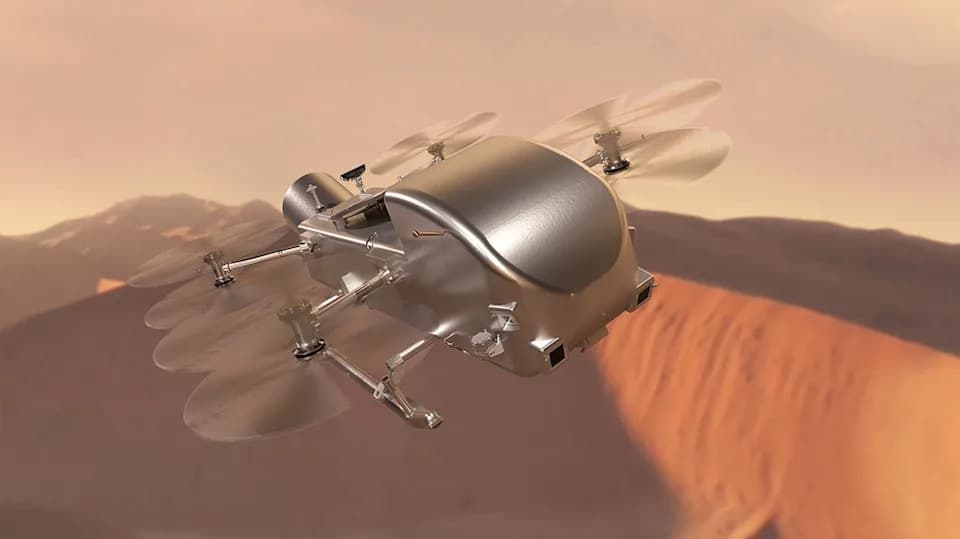
An illustration of NASA's Dragonfly rotorcraft soaring in the skies of Saturn’s larget moon, Titan. | Credit: NASA/Johns Hopkins APL/Steve Gribben
Technicians at the Johns Hopkins Applied Physics Laboratory (APL) in Maryland have begun assembling and testing Dragonfly, NASA's car-sized, nuclear-powered rotorcraft scheduled to launch toward Saturn's moon Titan in 2028.
"This milestone essentially marks the birth of our flight system," said Elizabeth Turtle, Dragonfly principal investigator at APL, in a NASA statement. "Building a first-of-its-kind vehicle to fly across another ocean world in our solar system pushes us to the edge of what's possible, but that's exactly why this stage is so exciting. The team is doing an outstanding job, and every component we install and every test we run brings us one step closer to launching Dragonfly to Titan."
About the size of a small car, Dragonfly will be the second rotorcraft to explore the skies of another world, following NASA's Mars helicopter Ingenuity. Unlike Ingenuity — a solar-powered technology demonstrator that completed an extended flight campaign on Mars — Dragonfly is a full science mission powered by a radioisotope power system (an MMRTG) that will provide steady electricity and heat in Titan's distant, sun‑dim environment.
Mission Scope and Cost
The mission is budgeted at roughly $3.35 billion and is designed to traverse diverse locations on Titan to study its chemistry, geology and atmosphere. Scientists are especially interested in Titan because it is believed to be rich in organic precursor molecules that could shed light on chemical pathways relevant to the origin of life.
Current Build-and-Test Activities
At APL the initial weeks of hands-on work focus on the integrated electronics module — the mission's "brain," responsible for guidance, navigation and data handling — and on power-switching units. Testing and system integration at APL are expected to continue into early 2027.
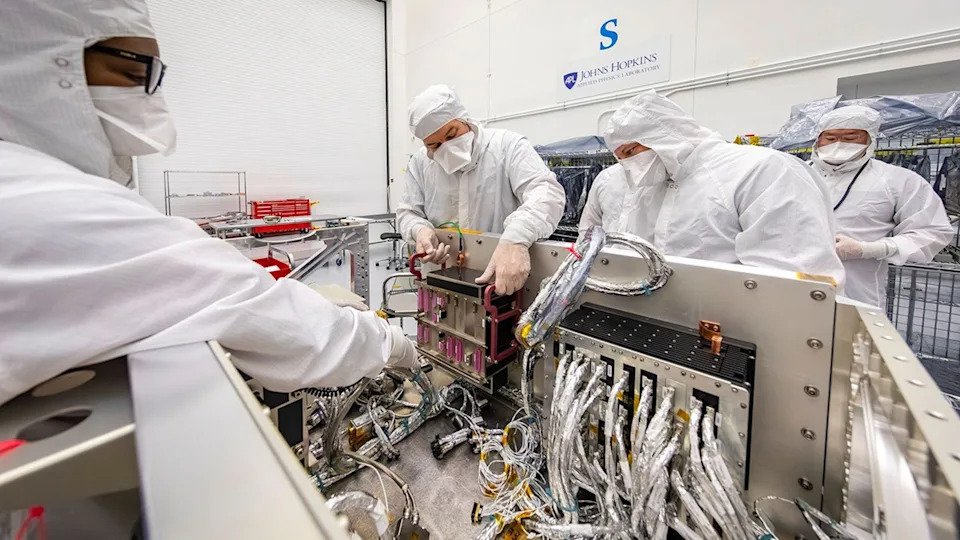
From left, Carlisa Drew, Seth Harvey, Anthony Fanelli, Emory Toomey and TJ Lee conduct power and functional testing on Dragonfly’s Integrated Electronics Module (IEM) and Power Switching Unit (PSU) in the cleanroom at the Johns Hopkins Applied Physics Laboratory (APL) in Laurel, Maryland. The IEM is Dragonfly’s “brain,” containing the spacecraft’s core avionics; the PSUs control the flow of power to Dragonfly’s instruments and systems. | Credit: NASA/Johns Hopkins APL/Ed Whitman
After APL integration, Dragonfly will be shipped to Lockheed Martin Space in Littleton, Colorado, for broader system-level testing. The spacecraft will briefly return to APL for assessments simulating the space environment before being transported to NASA's Kennedy Space Center no earlier than spring 2028 for launch aboard a SpaceX Falcon Heavy rocket.
Cruise, Thermal Protection and Instruments
Dragonfly's aeroshell — the protective exterior used during cruise and atmospheric entry — completed aerodynamic testing in wind tunnels at NASA's Langley Research Center and has moved into integration and testing at Lockheed Martin. Engineers at APL are also evaluating insulating foam designed to keep hardware from freezing in Titan's frigid atmosphere, while the science payload and flight radio continue to be assembled and tested.
"We've spent years designing and refining this amazing rotorcraft on computer screens and in laboratories, and now we get to bring all those elements together and transform Dragonfly into an actual flight system," said Annette Dolbow, Dragonfly integration and test lead at APL.
Why Titan?
Titan is Saturn's largest moon and the solar system's second-largest satellite after Jupiter's Ganymede. Its dense atmosphere and complex organic chemistry make it a compelling target for astrobiology and prebiotic chemistry. The only previous close visit was the European Huygens lander, which descended through Titan's atmosphere and operated on the surface for a few hours on Jan. 14, 2005.
Entering the physical build-and-test phase is a major milestone for Dragonfly: the project now moves from design and simulation to hardware assembly, test campaigns and preparations for the long cruise to Titan.
Help us improve.





















