
RBH-1 is an elongated feature discovered in Hubble images and later observed with JWST. Spectra place it 7.7 billion light-years away and about 200,000 light-years long, with a bright gas knot as luminous as ~50 million Suns. One team interprets it as a wake from a runaway supermassive black hole; another favors an edge-on bulgeless disk galaxy. JWST spectra showing a ~600 km/s velocity drop at the tip are disputed; the debate remains open pending further observations.
RBH-1: Runaway Supermassive Black Hole — Or An Edge‑On Galaxy?
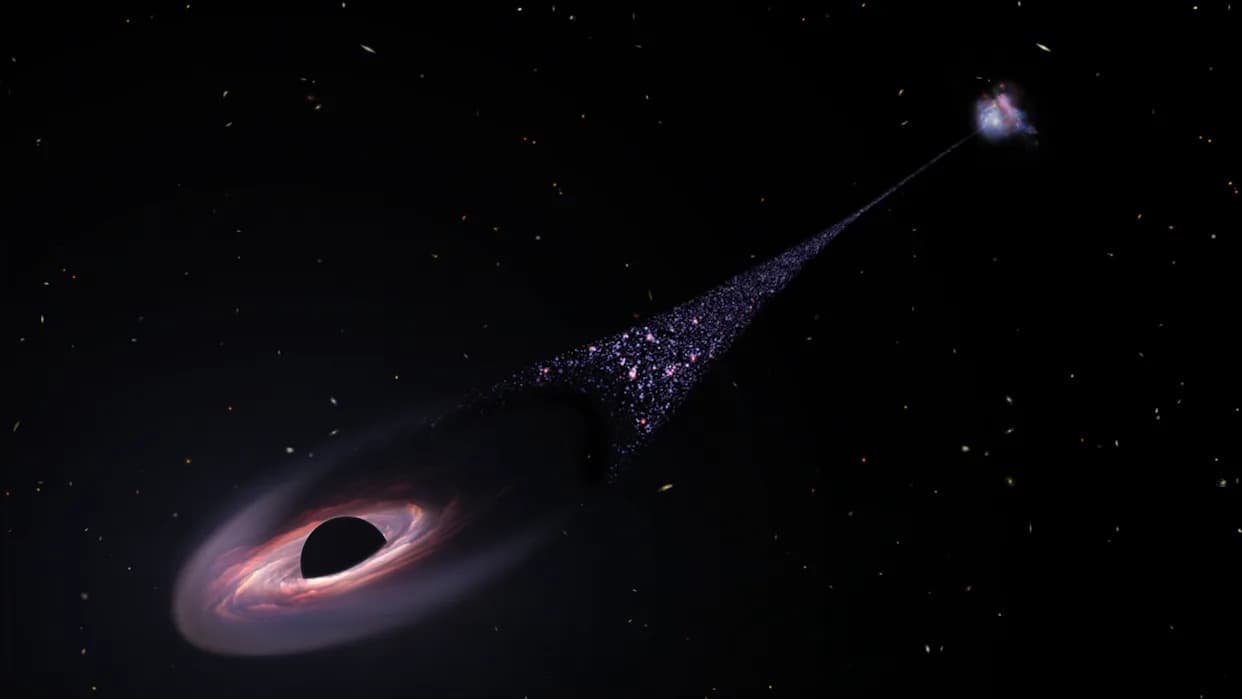
This artist’s concept shows a runaway supermassive black hole plowing through intergalactic space. Newborn stars trail in its wake, formed from the black hole’s compression of tenuous gas in front of it.(NASA, ESA, Leah Hustak (STScI))
There is something unnerving about the idea of a supermassive black hole careening through space at more than three million kilometers per hour. RBH-1 — shorthand for “runaway supermassive black hole” — is an elongated astronomical feature that has sparked lively debate among astronomers because its appearance and spectrum admit two very different explanations.
Discovery and Basic Facts
Astronomers found the structure serendipitously while inspecting Hubble Space Telescope images of a nearby dwarf galaxy. Follow-up spectroscopy placed the elongated feature about 7.7 billion light-years from Earth. At that distance its projected length is roughly 200,000 light-years (about twice the diameter of the Milky Way), and the far end contains a bright knot of gas with a luminosity comparable to nearly 50 million Suns.
Two Competing Interpretations
Runaway Supermassive Black Hole: The discovery team proposed that RBH-1 is the luminous wake of a supermassive black hole ejected from a galactic nucleus. Plausible ejection mechanisms include gravitational-wave recoil following a black-hole merger (an asymmetric burst of gravitational waves can give the merged hole a powerful kick) or a three-body interaction in a complex merger that slings one black hole outward. In this picture the moving black hole drives shocks through ambient gas, compressing it and triggering star formation behind it.
Edge-On Bulgeless Disk Galaxy: Another team argued the feature is instead an unusually thin, bulgeless disk galaxy seen almost exactly edge-on. Such galaxies are rare but known; seen from the side, a disk can appear as a long, linear streamer and show a spectrum made up of gas and stars consistent with star-forming regions.
New Observations And The Debate
The James Webb Space Telescope (JWST) added new data to the discussion. Members of the original team obtained infrared spectra and reported a sharp velocity drop of roughly 600 kilometers per second at the tip of the filament — a signature they interpret as consistent with a hypersonic shock front from a fast-moving black hole (paper in Astrophysical Journal Letters).
The dissenting group reanalyzed the same JWST spectrum and published a contrasting interpretation (Research Notes of the AAS): they find the emission-line ratios and other spectral characteristics are better matched by ordinary star-forming galactic gas clouds than by heavily shocked gas, favoring the edge-on disk galaxy hypothesis.
Physical Challenges And Timescales
Critics of the runaway-black-hole scenario also highlight physical difficulties: producing a sufficiently strong, star-forming wake in the tenuous intergalactic medium is challenging, and the inferred ejection time (about 39 million years ago, based on estimated speed and separation) may be a tight window in which to build the observed stellar population.
What This Means
Both teams use solid observational techniques and established astrophysical theory. The disagreement illustrates science in action: proposals are tested, data are reexamined, and interpretations are revised. At present RBH-1’s true nature remains unresolved. Whether it proves to be a titanic, roaming black hole lighting up a gaseous trail or an unusual, extremely elongated disk galaxy, either outcome would be scientifically valuable.
We don’t know what RBH-1 is — yet.
Help us improve.





















