
The LOFAR Two-metre Sky Survey (LoTSS-DR3) releases the largest radio map yet, cataloguing nearly 13.7 million sources across ~88% of the northern sky from ~13,000 hours of observations. The interferometric LOFAR array — roughly 20,000 antenna elements across 52 stations spanning >1,000 km — produced 18.6 PB of data and required over 20 million core hours of processing at Jülich. These low-frequency radio images pierce dust to reveal black-hole jets, galaxy-cluster collisions, energetic supernova magnetic fields, and other phenomena, and the public dataset is expected to fuel many new studies and inform future projects like the SKAO.
LOFAR’s Record Radio Map Reveals 13.7 Million Hidden Cosmic Sources
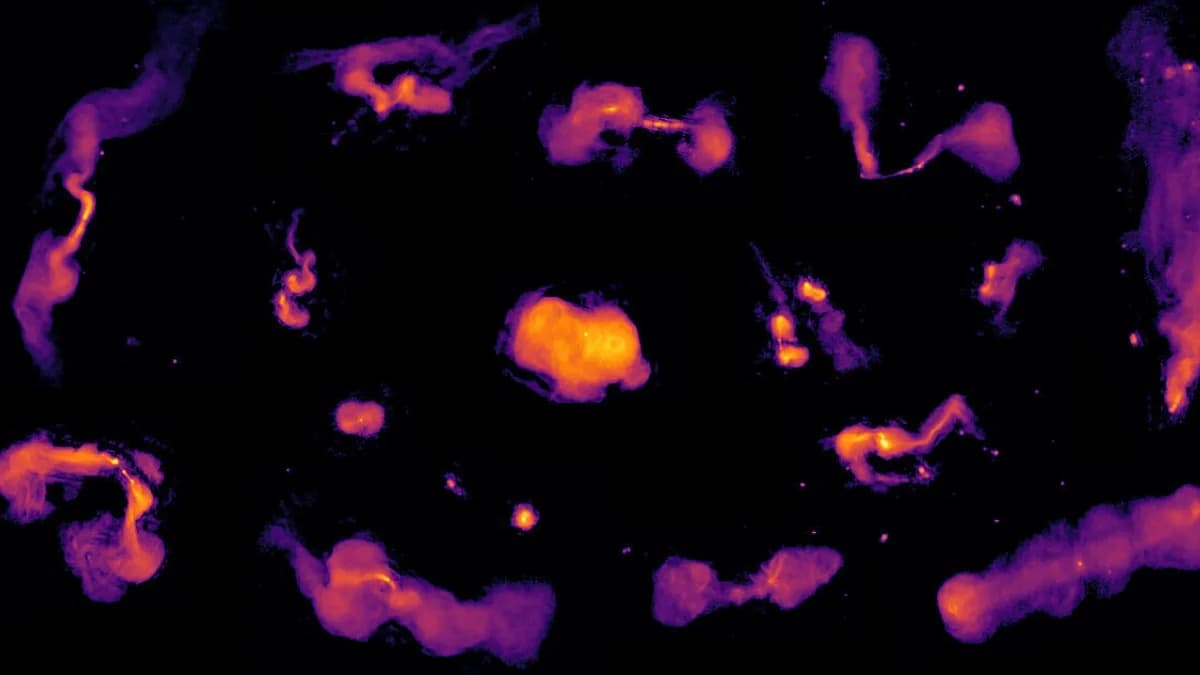
A selection of active galaxies with supermassive black holes at their centers, illustrating the variety of shapes that can result from the activity of black holes and their interaction with the environment. (Maya Horton/LoTSS-Team)
Astronomers have released the largest radio-wavelength map of the sky to date, unveiling nearly 13.7 million celestial sources invisible to the unaided eye. The third data release from the LOFAR Two-metre Sky Survey (LoTSS-DR3) provides an unprecedented catalogue of low-frequency radio emitters, from black-hole jets to supernova-driven magnetic fields.
What the Survey Covers
The survey spans roughly 88% of the northern sky and is built from about 13,000 hours of observations collected over many years. The international LoTSS team used the LOw Frequency ARray (LOFAR), an interferometric network made up of approximately 20,000 antenna elements distributed across 52 stations (38 in the Netherlands and 14 in other European countries). With baselines stretching more than 1,000 kilometres, the array can operate as many individual sensors or combine into a single radio telescope with Europe-scale resolving power.

Subscribe to ScienceAlert's free fact-checked newsletter
Massive Data And Processing Effort
Handling and processing the observations was a monumental effort: the project produced 18.6 petabytes of data and required more than 20 million core hours of computation. Much of the analysis ran on one of Europe’s major supercomputers at the Jülich Supercomputing Centre (JSC) in Germany. As study co-author Alexander Drabent explains, the team had to continuously process and monitor the data over many years to produce science-ready images.
"This data release brings together more than a decade of observations, large-scale data processing and scientific analysis by an international research team," says Timothy Shimwell, lead author and astronomer at ASTRON and Leiden University.
LOFAR does not simply take single snapshots. To form each image, researchers combine inputs from tens of thousands of antenna signals, digitizing and transporting roughly 13 terabits of raw data per second — the equivalent of hundreds of DVDs every second. That infrastructure and workflow have set important precedents for future, even larger survey projects.
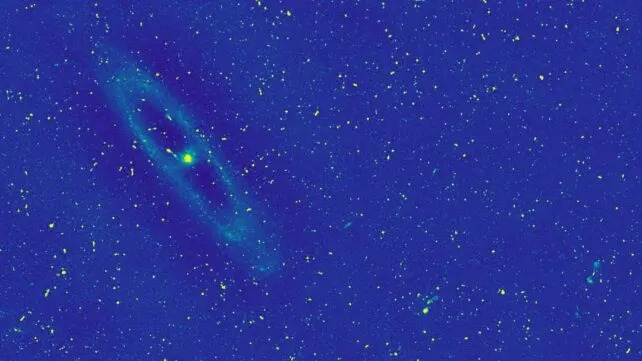
The Andromeda Galaxy (M31) looks much different in radio waves, as seen by LOFAR. Most of these radio waves are generated by the supermassiveblack holein its center and from a ring where new stars are forming. Nearly all the other points of light in the image are from distant active supermassiveblack holes. (LOFAR surveys collaboration)
Why Low-Frequency Radio Matters
Low-frequency radio light reveals a very different Universe than optical telescopes do. Radio images can penetrate dust that obscures optical views, allowing astronomers to study the dense centers of galaxies, jets launched by supermassive black holes, collisions between galaxy clusters, and the magnetic fields created by supernovae that accelerate particles to extreme energies. LOFAR’s images even give familiar objects a striking new look — for example, its view of the Andromeda Galaxy appears ghostly and eye-like in radio wavelengths.
Open Data and Future Prospects
With LoTSS-DR3 now publicly available, researchers worldwide can mine the dataset for new discoveries; previous LOFAR releases already spawned numerous studies, including single images containing tens of thousands of active galactic nuclei. LOFAR also serves as a technological and scientific precursor to the forthcoming Square Kilometre Array Observatory (SKAO), which will build the world’s largest radio telescope arrays in South Africa and Australia.
The full survey results and processing details are described in a paper published in the journal Astronomy & Astrophysics.
Help us improve.





















