
New JWST isotope measurements indicate interstellar comet 3I/ATLAS likely formed 10–12 billion years ago, making it far older than Earth and possibly near the ages of the Milky Way and universe. The comet’s water shows record-high deuterium enrichment and its carbon isotopes are elevated, pointing to formation in an extremely cold (~30 K), well-shielded protoplanetary disk. The study is a preprint under peer review; experts call the results valuable, though cosmic irradiation over billions of years may obscure the comet’s precise birthplace.
James Webb Finds Interstellar Comet 3I/ATLAS May Be 10–12 Billion Years Old — A Relic From the Early Galaxy
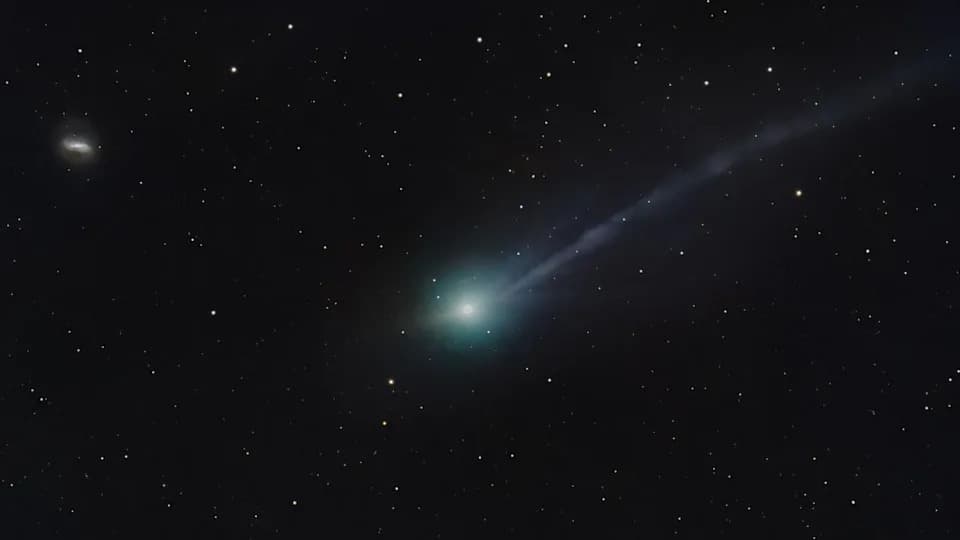
The long tail and secondary anti-tail of 3I/ATLAS, as well as several other smaller jets emerging from its coma, captured by astrophotographer Satoru Murata on Nov. 16, 2025. | Credit: Satoru Murata
New observations from the James Webb Space Telescope (JWST) indicate that the interstellar comet 3I/ATLAS could have formed roughly 10–12 billion years ago, making it dramatically older than Earth and our solar system and possibly approaching the ages of the Milky Way and the universe itself.
Detected as it sped through the inner solar system last year, 3I/ATLAS captured widespread attention. Early online speculation briefly floated exotic explanations, but the scientific consensus is that the object is a natural comet that originated outside our solar system.
Isotope Evidence Points To an Ancient Origin
The new findings, reported in a preliminary paper on the preprint server Research Square and currently under peer review, refine earlier age estimates. Previous analyses placed the comet somewhere between 3 billion and 11 billion years old. JWST’s isotope measurements, taken when the comet passed near Earth in December 2025, instead point to a formation epoch of about 10–12 billion years ago in a cold, distant part of the Milky Way.
"They show that 3I/ATLAS isotopic composition is very different from solar system comets and suggest that it likely formed 10–12 billion years ago," Romain Maggiolo of the Royal Belgian Institute for Space Aeronomy told Live Science. "In other words, 3I/ATLAS formed in a stellar environment different from ours, not only somewhere else in space, but also at a much earlier time in the history of the Milky Way."
Chemistry Suggests Extreme Cold and Long Travel
By studying gases released as surface ices sublimated, researchers measured isotopic ratios in material outgassed by 3I/ATLAS. The comet’s water is unusually enriched in deuterium (a heavy isotope of hydrogen) at levels higher than any previously studied comet. Its carbon isotope ratios are also higher than typical solar system values. Together these signatures suggest formation in a very cold environment—roughly 30 K (about −243 °C)—likely within a dense, well-shielded protoplanetary disk.
Those chemical fingerprints imply that rich volatile and prebiotic chemistry may have been present in some star-forming regions very early in the Milky Way’s history.
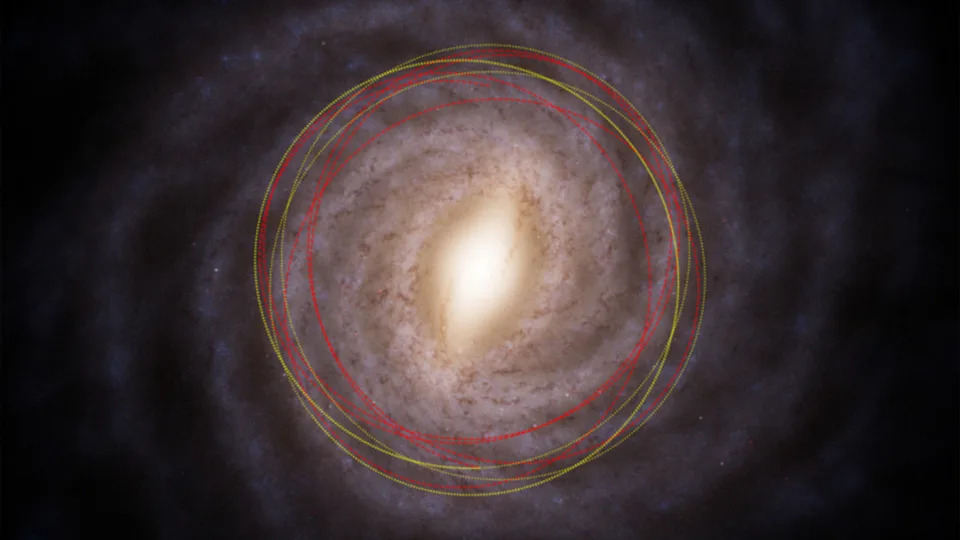
3I/ATLAS likely originated somewhere within the Milky Way's thick disk (red lines) before crossing paths with our sun along its orbit around the galaxy (yellow lines). | Credit: M. Hopkins/Ōtautahi-Oxford team. Base map: ESA/Gaia/DPAC, Stefan Payne-Wardenaar, CC-BY-SA 4.0
Size, Trajectory And Observations
3I/ATLAS remains only the third confirmed interstellar object recorded in our solar system. Hubble Space Telescope observations estimate its size between about 1,400 feet (440 meters) and 3.5 miles (5.6 kilometers). The comet entered the inner solar system at roughly 137,000 mph (221,000 km/h), reached perihelion on Oct. 29, 2025, and made its closest approach to Earth on Dec. 19, 2025—about 168 million miles (270 million km) away. JWST observed the comet on Dec. 22, 2025, providing the isotope data analyzed in the new study.
Uncertainties And Ongoing Questions
Because the study is a preprint and remains under peer review, its conclusions should be considered provisional. Experts who were not part of the research have called the measurements an important contribution. Josep Trigo-Rodríguez of the Institute of Space Sciences (CSIC/IEEC) described the work as a robust compilation from recognized specialists, and Maggiolo said the new data are "a crucial new piece of the puzzle."
However, tracing the comet’s exact birthplace is likely impossible. The object has probably been traveling through interstellar space for billions of years and has been heavily irradiated by cosmic rays. That prolonged exposure can alter chemical signatures and complicate efforts to identify the comet’s original stellar system.
Where It’s Headed
Time is running out for detailed study: 3I/ATLAS is now leaving the inner solar system. It is passing Jupiter and is expected to make its closest approach to the gas giant on Sunday, March 15, 2026, coming within about 33 million miles (54 million km) of Jupiter—far closer than its Earth flyby. The comet will then continue outward, crossing Saturn’s orbit in July 2026, Uranus’ orbit in April 2027, and Neptune’s orbit in March 2028. Observers can follow the trajectory using NASA’s Eyes on the Solar System simulation.
Bottom line: JWST’s isotope measurements suggest 3I/ATLAS is an exceptionally ancient and chemically distinct comet that offers a rare glimpse into conditions in the early Milky Way, even if its precise origin may remain forever unknown.
Help us improve.





















