
Exhausted Afghan families are returning from Iran through the Islam Qala border amid sandstorms, intensified strikes and economic pressure. Many report theft at the border, job losses and long, difficult journeys to drought-hit home provinces. The UN warns nearly half of Afghanistan—21.9 million people—will need humanitarian aid this year, and UNHCR says daily returns average about 1,700 but funding for relief is insufficient. Officials caution repeated mass returns could overwhelm Afghanistan without international support.
‘No Good Choice’: Exhausted Afghans Forced Back From Iran Face War, Drought and Few Prospects
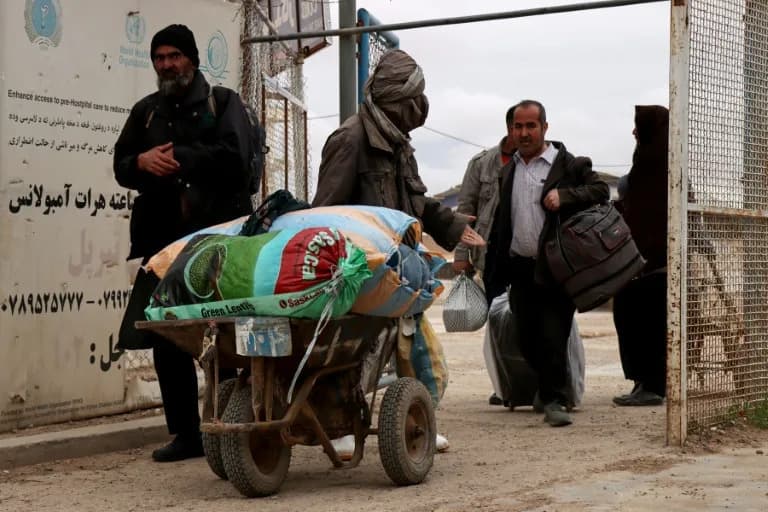
Afghan in Iran must decide between war there or war in their home nation (Mohsen KARIMI)(Mohsen KARIMI/AFP/AFP)
Exhausted Afghan families are crossing back from Iran at the Islam Qala border in Herat province, often amid sandstorms and with only a suitcase of belongings. Many say they were pushed out by intensified strikes in Iran, economic hardship and rising hostility toward migrant workers.
At The Border
At Islam Qala, Talibshah (who declined to give a family name) said he had worked in agriculture northwest of Tehran and in Qazvin to support seven relatives while drought ravaged farms back home. He said money changers at the border cheated him and he now faces a long, difficult journey to Sar-e-Pol province in northern Afghanistan.
Voices Of Returnees
"I don't know whether I will be able to find a job or not. We are left without prospects," Talibshah told AFP. "If I don't find a job here, I'll have to emigrate again. We have no choice. We can't starve."
Mohammad Kabir Nazari, 48, who had worked as a security guard in Tehran, described recent strikes as "50 times greater" than earlier clashes. "Missiles were coming from all sides, every day," he said. Nazari, originally from Ghazni, said he has travelled to Iran for work for 32 years and has never seen markets so empty around Nowruz and the end of Ramadan.
Naeemullah Rahimi, 24, said he sheltered from air strikes in a basement before returning to his home province of Wardak, where jobs are scarce. "When we saw that the situation was very bad, we had to come back to Afghanistan," he said.
Humanitarian Pressure
The United Nations has warned that nearly half of Afghanistan—21.9 million people—will require humanitarian assistance this year. Fresh clashes with Pakistan since 26 February have killed at least 56 civilians and displaced roughly 115,000 people. Since the Middle East war began on 28 February, about 1,700 Afghans have returned from Iran each day; UNHCR warns these flows could increase if fighting continues.
Arafat Jamal, the UN refugee agency's representative in Afghanistan, said: "They're fleeing war in Iran and coming to a country that is also itself at war. These people are entering a country wracked by drought, unemployment and now internal conflict."
The UN High Commissioner for Refugees (UNHCR) says it has staff and basic reception infrastructure in place at border points, but that funding for aid and relief remains insufficient. Jamal also reminded listeners that since September 2023 there have been "waves and waves" of deportations from Iran and Pakistan; in 2023 some 2.8 million Afghans returned to the country—the largest such movement globally.
What Lies Ahead
Officials warn Afghanistan cannot absorb repeated mass returns without significant international support. Aid shortfalls, continuing conflict, drought and a weak regional economy risk leaving many returnees with no safe or viable option other than to try migrating again.
Help us improve.





















