
TOI‑6255 b is an Earth‑sized exoplanet 66 light‑years away that completes an orbit in just 5.7 hours, placing it perilously close to its star’s Roche limit. Fei Dai and collaborators confirmed the planet by combining TESS transit data with Keck Planet Finder radial‑velocity measurements, allowing them to estimate its density and composition. As an extreme ultra‑short‑period world, TOI‑6255 b offers a rare opportunity to observe how stellar tides deform planets and drive orbital decay, although timing estimates remain uncertain by orders of magnitude.
TOI-6255 b — An Earth‑Sized Planet on the Verge of Tidal Destruction
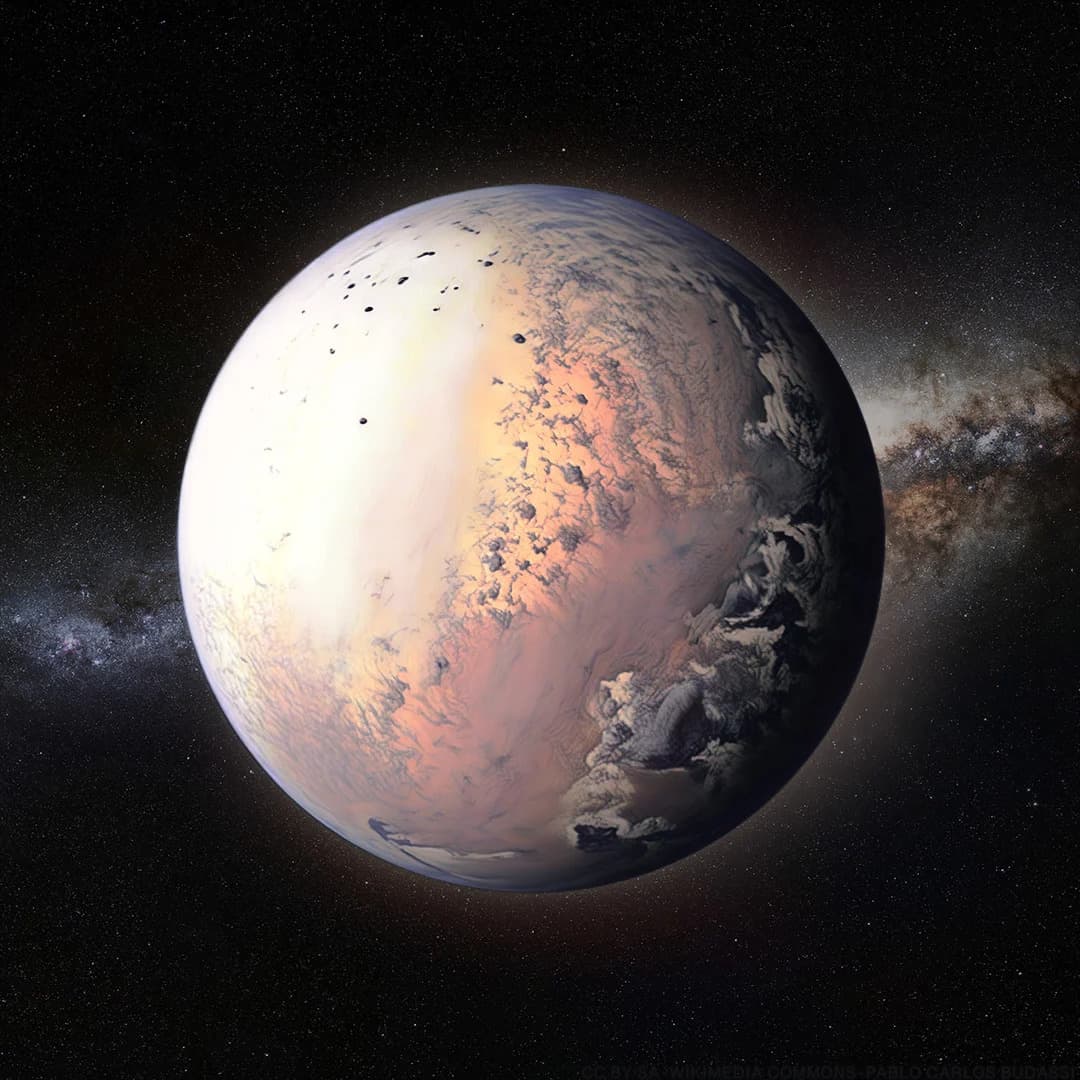
Sixty-six light‑years from Earth, an Earth‑sized world races around its star in just 5.7 hours, orbiting at roughly 1% of Mercury’s orbital distance from the Sun. Astronomers say this planet, TOI‑6255 b, is effectively living on the edge of destruction.
Discovery and confirmation
Fei Dai and colleagues at the University of Hawai‘i Institute for Astronomy combined space‑based observations from the Transiting Exoplanet Survey Satellite (TESS) with ground‑based radial‑velocity measurements from the Keck Planet Finder (KPF) to confirm TOI‑6255 b as an exoplanet. Their results were published in August 2024 in The Astronomical Journal and represent one of KPF’s early science outputs, demonstrating how the instrument complements targeted space surveys.
On the brink: tidal forces and the Roche limit
Tidal forces arise because a star’s gravity pulls more strongly on the near side of a planet than on its far side. On extreme scales, those differential forces can overwhelm a planet’s internal cohesion. The critical distance at which a planet will be pulled apart is called the Roche limit.
TOI‑6255 b currently orbits just outside its star’s Roche limit, but so close that stellar tides have stretched it from a sphere into an elongated, egg‑like shape. The team’s calculations indicate continued tidal interactions could cause the planet’s orbit to decay, and it may cross the Roche limit within a few hundred million years — a short interval on cosmic timescales.
Uncertainties and expert perspective
James Fuller, an astrophysicist at Caltech who was not part of the discovery team, warns the timeline could be much shorter. The rate at which orbital energy is dissipated depends sensitively on the star’s internal structure and the details of how the star is deformed by the planet; those factors are difficult to calculate precisely and can change estimates by orders of magnitude. Dai’s team adopted a reasonable value from commonly used ranges, but Fuller notes significant uncertainty remains.
“We don’t know necessarily,” Fuller says, referring to the uncertainty in the dissipation parameter. “That choice could be off by a factor of 1,000.”
A rare laboratory: Ultra‑short‑period planets
TOI‑6255 b is also an ultra‑short‑period (USP) planet — a class defined by orbital periods under one Earth day. Of the more than 5,000 confirmed exoplanets discovered so far, fewer than 150 are USPs, and TOI‑6255 b is one of the most extreme examples known.
Sam Halverson, a KPF instrument scientist and member of Dai’s team, calls the planet a “convenient data point.” Because so few planets are found near the Roche limit, TOI‑6255 b offers a rare opportunity to observe how extreme tidal forces reshape planetary structure and potentially drive orbital decay in real time.
How TESS + KPF unlock composition
TESS detects transits — tiny dips in a star’s brightness when a planet crosses the stellar disk — which yield precise orbital periods and planetary radii. KPF measures the star’s radial velocity, the subtle wobble caused by the planet’s gravity, which yields planetary mass. Combining radius and mass gives density, a key clue to composition. This targeted space‑and‑ground approach is more efficient than blind searches and helps astronomers characterize rare planets like USPs more quickly.
Why it matters
Tidal forces shape many phenomena across the Solar System — from Earth’s ocean tides to Io’s volcanic activity and possibly the origin of Saturn’s rings. At a distance of dozens of light‑years, those same forces are actively reshaping TOI‑6255 b. In possibly the final few hundred million years of its existence, the planet could teach astronomers about the physics of extreme exoplanets, planetary interiors, and the destructive power of stellar tides before it is ultimately torn apart.
Help us improve.





















