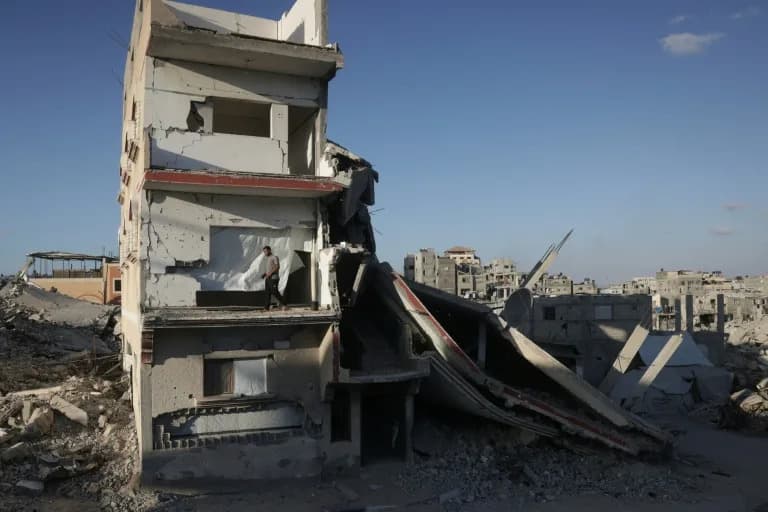
Gaza’s fishermen risk their lives to fish in tightly controlled waters after much of the fleet and coastal infrastructure was destroyed. Displaced and often without engines or nets, many now paddle makeshift skiffs only a few hundred metres offshore under the threat of patrols, chases and attacks. The UN says the sector is operating at under 7.3% of its pre-October 2023 capacity and about 72% of the fleet was damaged. Recovery will require sustained, safe access and the entry of equipment and materials.
Risking Everything: Gaza Fishermen Brave Israeli-Controlled Waters After Fleet Devastation
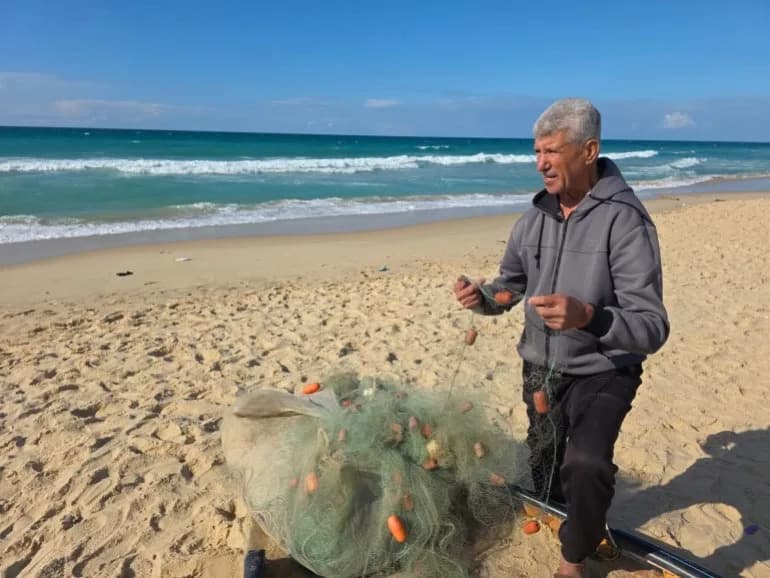
Fisherman Adnan Sehwail risks his life every time he gets on a boat in Gaza [Ahmed Al-Najjar/Al Jazeera]
Khan Younis, Gaza Strip — On a blue, choppy stretch of sea off Khan Younis port, two Palestinian fishermen pushed a battered skiff roughly 200 metres (656 feet) from the shore. On the beach, 72-year-old Dawood Sehwail examined a ripped net, his gaze fixed on the waves as if reading a familiar language.
Displaced from Rafah in May 2024 amid the October 2023 offensive — described by some interviewees as a "genocidal war" — Sehwail returns daily to the shoreline. He comes not only to fish, but to escape, to study the sea and to remember.
“The feeling never gets old,” he said, a sparkle in his eye. “You come to see what wonders the sea might still have for you.”
Sehwail and other fishermen describe a long history of restrictions at sea. Even before October 2023, fishing zones were repeatedly curtailed, maritime boundaries agreed on paper after the 1993 Oslo Accords were rarely enforced on the water, and the distances fishermen were allowed to travel shifted frequently — often tightening without warning.
“After every Israeli aggression, the consequences fell on us,” Sehwail said. “We were supposed to go further into the sea, but the occupation kept pushing us back.”
From Livelihood To Survival
For a coastal territory, the sea should provide livelihoods, stability and fresh food. Instead, under an Israeli blockade that has controlled Gaza’s land, air and sea since 2007, fishermen say the maritime zone has become another mechanism of restriction. Sehwail, who once ran a stone-distribution business before the tightened blockade of 2007, returned to fishing — a craft he learned in childhood — after other work collapsed.
“Our work is day by day,” he said. “If you worked and were lucky, you could sell your catch and feed your family. If you were very lucky, you might save a little for your children’s future.”
But the October 2023 offensive further devastated Gaza’s marine economy. Gaza’s seaport and fishing installations were hit by air strikes; boats were burned, sunk or otherwise damaged; and the sector collapsed almost overnight. In Rafah, Sehwail recalled, six trawlers were bombed and burned. At Khan Younis, harbours have become overcrowded displacement sites and wrecked boats are repurposed as tent supports.
“What we do now is try not to die,” he said. “We borrow tools. Some turn refrigerator parts into floating boards. We have no engines, only paddles. We use whatever is left.”
Human Cost And Shrinking Catch
Beyond material loss, Gaza’s fishing community has paid a significant human toll. The Gaza Fishermen’s Syndicate reports at least 238 fishermen killed since October 2023, among the broader Palestinian casualties. Before the offensive the sector included more than 5,000 fishermen supporting over 50,000 family members.
According to United Nations estimates, by the end of 2024 the sector was operating at less than 7.3% of its pre-October 2023 production capacity and roughly 72% of Gaza’s fishing fleet had been damaged or destroyed. The permitted fishing zone has been repeatedly reduced — in some cases to under one nautical mile (1.85 km) — and many skiffs do not venture farther than about 800 metres because of patrols and uncertainty.
“The sea is practically closed,” Zakaria Baker, head of Gaza’s Fishermen Syndicate, told Al Jazeera. Many fishermen report sudden chases by naval patrols, boats being shot at or sunk, and arbitrary detentions.
“They are always there,” Sehwail said, pointing to an Israeli naval boat. “There is no official clearance for us. We enter at our own risk. The farthest we can go is about 800 metres, and even that depends on their mood.”
Fishing in shallow waters has reduced both catch volumes and species variety. Coastal fishermen report mostly juvenile sardines and small catches that would otherwise be left to grow — while many families face acute food insecurity and cannot afford imported frozen fish that now fills the markets.
What’s Needed For Recovery
Local leaders and international agencies stress that recovery will require predictable, sustained access to fishing grounds and the entry of equipment and repair materials. Baker warned that ceasefire declarations alone are not enough: “No materials or compensation have been allowed in so far,” he said. “Fishermen need predictable and safe conditions to return to work without fear of bullets.”
Sehwail framed the issue simply: “The fishermen are simple, poor people. We just want to live with dignity and provide for our families. From north to south across Gaza, we all need support to finally fish as we deserve.”
Help us improve.