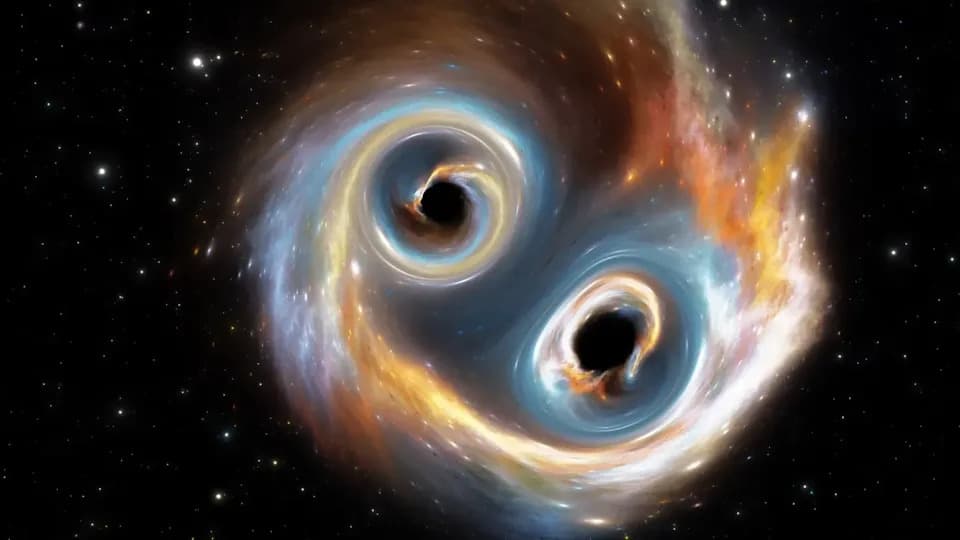
GWTC‑4, released by the LIGO–Virgo–KAGRA collaboration, doubles the public gravitational‑wave catalog to 128 events recorded between May 2023 and January 2024. The dataset includes the heaviest black hole components yet (~130 solar masses), highly unequal‑mass mergers, black holes spinning at ~40% of light speed, and two new black hole–neutron star events. Some signals were seen from distances up to ~10 billion light‑years, enabling stringent tests of general relativity and supporting scenarios in which black holes grow via merger chains.
GWTC‑4 Doubles Gravitational‑Wave Catalog — 128 Cosmic Collisions, Including Heaviest Black Hole Merger Yet
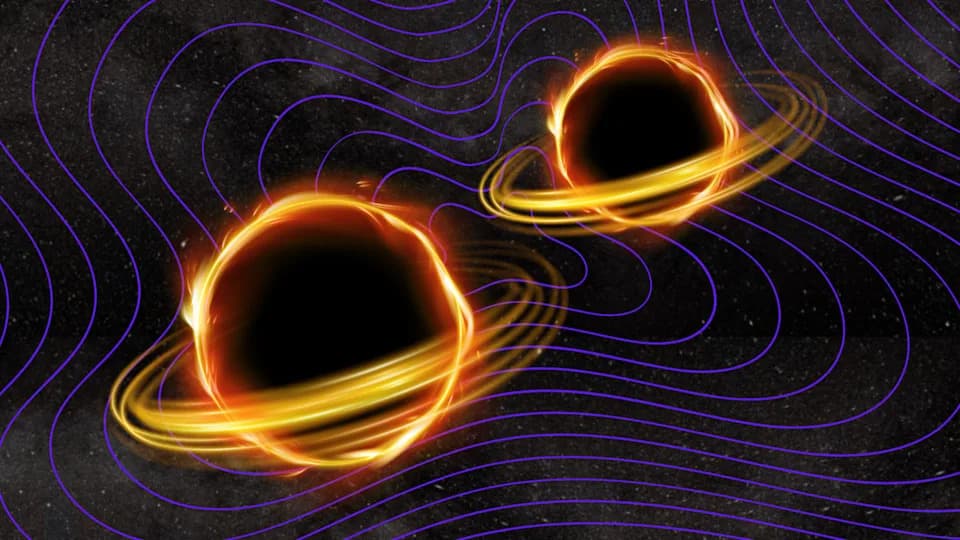
Scientists have discovered over 100 more gravitational wave events. | Credit: Robert Lea (created with Canva)
The LIGO–Virgo–KAGRA (LVK) collaboration has released its fourth public catalog, GWTC‑4, adding 128 gravitational‑wave sources detected during the network's fourth observing run (May 2023–Jan 2024) and effectively doubling the known sample of spacetime ripples recorded on Earth.
These new detections expand the variety and extremity of observed mergers: the catalog includes the heaviest black hole binary components seen so far (each near ~130 solar masses), highly unequal‑mass pairings, black holes spinning at roughly 40% of the speed of light, and two additional mixed black hole–neutron star mergers. Researchers argue that many extreme properties — especially very large masses and rapid spins — could result from previous mergers, supporting the idea of merger chains that let some black holes grow to enormous sizes over cosmic time.
“Each new gravitational‑wave detection allows us to unlock another piece of the universe’s puzzle in ways we couldn’t just a decade ago,” said Lucy Thomas of Caltech. “It's incredibly exciting to think about what astrophysical mysteries and surprises we can uncover with future observing runs.”
Prior to GWTC‑4, the first three observing runs had yielded roughly 90 candidate events; the LVK teams note that about 170 additional triggers have been recorded but are not yet incorporated into the public catalog. The increased detection rate reflects steady improvements in detector sensitivity and analysis pipelines.
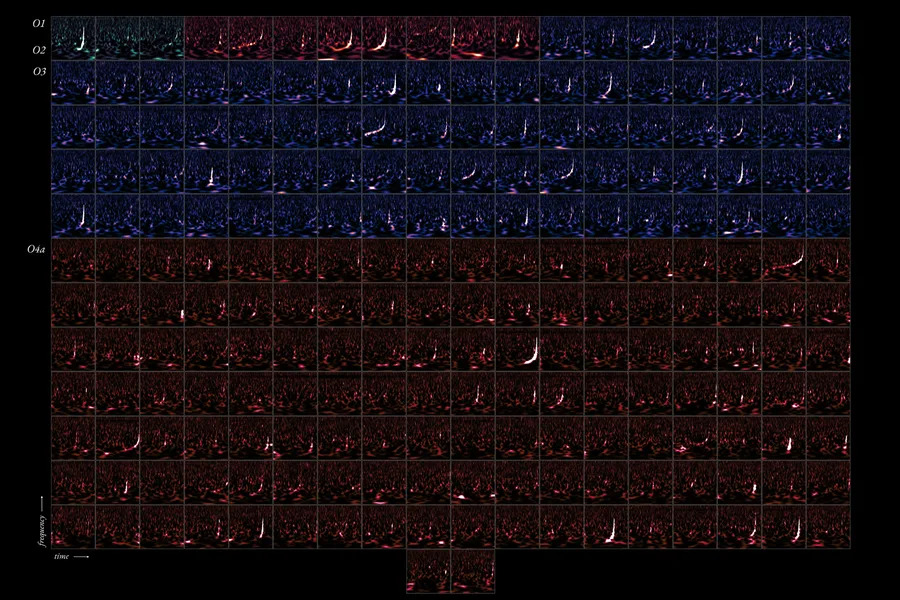
The Gravitational-Wave Transient Catalog 4.0 and the cosmic collisions it contains. | Credit: Ryan Nowicki/Bill Smith/ Karan Jani
The catalog also demonstrates the reach of current detectors: some neutron star mergers in GWTC‑4 were detected at distances approaching ~1 billion light‑years, and several black hole mergers were observed at distances of order ~10 billion light‑years. These distant events give physicists powerful, independent tests of general relativity in the most extreme environments we can probe.
“In the past decade, gravitational‑wave astronomy has progressed from the first detection to the observation of hundreds of black hole mergers,” said Stephen Fairhurst of Cardiff University. “These observations help us understand black hole formation, cosmological evolution, and the limits of general relativity.”
GWTC‑4 will be detailed in a special issue of the Astrophysical Journal Letters, providing the broader community with an expanded dataset to study black hole formation channels, spin evolution, and the astrophysical environments that produce these extreme mergers.
What To Watch Next: LVK plans further observing runs and catalog updates; roughly 170 additional triggers await vetting and inclusion, so the catalog may grow substantially in the near future.
Help us improve.