The Democratic Action Party (DAP), a major partner in Prime Minister Anwar Ibrahim’s coalition, is reassessing its role ahead of the next election amid allegations of misconduct at the Malaysian Anti‑Corruption Commission (MACC). DAP says it will not withdraw support this term but may change strategy at the ballot box if reforms stall. MACC chief Azam Baki denies wrongdoing while a government committee probes the claims and results are expected soon. Analysts warn the dispute could damage voter trust and threaten the coalition’s stability.
Malaysia's DAP Reconsiders Coalition Role as Anti‑Corruption Scandal Deepens

People hold placards bearing images of Azam Baki, chief commissioner of the Malaysian Anti-Corruption Commission (MACC), during a protest calling for his resignation outside the agency’s headquarters at Putrajaya, Malaysia, February 27, 2026. REUTERS/Hasnoor Hussain
KUALA LUMPUR, March 6 — A senior leader of the Democratic Action Party (DAP), a key partner in Prime Minister Anwar Ibrahim’s ruling coalition, said the party is reassessing its role in the pact ahead of the next general election as frustration grows over the government’s handling of allegations at the national anti‑corruption agency.
Allegations, Probe and Government Response
Allegations of misconduct this year at the Malaysian Anti‑Corruption Commission (MACC) — while smaller in scale than the multibillion‑dollar 1MDB scandal that crippled investor confidence a decade ago — have renewed scrutiny of Anwar’s promise to tackle graft. Bloomberg reports last month suggested MACC chief Azam Baki may have breached shareholding rules for public officials and that the agency aided a group of businessmen in taking control of companies. Azam and the MACC have denied wrongdoing.

FILE PHOTO: Malaysia's opposition leader Anwar Ibrahim waves to his supporters after he filed his nomination to contest in Malaysia's general election at Tambun, Perak, Malaysia November 5, 2022. REUTERS/Hasnoor Hussain/File Photo
The government has established a committee to investigate the claims, with findings expected this week. But DAP has called for a broader, independent royal commission of inquiry (RCI), a demand so far rebuffed by Anwar. That refusal has alarmed coalition partners and analysts who warn a weak response could alienate voters and deepen internal rifts.
Pressure From Within the Coalition
Tony Pua, DAP’s disciplinary chief, told Reuters the party will evaluate its position in relevant coalitions when election time approaches to determine the best strategy. He added that DAP will not withdraw support for the government during the current parliamentary term to avoid precipitating political instability.

A man places placards bearing images of Azam Baki, chief commissioner of the Malaysian Anti-Corruption Commission (MACC), during a protest calling for his resignation outside the agency’s headquarters in Putrajaya, Malaysia, February 27, 2026. REUTERS/Hasnoor Hussain
'I expect the party to evaluate its position in the relevant coalitions when the time comes for elections, to determine the best strategy going forward,' said Tony Pua.
Some lawmakers within Anwar’s own People’s Justice Party (PKR) have privately warned they might run as independents if their confidence in the prime minister falters. PKR lawmaker Hassan Karim urged decisive action: 'The prime minister and his government must terminate the contract of the MACC chief immediately and promptly form the RCI.'
Political Stakes and Upcoming Tests
Anwar’s administration has introduced some progressive reforms — for example, abolishing the mandatory death penalty — but critics cite slow progress on governance changes, rising living costs, and internal cabinet disputes. Parliament narrowly failed this week to pass a constitutional amendment that would have capped the prime minister’s term at 10 years after several government‑aligned lawmakers were absent for the vote.
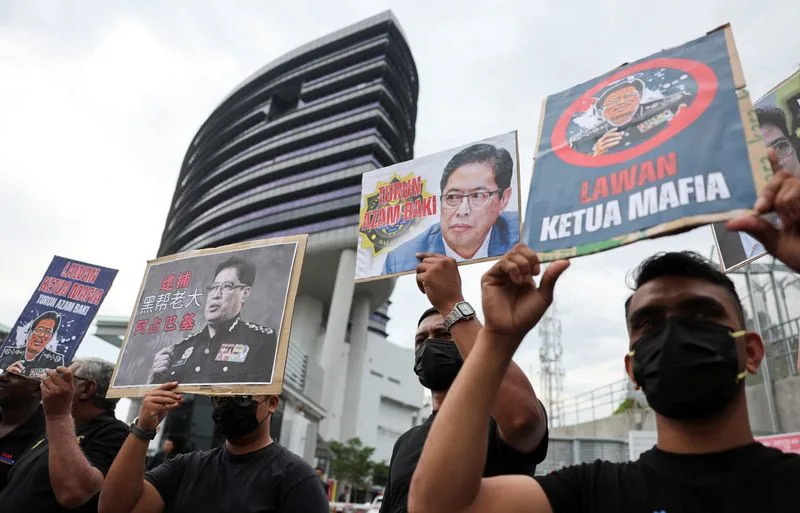
People hold placards bearing images of Azam Baki, chief commissioner of the Malaysian Anti-Corruption Commission (MACC), during a protest calling for his resignation outside the agency’s headquarters at Putrajaya, Malaysia, February 27, 2026. REUTERS/Hasnoor Hussain
The coalition suffered a significant regional election defeat in November, a result DAP leaders called a shock and which has intensified calls for faster reforms. DAP holds 40 parliamentary seats to PKR’s 31 and plans a July meeting to decide whether its leaders should resign from government roles, including cabinet positions, if promised reforms are not implemented.
National elections are due by early 2028, but some government lawmakers say Prime Minister Anwar could call snap polls as early as July. Analysts caution that if the MACC controversy is not resolved quickly, it could remain a dominant campaign issue and threaten the coalition’s electoral prospects.
(Reporting by Danial Azhar; Editing by Rozanna Latiff and Lincoln Feast.)
Help us improve.