
Israeli and US officials say fighting with Iran could persist for weeks, but Israel faces mounting military, social and economic strains. Iran reportedly launched 200+ ballistic missiles in the opening days, and Israel’s interceptor stocks were already stressed during the June 2025 "12-day" clash. Sustained conflict risks deeper societal militarisation, political polarisation and greater economic strain, while Israel’s ability to continue depends heavily on allied support and available interceptor stocks.
How Long Can Israel Sustain a Military Campaign With Iran? Costs, Air Defences and Social Impact
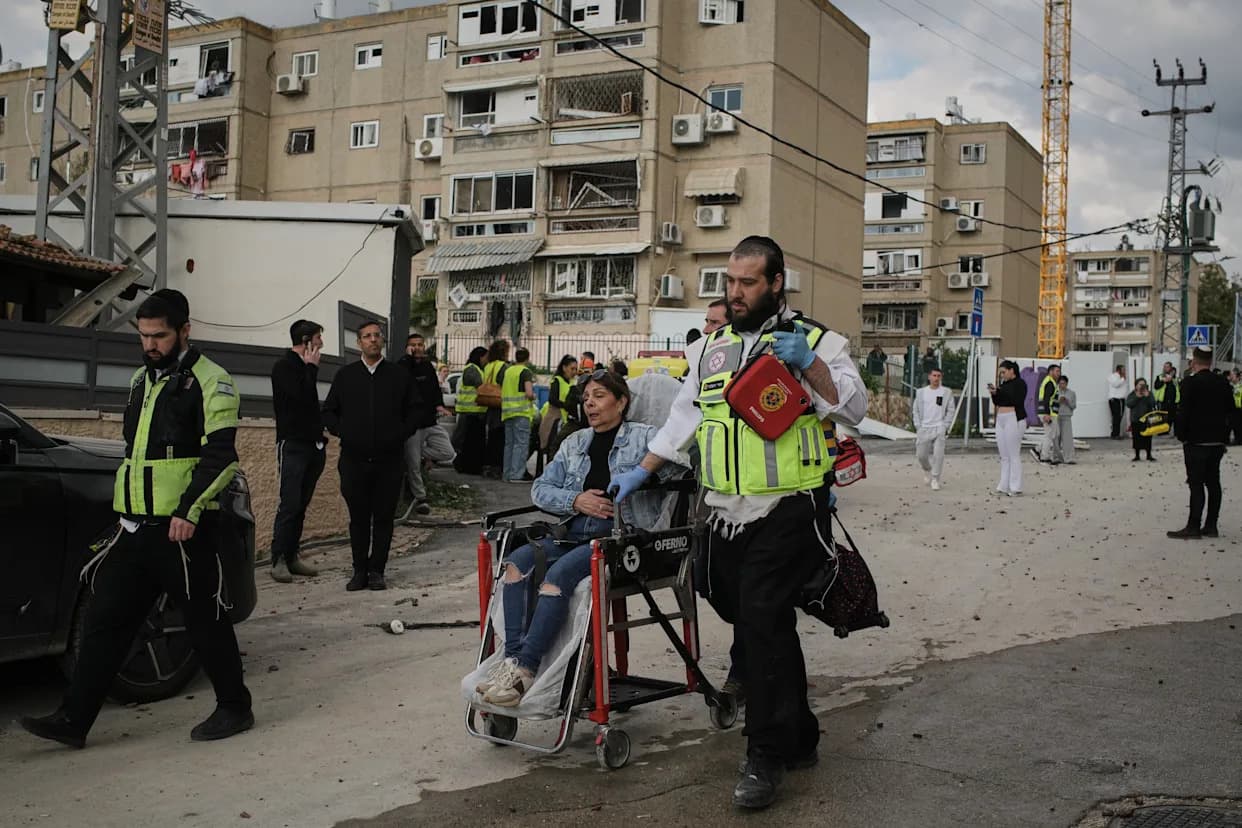
Paramedics evacuate wounded people from the site of a deadly Iranian missile strike in Beit Shemesh, Israel, on March 1, 2026 [Leo Correa/AP Photo]
Israeli and US leaders have signalled that fighting with Iran could persist for weeks. The United States, under President Donald Trump, has emphasised that it can support a protracted campaign; for Israel, however, already strained by sustained operations in Gaza and previous confrontations in Lebanon, Syria and with Iran, an extended confrontation would carry heavy military, social and economic costs.
Since launching strikes on Iran, Israel has faced repeated missile and drone barrages that prompted widespread air-raid alerts, school closures and the mobilisation of tens of thousands of reservists. Cities including Haifa and Tel Aviv have come under sustained attack, stretching emergency services and sending many civilians into shelters for days at a time.
Public support for the campaign remains strong for now. Interviews across major Israeli cities show a readiness to confront an enemy long portrayed by the state as an existential threat, and most political parties outside the far left have rallied behind the government.
"As soon as the war started, Israel was swept in a wave of militarism," said Israeli political economist Shir Hever, describing a shift from existential panic to a confident, martial mood. Hever noted that even many critics urge the government to keep the conflict "short," as though Israel alone could set its timetable.
Analysts warn that this public mood reflects a broader radicalisation and polarisation of Israeli society. Figures once at the margins of the political right have moved closer to the centre of power, accelerating social polarisation and contributing to an outward migration of young talent. Weeks of fighting could further militarise public life and harden political positions.
Military Calculations
One immediate question is how long Israel can sustain current rates of defence and counter-fire against an opponent with Iran’s missile capabilities and production capacity. Defence analyst Hamze Attar told Al Jazeera that Iran launched more than 200 ballistic missiles at Israel in the opening three days of the latest exchange. By comparison, during the June 2025 "12-day" clash Tehran fired roughly 500 ballistic missiles.
Each incoming ballistic missile generally requires an interceptor response. Israel fields layered air-defence systems: Iron Dome (short-range rockets and artillery), David’s Sling (medium-range rockets and cruise missiles) and Arrow 2/3 (designed to intercept ballistic missiles). The government does not publish interceptor stockpiles, but stocks were reportedly depleted during the June 2025 fighting, indicating that sustaining a high tempo of interceptions over an extended period would become increasingly difficult.
Interceptor scarcity could force commanders to ration interceptors and prioritise protection of military and political assets, raising the risk of increased civilian casualties. Attar also emphasised that the strategic threat depends on missile types and launcher availability: long-range missiles can reach the eastern Mediterranean, medium-range missiles can hit Israel, and short-range missiles primarily threaten Gulf states. Iran has reportedly been producing missiles at an estimated rate of roughly 100 per month since the June clashes, suggesting a substantial stockpile — but the number of functional launchers and their survivability under targeted strikes are critical variables.
Economic And Societal Costs
More than two years of near-constant conflict have strained Israel’s economy. Analysts say munitions expenditure and long-term mobilisations of reservists have been costly: reported war-related spending in 2024 on campaigns in Lebanon and Gaza reached about $31 billion, with preliminary figures for 2025 indicating spending climbing toward $55 billion. Those pressures contributed to sovereign credit-rating downgrades in 2024 by the three major agencies.
"Israel is experiencing a debt crisis, an energy crisis, a transportation crisis, [and] a health service crisis," Hever warned, while adding that economic strain alone might not stop military operations if foreign partners continue to supply advanced weaponry and interceptors.
Ultimately, the duration and intensity of the conflict will depend on a mix of factors: the scale of allied support (especially from the US), the availability of interceptors and other munitions, the resilience of Israel’s civil infrastructure and public morale, and the degree to which Iran can sustain missile launches and preserve its launch capabilities. Prolonged fighting risks higher civilian casualties, deeper economic damage and further social polarisation.
Conclusion: Israel’s ability to sustain a prolonged conflict with Iran is not determined by a single variable. It rests on logistics (interceptor and munitions stocks), allied political and material support, the evolving capabilities of both sides, and the political will of Israeli society — all of which make the conflict’s length and outcome uncertain.
Help us improve.





















