
Quick Take: After reported US and Israeli strikes that those governments said killed Iran's supreme leader and senior officials, Tehran launched retaliatory attacks and warned of further action. Iran's varied missile inventory — short-, medium- and longer-range ballistic missiles, cruise missiles and drones — and hardened launch infrastructure give it options to threaten regional bases, shipping and energy chokepoints. Proxy groups and disruptions in the Strait of Hormuz could broaden the confrontation and unsettle global markets.
How Iran Can Strike Back: Missiles, Drones and Risks to Shipping
(Al Jazeera)
After reported US and Israeli strikes that those governments said killed Iran's Supreme Leader Ayatollah Ali Khamenei and several senior officials, Tehran moved quickly to retaliate. Independent verification of those initial casualty claims remains limited. Iran said its response targeted Israeli and US-linked military sites across the region, including facilities in Gulf states that host American forces.
What Happened and Why It Matters
The early exchange has sharpened a key strategic question for regional capitals and global markets: will this remain a cycle of reciprocal strikes, or will it escalate into a prolonged campaign shaped by Iran's strike reach, allied proxies and pressure on shipping and energy infrastructure? Tehran describes retaliation as a duty and a necessary deterrent; Western officials warn of broader destabilisation risks.
Iran's Missile Arsenal: Range, Types and Purpose
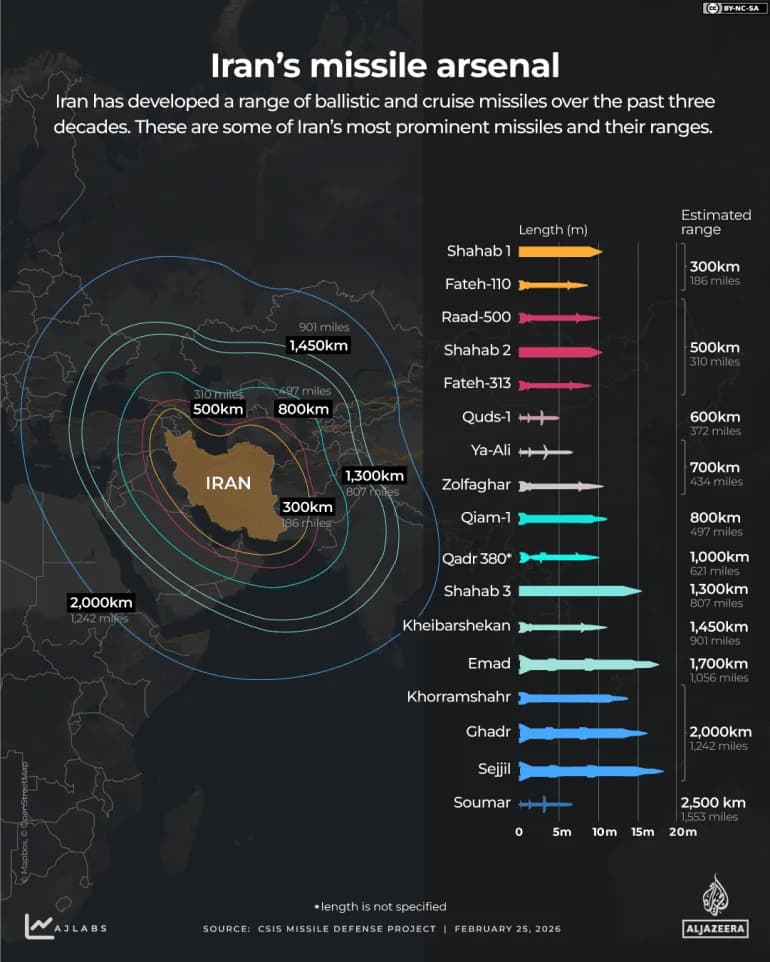
Defence analysts say Iran fields the Middle East's largest and most varied missile force, spanning short-, medium- and longer-range ballistic missiles as well as cruise missiles. Iranian officials portray the programme as central to national deterrence, particularly given the ageing Iranian air force. Western governments argue the arsenal fuels regional instability and could, in a worst-case scenario, be adapted to deliver nuclear payloads—a claim Tehran rejects.
(Al Jazeera)
Ballistic Missiles
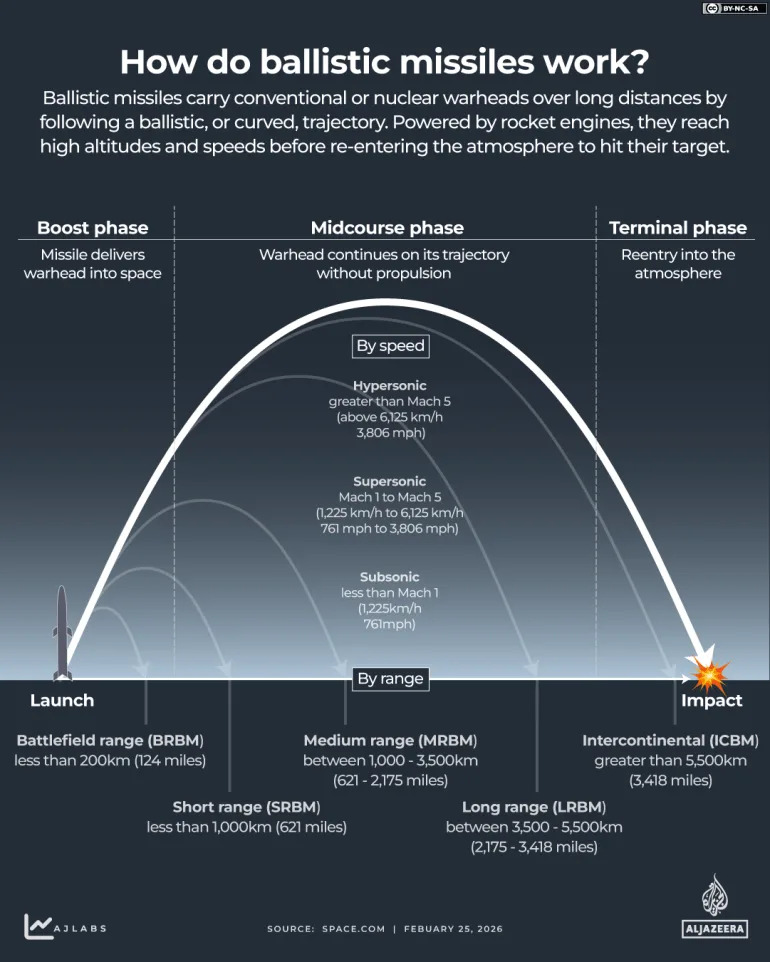
- Short-Range (150–800 km): Systems such as Fateh variants (Zolfaghar), Qiam-1 and older Shahab-1/2 are optimised for nearby targets and rapid, salvo-style strikes that compress warning time and complicate pre-emption.
- Medium-Range (≈1,500–2,000 km): Missiles like Shahab-3, Emad, Ghadr-1, Khorramshahr variants, Sejjil and newer designs such as Kheibar Shekan and Haj Qassem extend Tehran's reach across the eastern Mediterranean and much of the Gulf. Sejjil's solid-fuel design typically allows faster launch-readiness than liquid-fuel systems.
- Longest-Range (≈2,000–2,500 km): These place Israel, US-linked bases in several Gulf states and a wide arc of the region within range, but they do not pose a credible threat to the US mainland as claimed by some political figures.
Cruise Missiles and Unmanned Systems
Cruise missiles fly at low altitude and can follow terrain to complicate detection. Tehran is widely assessed to field land-attack and anti-ship cruise missiles such as Soumar, Ya-Ali, Quds variants, Hoveyzeh, Paveh and Ra'ad; some reports attribute ranges up to ~2,500 km to particular systems. Drones (UAS) — relatively cheap and launchable in numbers — can be used in waves to saturate air-defence systems, strike fixed infrastructure and keep ports and airports on extended alert.
Survivability: Hardened Storage and Dispersal
Iran has spent years dispersing and hardening parts of its missile programme in underground tunnels, concealed depots and protected launch sites. That posture makes it harder for adversaries to quickly degrade launch capacity and increases the chances that some capability will survive an initial strike — raising the prospect of prolonged exchanges rather than a single decisive campaign.
(Al Jazeera)
Maritime Threats: Strait Of Hormuz And Energy Markets
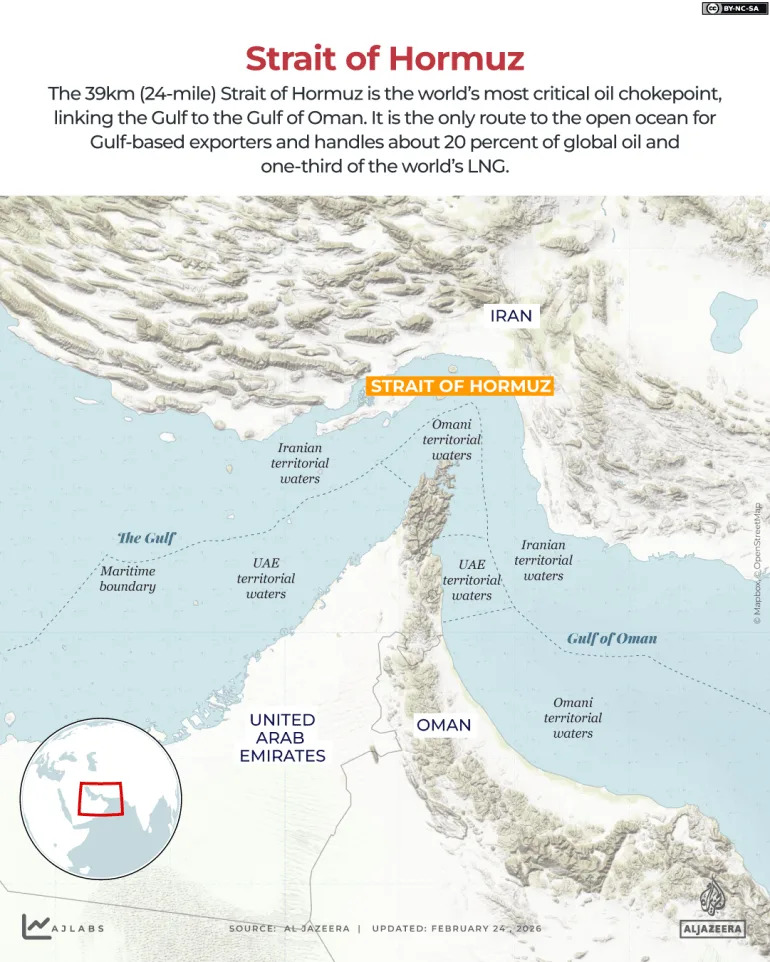
The Gulf and the Strait of Hormuz give Tehran a quick lever to unsettle global energy markets. Iran can threaten naval forces and commercial shipping with anti-ship missiles, naval mines, drone attacks and fast-attack craft. Radio warnings, reports of vessels held outside the strait and higher war-risk insurance premiums are already affecting shipping decisions. Iran has also publicised "hypersonic" systems such as Fattah-family missiles, but independent confirmation of operational hypersonic capability remains limited.
Regional Dynamics And Proxy Risks
Washington has surged naval and air assets into the region, increasing both defensive capacity and the list of potential targets. Iran-aligned groups such as Hezbollah in Lebanon and the Houthi movement in Yemen have condemned the reported killing of Iran's leader and signalled alignment with Tehran, creating pathways for the confrontation to widen via proxy attacks.
What Comes Next
Key variables to watch are the tempo and accuracy of strikes, Iran's inventory and launch survivability, the role of allied proxies, and how shipping and insurance markets respond. Even without a formal blockade, disruptions to the Strait of Hormuz and rising insurance costs can quickly ripple through global energy markets. Independent verification of battlefield claims and transparent reporting will remain critical as events unfold.
Note: Some early casualty claims and strike assessments remain unverified. Reporting may evolve as more information becomes available.
Help us improve.





















