
The James Webb Space Telescope’s NIRSpec instrument observed Uranus for nearly a full rotation, producing the most detailed three-dimensional view yet of the planet’s upper atmosphere and auroral regions. Webb data show how the ionosphere interacts with Uranus’s unusually tilted and offset magnetic field and map auroral patches of orange and red light. The observations also reinforce earlier evidence that the upper atmosphere is cooling, and they provide a remote method to probe the planet’s internal magnetic field ahead of any future spacecraft missions.
James Webb Maps Uranus in 3D: Revealing Auroras, Magnetic Oddities, and a Cooling Upper Atmosphere
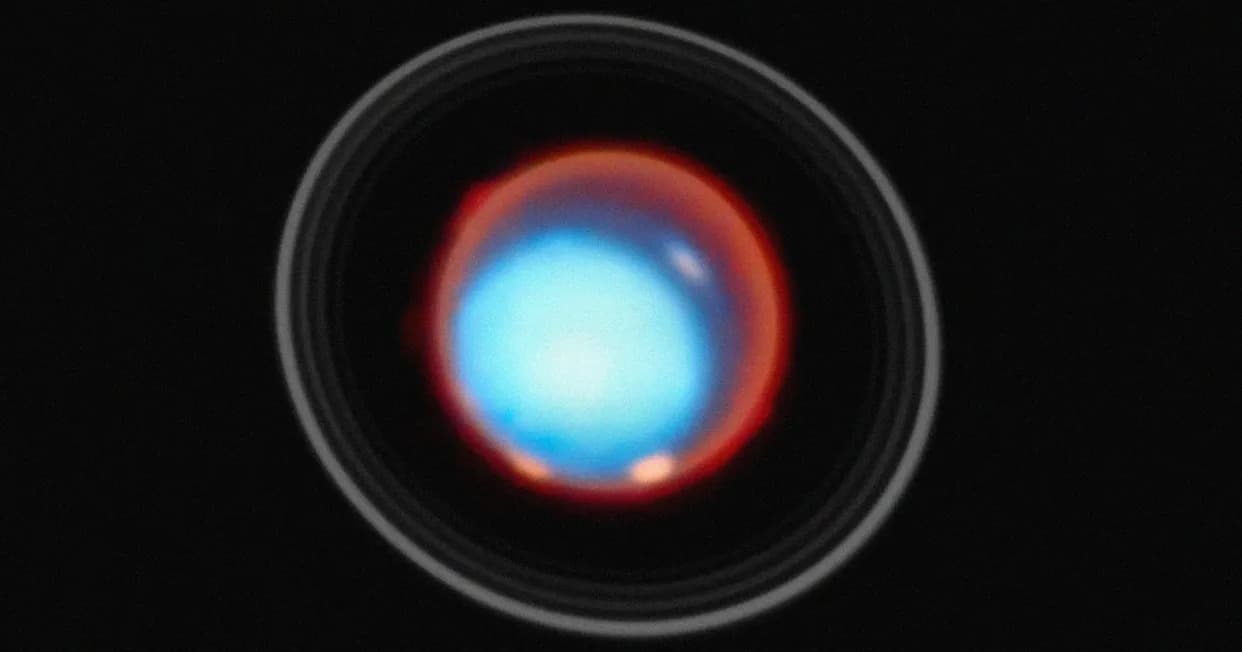
NASA's groundbreaking James Webb Space Telescope has given us an astonishingly detailed peek inside the layers of Uranus' upper atmosphere.
Uranus, the seventh planet from the Sun, has been visited directly only once—when NASA’s Voyager 2 flew past the ice giant in 1986, photographing a muted, light-blue sphere from more than a billion miles away. Now the James Webb Space Telescope (JWST) has offered a far richer view: three-dimensional insight into the planet’s upper atmosphere and auroral regions.
Webb’s NIRSpec Captures Nearly a Full Rotation
Webb’s Near-Infrared Spectrograph (NIRSpec) observed Uranus for nearly a full rotation, producing the most detailed map yet of the ionosphere, the thin, solar-ionized layer high in the atmosphere. These data trace how energy moves upward through the atmosphere and show how the ionosphere interacts with Uranus’s unusually tilted and offset magnetic field.
Strange Magnetosphere, Complex Auroras
Uranus’s axial tilt is extreme—its equator is tipped about 97.77 degrees relative to its orbit—while its magnetic axis is itself strongly misaligned and offset from the planet’s center. That unusual geometry makes the magnetosphere one of the Solar System’s oddest, and it produces auroral patterns very different from Earth’s polar rings.
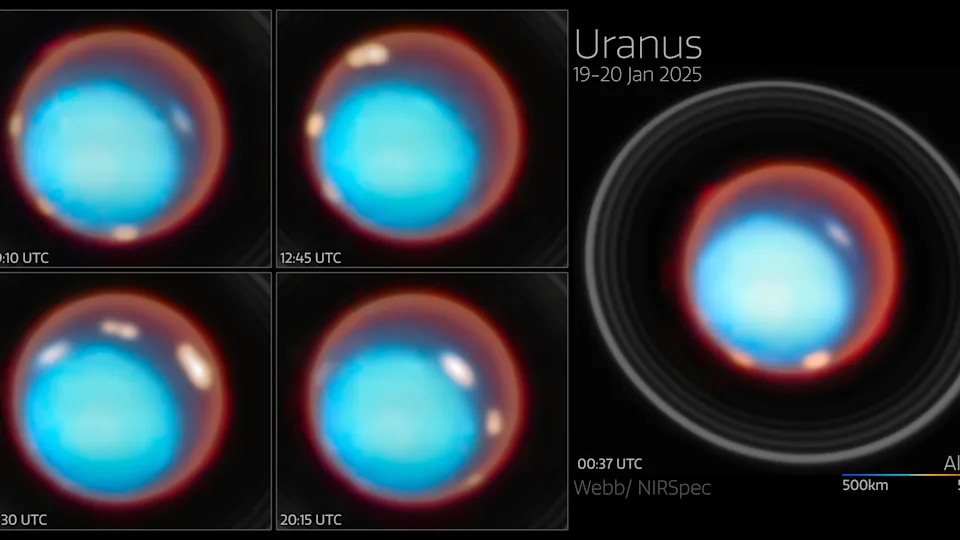
For the first time, an international team of astronomers have mapped the vertical structure of Uranus’s upper atmosphere, uncovering how temperature and charged particles vary with height across the planet. Using Webb’s NIRSpec instrument, the team detected the faint glow from molecules high above the clouds. These unique data provide the most detailed portrait yet of where the planet’s auroras form, how they are influenced by its unusually tilted magnetic field, and how Uranus’s atmosphere has continued to cool over the past three decades. The results offer a new window into how ice-giant planets distribute energy in their upper layers. Two bright auroral bands were detected near Uranus’s magnetic poles, together with reduced emission and ion density in part of the region between the two bands (a feature likely linked to transitions in magnetic field lines).
In Webb images and spectra, auroral signatures appear as luminous orange and red patches that in some cases extend beyond the visible limb, revealing where energetic particles are funneled by the internal magnetic field.
“This is the first time we’ve been able to see Uranus’s upper atmosphere in three dimensions,” said Paola Tiranti, a PhD student at Northumbria University and lead author of the new paper in Geophysical Research Letters. “With Webb’s sensitivity, we can trace how energy moves upward through the planet’s atmosphere and even see the influence of its lopsided magnetic field.”
Cooling Upper Atmosphere and Implications
The Webb results support earlier evidence—first seen in near-infrared observations beginning in the early 1990s—that Uranus’s upper atmosphere has been cooling over time. Understanding this vertical thermal structure is important for modeling the energy balance of ice giants and for interpreting observations of similar exoplanets.
Heidi Hammel, an interdisciplinary scientist on the JWST team who was not involved in the study, said these remote auroral detections are crucial: they provide a way to probe the planet’s internal magnetic field without an in-situ spacecraft.
Looking Ahead
These Webb observations refine our picture of Uranus and could shape priorities for future missions. However, four decades after Voyager 2’s flyby, plans for a return mission remain uncertain amid constrained planetary science budgets and competing priorities.
Bottom line: JWST has produced the first three-dimensional maps of Uranus’s upper atmosphere and auroral regions, revealing how its ionosphere couples to a uniquely tilted and offset magnetic field and confirming ongoing upper-atmosphere cooling. These findings advance our understanding of ice-giant physics and help prepare for future exploration.
Help us improve.





















