Quick facts
- What it is: HD 61005, a Sun-like star nicknamed the "Moth"
- Where it is: About 117 light-years away in the constellation Puppis
- When it was shared: Feb. 23, 2026
The Sun travels through the Milky Way surrounded by a protective bubble called the heliosphere, formed by the continuous flow of charged particles known as the solar wind. That bubble shields the solar system from much interstellar radiation and marks the transition to interstellar space.
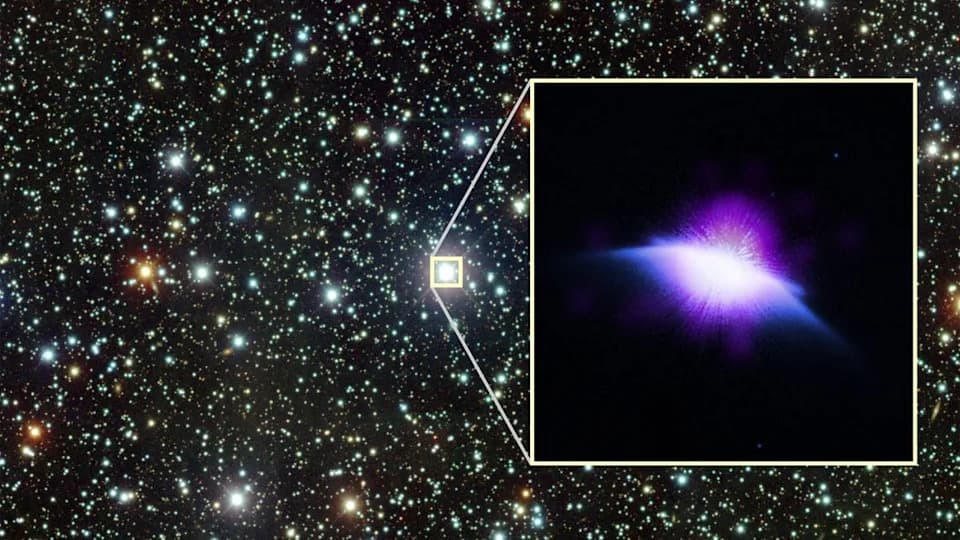
A zoomed-in view of the 'Moth' and its astrosphere | Credit: X-ray: NASA/CXC/John Hopkins Univ./C.M. Lisse et al.; Infrared: NASA/ESA/STIS; Image Processing: NASA/CXC/SAO/N. Wolk
For the first time, astronomers have confirmed a similar protective bubble—a bona fide astrosphere—around another star: HD 61005. Because HD 61005 is much younger than the Sun (about 100 million years versus the Sun’s 4.6 billion years), this detection offers a rare look at what our star might have been like early in its life.
How the discovery was made
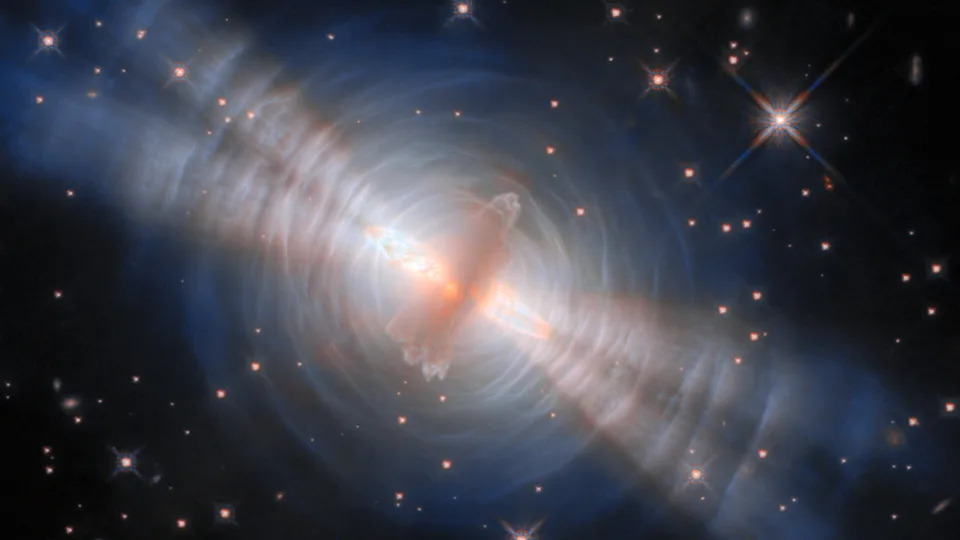
An image of the egg nebula, with a glowing streak of pink gas in the middle surrounded by concentric circles of white like with four diagonal beams of light streaking from top left to bottom right all in front of a deep space starry background
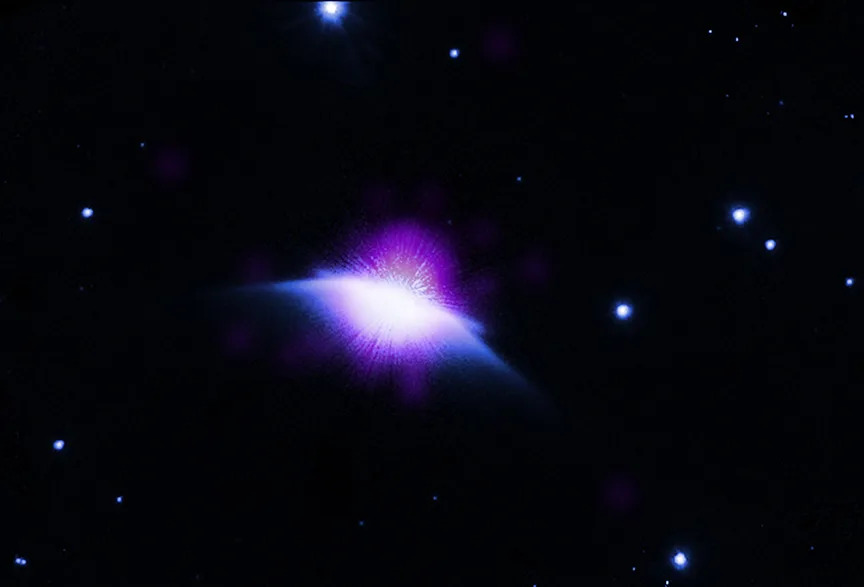
The breakthrough comes from a composite image that merges X-ray data from NASA’s Chandra X-ray Observatory (rendered in purple and white) with infrared and optical observations (blue, red, green) from the Hubble Space Telescope and the Cerro Tololo Inter-American Observatory in Chile. That combination allowed astronomers to separate the star’s high-energy emission from the surrounding dust and gas and visually isolate the wind-driven bubble around the star.
At the center of the portrait is a bright white X-ray core; wrapped around it is a neon-purple halo that traces the astrosphere itself. HD 61005 also displays a striking wedge-shaped dust tail—debris left over from the star’s formation—that sweeps backward like wings as the star moves through the surrounding interstellar medium. This striking morphology is what gave the star its nickname, the "Moth."
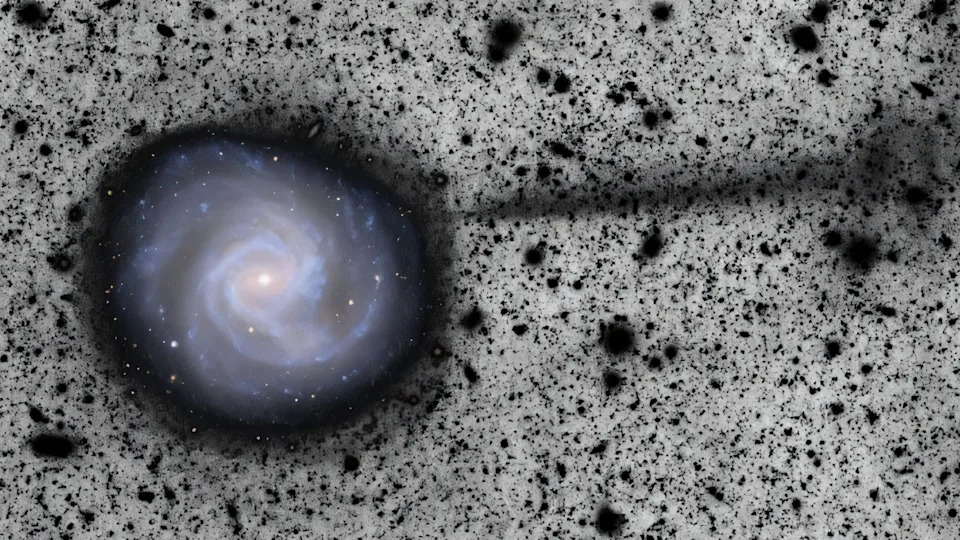
An image of a spiral galaxy on a splotchy black and white background with a stream of black material emerging from the galaxy
"There’s a saying about a moth being drawn to a flame," said Brad Snios, a physicist formerly at the Harvard & Smithsonian Center for Astrophysics. "In the case of HD 61005, the ‘Moth’ can’t easily escape from the flame because it was born around it."
Physical implications
Although HD 61005 is similar to the Sun in mass and temperature, it is far more active. Astronomers estimate its stellar wind is roughly three times faster and about 25 times denser than the present-day solar wind. If HD 61005 replaced the Sun in our solar system, its wind could create a heliosphere up to ten times larger than the Sun’s current bubble, according to NASA estimates.
Hundreds of gold and orange clouds with feathered trails going down behind them. The small clouds are covering a few scattered, bright stars.
The astrosphere became visible because HD 61005’s powerful wind collides with an unusually dense patch of interstellar material, producing X-rays that Chandra could detect. Detecting this interaction made an otherwise invisible wind bubble observable for the first time.
Why this matters
Finding a confirmed astrosphere around a young, Sun-like star gives astronomers a direct window into the early environment of stellar systems. It helps researchers study how stellar winds shape surrounding gas and dust, influence planet-forming disks, and affect the habitability prospects of young worlds as they evolve inside their galactic neighborhoods.
Image credit: NASA/Chandra X-ray Observatory, Hubble Space Telescope, Cerro Tololo Inter-American Observatory.