Emmy Noether (1882–1935) overcame institutional sexism and later Nazi persecution to become one of the most influential mathematicians of the 20th century. Her 1921 work on ring theory introduced the concept of Noetherian rings, providing a structural framework used across algebra, number theory and algebraic geometry. Earlier, her 1918 theorem linking symmetry and conservation laws reshaped theoretical physics. Dismissed from Göttingen in 1933, she continued her scholarship and mentorship at Bryn Mawr until her untimely death in 1935.
Emmy Noether: How Sexism, Nazism and a 1921 Breakthrough Transformed Modern Algebra
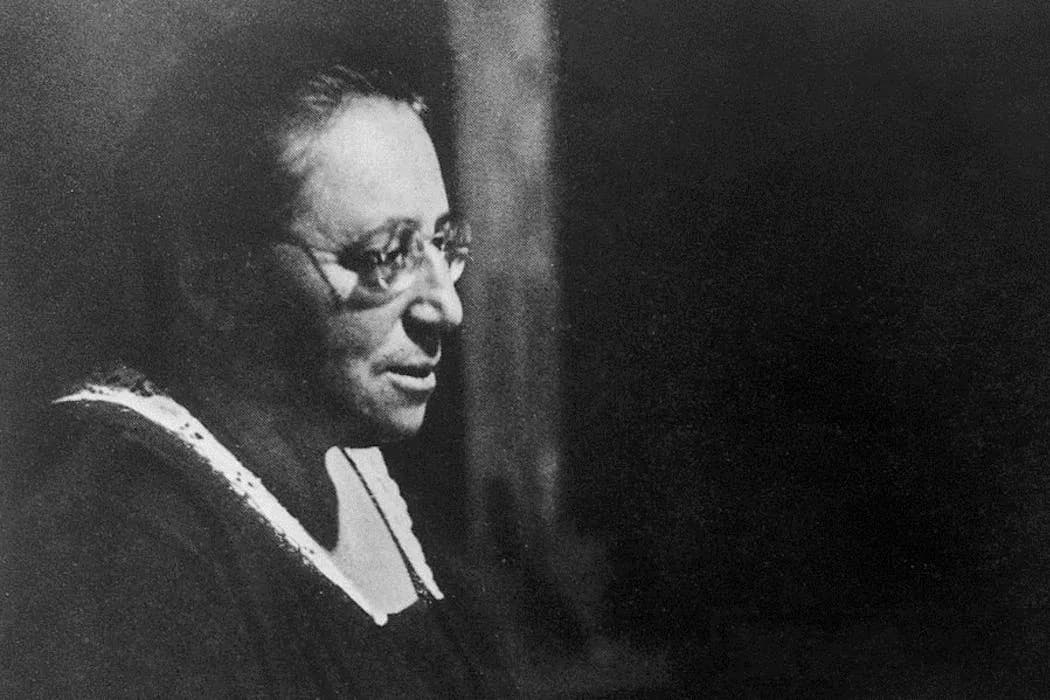
Emmy Noether made significant contributions to theoretical mathematics.Konrad Jacobs, Erlangen/Wikimedia Commons,CC BY-SA
When Albert Einstein wrote an obituary for Emmy Noether in 1935, he called her “creative mathematical genius” who, despite “unselfish, significant work over a period of many years,” had not received the recognition she deserved. Noether’s life combined extraordinary mathematical insight with persistent barriers: she navigated institutional sexism in Germany and the brutal anti‑Jewish policies of the Nazi era, yet still produced ideas that shape mathematics today.
Early Life and Barriers
Emmy Noether was born in 1882 in Erlangen, Germany. Her father was a mathematics professor, but the academic world was largely closed to women. German universities only slowly opened their doors to female students; until the early 20th century most women could only audit classes and were excluded from faculty positions.
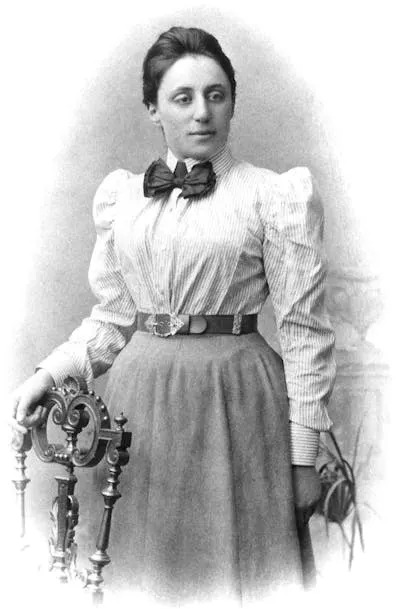
Emmy Noether earned a doctorate in mathematics in 1909, but women were not allowed to work as professors at that time in Germany.Mathematical Assoc, iabutit onat ofth Aatme triimcae, v ia WikimediaCommons
After finishing a girls' high school, Noether enrolled at the University of Erlangen when it began admitting women in 1903 and earned her doctorate in mathematics. Despite her qualifications, she was initially barred from holding a paid university post. She stayed in Erlangen working informally—supervising students without pay—and in 1915 applied to the University of Göttingen. The dean supported her appointment but couched it in condescension, calling her “one of the rare exceptions” to his belief that the female brain was generally unsuitable for mathematical production. The Prussian Ministry of Education nevertheless refused to permit a woman on the faculty, so Noether taught under the name of male colleagues until she was officially granted lecturer status in 1919.
Mathematical Breakthroughs
Noether produced several far‑reaching contributions. In 1918 she published the result now known as Noether’s theorem, which connects continuous symmetries to conservation laws in physics and became foundational for modern theoretical physics. In 1921 she published a landmark paper in abstract algebra that introduced key structural ideas about rings. Rather than study rings individually, she identified conditions that make many rings behave similarly; these rings are now called Noetherian rings. Informally, a Noetherian ring satisfies finiteness conditions that prevent infinite, pathological ascending chains of ideals, giving mathematicians a powerful structural 'map' to navigate diverse algebraic objects.
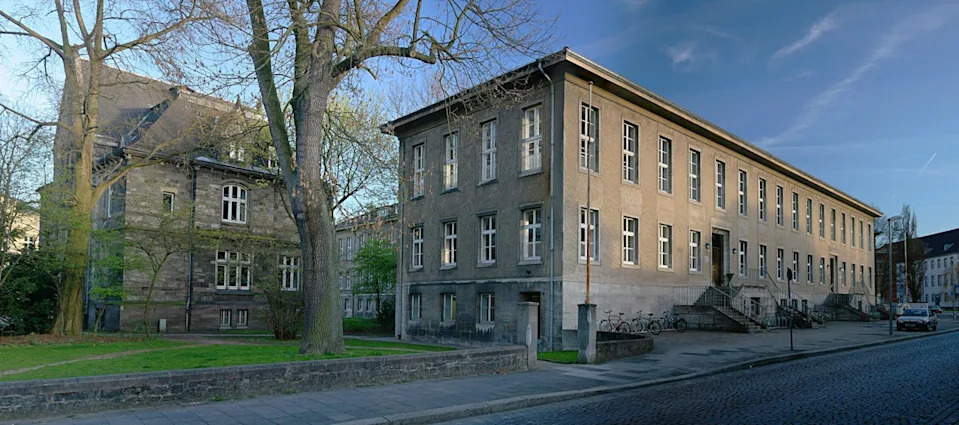
The University of Göttingen, seen here, was unable to hire Noether as a professor, so she taught courses under a male colleague’s name.Daniel Schwen/WikimediaCommons,CC BY-SA
Noetherian rings and the techniques Noether introduced are central across modern mathematics: they appear in commutative algebra, algebraic geometry and number theory, and continue to inform research and teaching a century later.
Exile, Mentorship and Legacy
From 1919 until 1933 Noether worked and published at Göttingen. In 1933 the Nazi government enacted laws expelling Jewish professors from university posts. Göttingen ordered six faculty, including Noether, to stop teaching immediately. Calm but realistic, she wrote that the situation was “much less terrible for me than it is for many others,” but she was effectively unemployable in Germany.
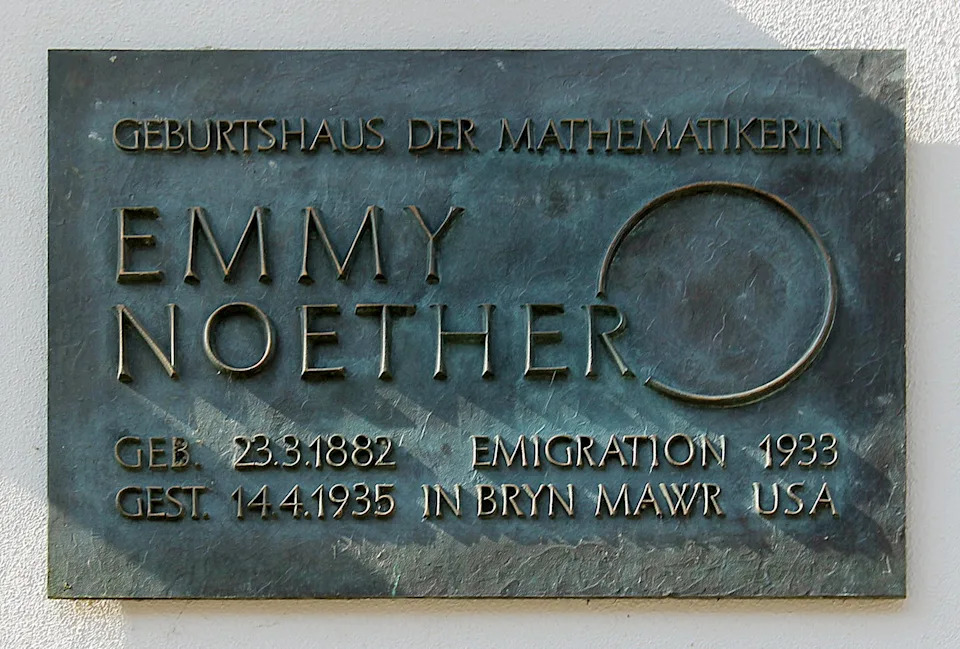
A plaque in her home town of Erlangen honors Emmy Noether and mentions her immigration to the U.S.Norman Rönz/WikimediaCommons,CC BY-SA
Support came from abroad: Bryn Mawr College in Pennsylvania offered Noether a professorship funded to help refugee German scholars. There she continued research and mentored younger women—supervising doctoral students and postdoctoral researchers—helping to cultivate the next generation of mathematicians.
Her time in the United States was short. In 1935 Noether underwent surgery to remove a tumor and died unexpectedly four days later. At her funeral Hermann Weyl compared her death to “the echo of a thunderclap.” In a career cut short, Noether transformed algebraic thought, broke barriers for women in mathematics, and left a legacy that continues to shape multiple fields.
Why It Matters
Noether combined deep conceptual thinking with elegant structural methods. Her work helped shift mathematics toward modern structural approaches: classifying large families of objects by shared properties rather than studying isolated examples. That move underpins much of contemporary pure mathematics and influences areas beyond, including theoretical physics.
Einstein: “A creative mathematical genius... who did not get the recognition she deserved.”
Hermann Weyl: At her funeral he likened her sudden death to “the echo of a thunderclap.”
Help us improve.