
3I/ATLAS is an interstellar comet first seen in July 2025 that sped between Earth and Mars in late 2025, exceeding 150,000 mph near perihelion. ESA’s JUICE spacecraft photographed the object last November, revealing an elongated, egg‑shaped nucleus surrounded by a gas envelope. Its activity so far resembles that of typical Solar System comets, but its origin remains unknown; only three interstellar objects have been recorded. Observers continue coordinated studies to learn whether its composition differs from comets formed around the Sun.
Interstellar Comet 3I/ATLAS Photographed by ESA’s JUICE — Egg‑Shaped Nucleus Racing at 150,000 mph
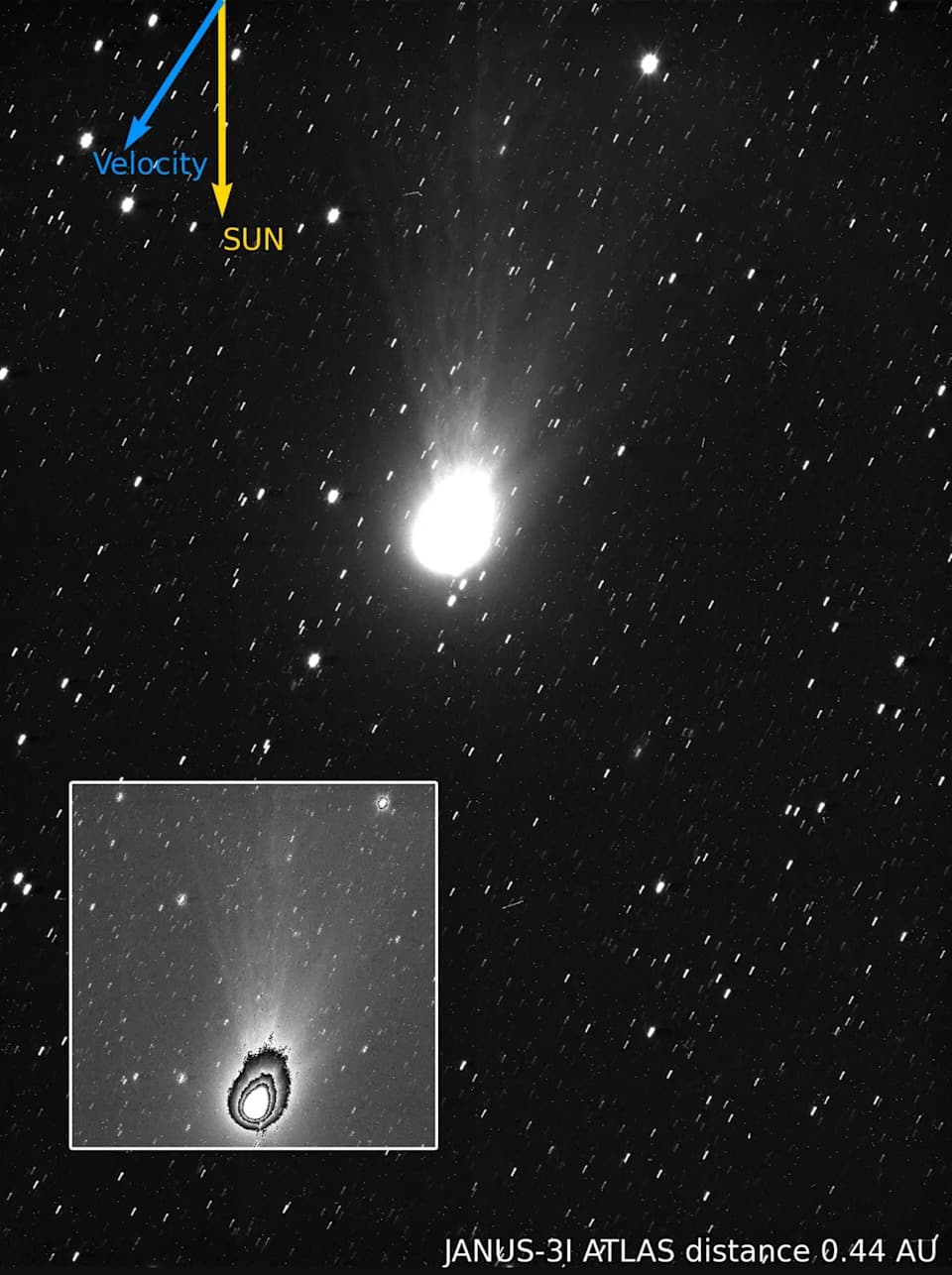
Comet 3I/ATLAS, as seen from ESA’s JUICE.Sign up for Today in Science, a free daily newsletter from Scientific American and join a community of science-loving readers.ESA/Juice/JANUS
In late 2025, a mysterious comet swept between the orbits of Earth and Mars and reached speeds exceeding 150,000 miles per hour at its closest approach to the Sun. The rare interstellar visitor, designated 3I/ATLAS, attracted global attention as astronomers and space agencies hurried to observe it and learn what it can reveal about material formed beyond our Solar System.
Last November, the European Space Agency’s Jupiter-bound probe, the Jupiter Icy Moons Explorer (JUICE), captured a striking image of the object. The photograph shows an elongated, almost egg-shaped body wrapped in a diffuse cloud of gas that partly obscures its nucleus, offering the best look yet at the comet’s shape and activity while it speeds through our cosmic neighborhood.
What the JUICE Image Reveals
JUICE’s observations indicate that 3I/ATLAS appears physically similar to many comets formed inside our Solar System: an active nucleus surrounded by a coma of gas and dust. The European Space Agency commented that, despite the comet’s interstellar origin, "its behaviour is completely in line with that expected from a ‘normal’ comet."
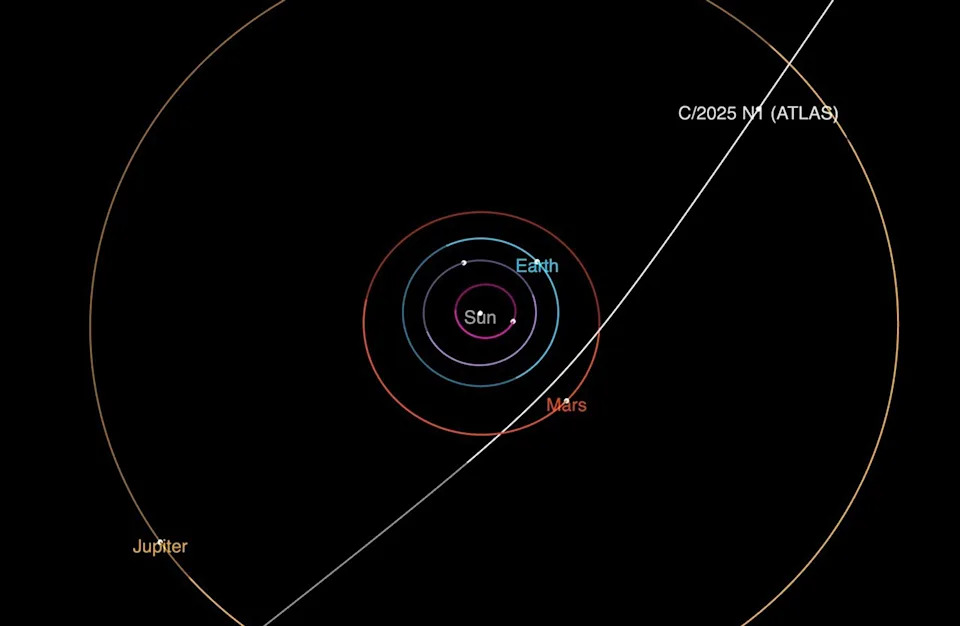
The trajectory of Comet 3I/ATLAS as it passes through the solar system.NASA/JPL-Caltech
"No one knows where the comet came from," said David Jewitt, director of the Institute for Planets and Exoplanets at UCLA. "You can’t project that back with any accuracy to figure out where it started on its path."
Scientists first detected 3I/ATLAS in July 2025, when it was already moving extremely fast—measured at about 137,000 miles per hour—and on a trajectory that indicated an origin outside the Solar System. Including 3I/ATLAS, only three interstellar objects have been observed passing through our system to date, making each new observation especially valuable.
Teams across the world continue to monitor 3I/ATLAS, combining ground-based telescopes and spacecraft imagery to study its composition, shape and activity. Because such visitors traverse the inner Solar System quickly, researchers compare every dataset to models of cometary behavior to test whether interstellar material differs chemically or physically from native Solar System comets.
As Jewitt summarized, "It’s like glimpsing a rifle bullet for a thousandth of a second"—a brief opportunity to study matter formed around another star.
Help us improve.





















