
Analysts say the U.S. operation that captured Venezuelan President Nicolás Maduro is a major setback for Iran’s influence in Latin America. Experts argue Venezuela served as a strategic hub for Tehran and allied groups — including alleged involvement in drug trafficking, terrorism facilitation, and military cooperation such as drone technology. Iran condemned the operation as a sovereignty violation, while analysts say the full impact depends on Maduro’s successor and how quickly Iran can adapt.
U.S. Operation That Captured Nicolás Maduro Is a Major Setback for Iran’s Regional Reach

Venezuelan President Nicolás Maduro (L) meets with Supreme Leader of Iran Ayatollah Ali Khamenei (R) within Maduro's visit for "Gas Exporting Countries Forum" (GECF) meeting in Tehran, Iran on November 23, 2015.
The Trump administration’s military operation that resulted in the capture of Venezuelan President Nicolás Maduro represents a significant setback for Iran’s influence in the Western Hemisphere, analysts say. The move has reverberated across Latin America and sparked debate among foreign-policy experts about Tehran’s remaining footholds in the region.
Regional Impact and Expert Views
Jason Brodsky, policy director at United Against Nuclear Iran (UANI) and a long-time observer of Venezuelan affairs, told Fox News Digital that Maduro’s removal was "a blow to Iran’s interests in the Western Hemisphere" because Maduro had been a longtime ally of Tehran under an anti‑Western political banner. Brodsky warned that the ultimate scale of the setback will depend on Maduro’s successor and how quickly a new government severs or preserves ties with Iran and its proxies.
“How much of a blow it will be will depend on who comes to power after Maduro. Iran and Hezbollah have used Venezuela as an operational hub for terrorism, drug trafficking, and power projection in Latin and South America.” — Jason Brodsky, UANI
Experts note that Tehran and its regional partners cultivated ties to Caracas that included intelligence cooperation, logistics and military technology exchanges — reportedly including drone collaboration. Those links, analysts say, allowed Iran and allied groups to extend their reach into the Americas.
Political Context
Observers point out that Iran’s regional position had already been strained by recent political shifts in Latin America, such as Bolivia’s election of a center‑right government that reestablished ties with Israel. The loss of Maduro, even though he was geographically distant, compounds longer‑term erosion of Iran’s so‑called "axis of resistance," which once included partnerships in Syria and Lebanon.
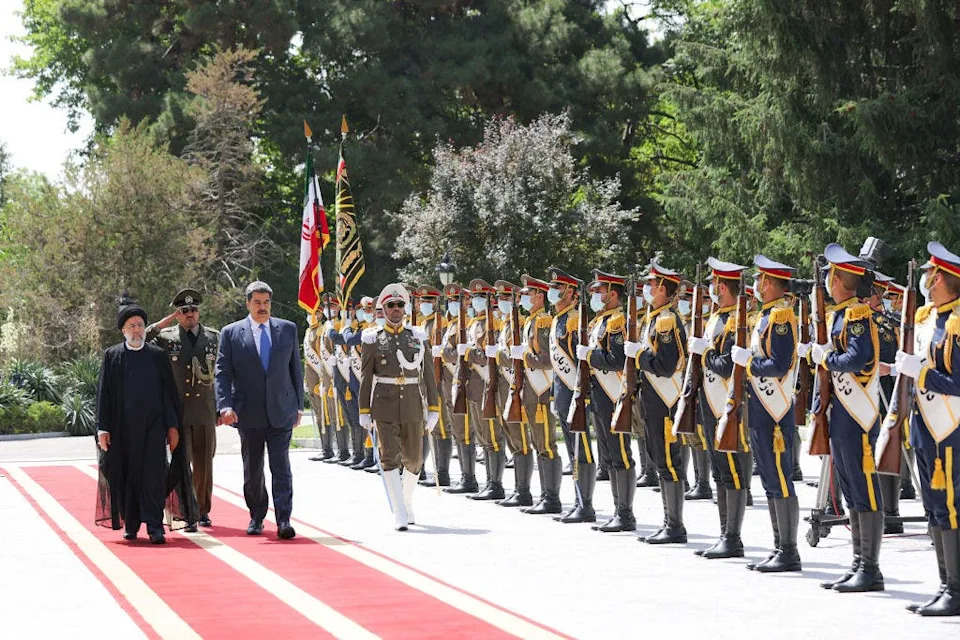
Ex-Iranian President Ebrahim Raisi (L) welcomes Venezuelan President, Nicolás Maduro (3rd L) at Sadabat Palace in Tehran, Iran on June 11, 2022. (Photo by Iranian Presidency / Handout/Anadolu Agency via Getty Images)
Potkin Azarmehr, a British‑Iranian analyst, said the fall of an allied leader tends to boost morale among Iranians protesting at home while undermining the clerical regime in Tehran. "This will seriously damage the regime’s revenues and resources," he told Fox News Digital, adding that some officials might consider defecting if Iran’s regional networks weaken further.
Official Reactions
The Iranian Foreign Ministry condemned the U.S. operation, calling it an attack and a "flagrant violation of the national sovereignty and territorial integrity" of Venezuela. U.S. officials framed the operation as part of a broader campaign to disrupt criminal networks tied to the Caracas regime and to demonstrate American resolve.
Outlook
Analysts say the long‑term consequences will hinge on who leads Venezuela next and whether Tehran can pivot to other partners or reestablish influence through covert channels. For now, the capture of Maduro is widely viewed by Western analysts as a tangible loss for Iran’s strategic posture in the Americas.
Reporting cited statements to Fox News Digital and commentary from policy experts. Fox News' Efrat Lachter contributed to earlier coverage.
Help us improve.





















