
Major brands leaned heavily into AI for advertising in 2025, but several high‑profile missteps provoked consumer and industry backlash. A Tracksuit survey of 6,000+ U.S. respondents found 39% negative sentiment toward AI ads and just 18% positive. Notable incidents included McDonald’s Netherlands pulling an AI holiday spot, Coca‑Cola’s inconsistent truck animation, Meta’s Advantage+ accidentally running AI swaps, H&M’s controversial digital twins plan, and AI‑generated models appearing in fashion ads for Guess and Vogue. These episodes highlight tensions around transparency, creative quality and potential job displacement.
When AI Misfired: Five High‑Profile Advertising Flops of 2025 — From Meta’s Granny Swap to Coca‑Cola’s Shape‑Shifting Trucks

Coca-Cola's holiday ad, featuring AI, got mixed feedback.YouTube/@Coca-Cola
Chief marketing officers at many of the world’s largest brands leaned heavily into artificial intelligence in 2025 — and the results were mixed. While AI proved valuable for ad buying and targeting, attempts to automate creative work led to a string of awkward, uncanny and controversial moments that sparked consumer and industry backlash.
A November Tracksuit survey of more than 6,000 U.S. consumers found overall sentiment toward AI‑generated advertising tilted negative: 39% viewed AI ads unfavorably, 36% were neutral and only 18% said they felt positive about brands using AI‑created content. Those numbers help explain why several high‑profile campaigns became lightning rods for criticism.
What Went Wrong — And Why It Matters
Across quick creative swaps, animated glitches and experiments to replace or augment human talent, the controversies raise recurring questions about transparency, ethics, creative quality and the impact on jobs — especially in sectors that rely on models, stylists and production crews.
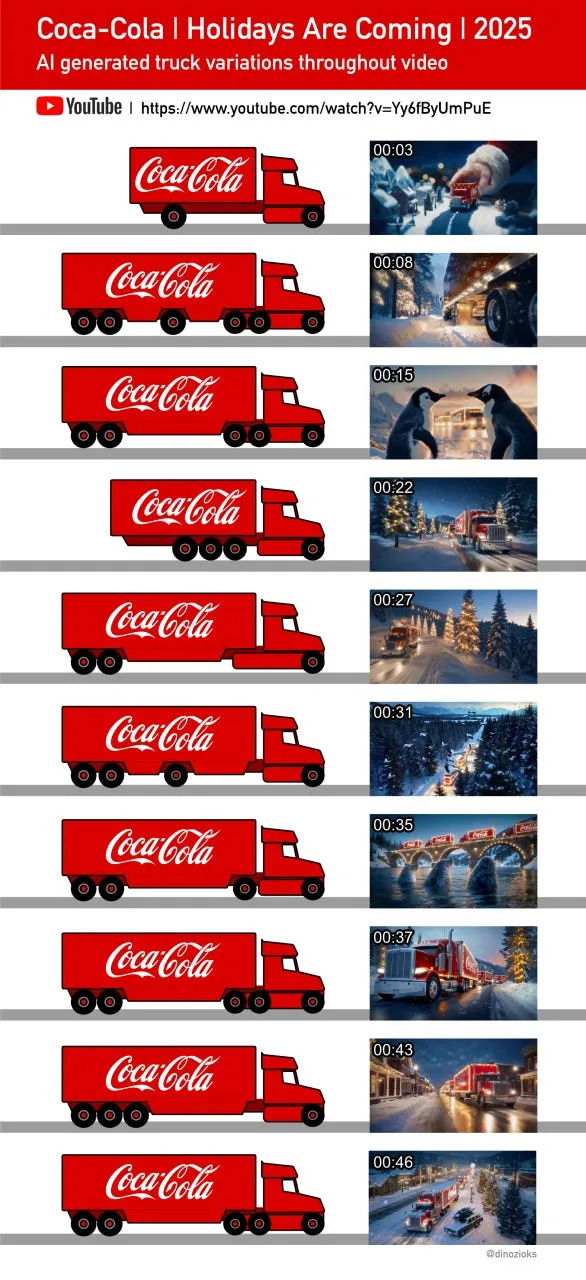
Dino Burbidge
McDonald’s Netherlands
McDonald’s Netherlands released a 45‑second AI‑generated holiday spot intended as a satirical montage of festive mishaps — from cooking disasters to falls at an ice rink and a sleigh stuck in traffic — positioning its restaurants as a refuge. Viewers called the commercial cynical and complained about its 'creepy' characters. After first disabling comments on the YouTube upload, McDonald’s removed the ad and said it respected that many customers view the holidays as 'the most wonderful time of the year.'
Coca‑Cola
Coca‑Cola released three AI‑generated holiday spots this year. One iteration revived the brand’s iconic caravan of trucks, but eagle‑eyed viewers noticed animation inconsistencies: truck counts appeared to change as the sequence progressed, even though wheel rotation issues from last year were fixed. The ad’s producers said they were exploring creative uses of AI; consumer testing firms offered mixed context — System1 gave the 2025 ads a top score of 5.9/5.9 for long‑term brand growth potential, while DAIVID reported higher‑than‑average attention and brand recall.
True Classic And Meta’s Advantage+ Image Toggles
Performance brand True Classic discovered that Meta’s Advantage+ suite had replaced a top‑performing creative — a millennial man in a fleece set — with an obviously AI‑generated elderly woman. Several advertisers told Business Insider that Meta’s platform can auto‑generate creative assets and that, in some cases, image‑generation toggles were switched to 'on' without their intent, causing budgets to run on AI‑created ads. Meta said advertisers can review generated images before campaigns run, but multiple advertisers reported unexpected automatic toggles.

H&M released images of its "digital twins" in July.H&M
H&M’s Digital Twins
H&M announced plans to create 'digital twins' for 30 models, enabling the brand to reuse or license likenesses across social channels and campaigns. The company said models would own the rights to their twins, but the initiative drew criticism from influencers and industry advocates who warned about consent, compensation and the potential displacement of makeup artists, stylists and other creative workers. H&M said it is exploring generative AI in 'thoughtful and responsible ways.'
AI Models In Fashion Ads: Guess, Vogue And Seraphinne Vallora
Readers noticed AI‑created models credited in advertising for Guess in the August 2025 issue of Vogue, produced by London‑based agency Seraphinne Vallora. The images, of fictional models 'Vivienne' and 'Anastasia,' prompted accusations that AI perpetuates unrealistic beauty standards and threatens creative jobs. The agency said its aim was to 'co‑exist' with traditional photography and modeling, while Condé Nast clarified that AI models had not appeared in Vogue's editorial content.
Broader Trends And Takeaways
Transaction data compiled by influencer‑marketing platform Collabstr shows brand partnerships with AI social accounts dropped about 30% in Jan–Aug 2025 versus the same period in 2024 — an early sign that advertiser appetite for purely AI‑driven talent may be waning. The controversies of 2025 underline that, while generative tools can boost efficiency and unlock new creative possibilities, they also demand stricter standards for transparency, quality control and fair treatment of creative workers.
Bottom line: AI can be a powerful tool in marketing, but missteps this year show brands must balance experimentation with oversight — and communicate clearly about how AI is used.


