
Four Palestine Action members are continuing a hunger strike while held in five UK prisons after alleged break-ins at an Elbit Systems facility and an RAF base. They demand better prison conditions, assurances of a fair trial and reversal of the UK decision to list the movement as a "terror" group; lawyers say they will sue the government. The article places the fast in historical context, summarising notable hunger strikes from Ireland, India, Palestine, Guantánamo and Robben Island to illustrate the tactic's moral and political force.
Palestine Action Hunger Strike: UK Prison Protests, Hospitalisations and a Century of Fasting

A pigeon flies past a mural supporting the Irish Republican Army in the Ardoyne area of north Belfast, September 9, 2015 [Cathal McNaughton/Reuters]
Four members of the activist group Palestine Action have vowed to continue a hunger strike while held across five prisons in the United Kingdom, despite serious medical warnings and repeated hospital admissions among fellow detainees. The arrests follow allegations linking some members to break-ins at the UK subsidiary of Israeli defence firm Elbit Systems in Bristol and at a Royal Air Force base in Oxfordshire. The protesters say their fast seeks improved prison conditions, guarantees of a fair trial and the reversal of a July decision that listed the movement as a "terror" group.
Current Situation
Palestine Action rejects charges including "violent disorder" and other accusations levelled against eight people in custody. Family members speaking to Al Jazeera report deteriorating health and multiple hospital transfers for some of the strikers. Lawyers for the detainees have said they plan to pursue legal action against the government. The case has drawn international scrutiny and weekly solidarity demonstrations by thousands of supporters across the UK.
Historical Context: Hunger Strikes as Political Protest
Hunger strikes have a long record as an extreme, non-violent method of protest, their power resting largely on the moral pressure they place on authorities and public opinion. Historical accounts trace the tactic to practices in ancient India and Ireland, where fasting at an offender's doorstep aimed to shame the offender publicly. In modern times, hunger strikes have been used repeatedly by political prisoners and activists around the world.
Ireland: Cork, The Dirty Protest and Bobby Sands
One early and consequential episode was the 1920 Cork hunger strike during the Irish War of Independence, when roughly 65 detainees at Cork County Gaol refused food while demanding release and recognition as political prisoners; Terence MacSwiney, the Lord Mayor of Cork, joined and died after 74 days, drawing international attention. Later, during the Troubles, jailed Irish republicans staged the 1980s "dirty protest" and the 1981 hunger strikes. Bobby Sands, elected to the British Parliament while imprisoned, died in that campaign along with nine others, prompting intense criticism of the UK government of the time.
India: Gandhi and Jatin Das
Mohandas Karamchand Gandhi used fasting as a political and spiritual tactic under the philosophy of Satyagraha. His fasts—usually accompanied by water or lime juice—aimed to mobilise public opinion and bind protest to moral self-discipline. A notable example came in February 1943, when Gandhi fasted for 21 days in protest after his arrest during the Quit India movement. Jatindra Nath Das, a revolutionary later known as Jatin Das, died in 1929 after a 63-day fast protesting prison treatment; his funeral drew massive public attention.
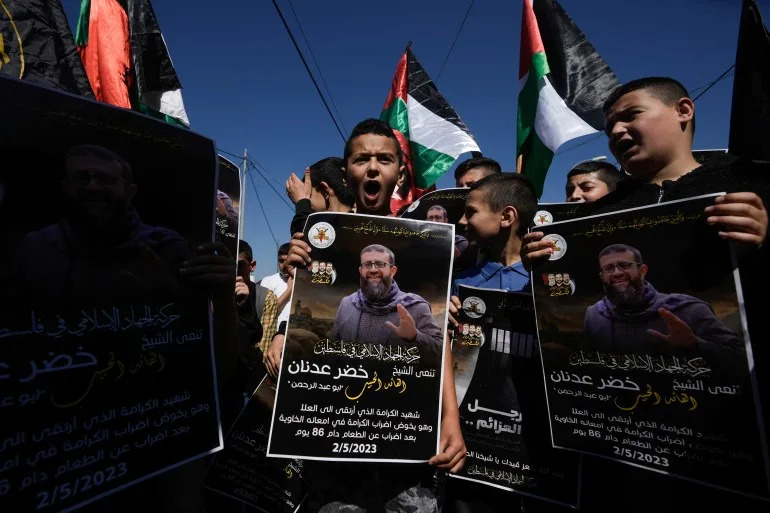
Palestinian kids wave their national flag and hold posters showing Khader Adnan following his death on May 2, 2023 [Majdi Mohammed/AP Photo]
Palestinian Prisoners: Khader Adnan
Palestinian detainees held—often without trial—in Israeli prisons have long used hunger strikes to protest detention conditions. Khader Adnan, a high-profile case, died on 2 May 2023 after an 86-day hunger strike. Adnan had been repeatedly detained over two decades and had used fasting repeatedly to protest administrative detention and alleged mistreatment; his 2012 66-day strike led to mass demonstrations and his temporary release.
Guantánamo Bay: Mass Strikes and Force-Feeding
After the opening of the Guantánamo Bay detention camp in 2002, detainees staged multiple waves of hunger strikes to protest indefinite detention and alleged mistreatment. In 2005, reports described mass strikes involving at least 200 detainees; authorities used force-feeding via nasal tubes for prisoners whose health had sharply declined. Former detainees such as Lakhdar Boumediene later described being restrained and force-fed under harsh conditions. Another major wave in 2013 involved more than 100 detainees, and legal challenges to force-feeding, such as the case brought by Jihad Ahmed Mustafa Dhiab, have largely been rejected by US courts.
Robben Island: Nelson Mandela and Collective Action
On Robben Island in South Africa, Black and Indian political prisoners staged a collective hunger strike in July 1966 to protest forced labour, reduced rations and harsh conditions. Nelson Mandela later recalled that authorities tried to break the strike with improved rations but continued harsh treatment in prison work. A notable turning point came when some prison wardens joined protests over pay and food, prompting negotiations; the episode lasted about a week. In 2017, South African figures staged a one-day fast in solidarity with Palestinian hunger strikers.
Legal, Medical and Ethical Issues
Hunger strikes raise complex ethical and legal questions. Medical professionals warn about severe, sometimes irreversible harms from prolonged fasting, and debates over force-feeding pit medical ethics and state obligations against detainee autonomy. Lawyers for hunger-striking detainees often pursue remedies in domestic and international courts, while governments balance security considerations, prison discipline and legal duties of care.
Why These Protests Matter
Hunger strikes convert private suffering into public pressure and can catalyse wider political solidarity. They do not guarantee policy change, but they frequently force renewed scrutiny of detention practices, legal processes and treatment of political dissidents. The Palestine Action case sits within this long tradition, and its outcome will likely influence public debate on protest rights, prison conditions and the UK government's recent designation of the group.
What to Watch: developments in the health of the strikers, any legal action filed by their lawyers, and official responses to demands for improved prison conditions and fair trial guarantees.


