
Michaela "Michi" Benthaus, 33, who became paralyzed from the waist down after a 2018 mountain-biking accident, will become the first wheelchair user to fly on Blue Origin's New Shepard suborbital mission from West Texas. Blue Origin retrofitted facilities, added transfer benches and refined a leg restraint tested with AstroAccess so Benthaus can participate independently and safely. Independent studies at NASA's Johnson Space Center show people with lower-limb amputations can evacuate capsule mockups quickly, supporting broader inclusion in crewed missions. The flight aims to expand accessibility and spotlight spinal cord injury research through fundraising for Wings for Life.
Michaela "Michi" Benthaus To Become First Wheelchair User On Blue Origin Suborbital Flight

Michaela "Michi" Benthaus poses inside a mockup of the New Shepard capsule. Benthaus is scheduled to launch on Blue Origin's next suborbital flight from West Texas. She will be the first person who uses a wheelchair to go to space. (Courtesy of Michaela Benthaus)
Michaela "Michi" Benthaus, a 33-year-old German engineer paralyzed from the waist down after a 2018 mountain-biking accident, will fly on Blue Origin's New Shepard suborbital rocket from West Texas, becoming the first person who uses a wheelchair to travel to space. The mission is a milestone in efforts by commercial space companies to broaden who can access space.
Background
Benthaus grew up loving high-intensity sports such as parkour and downhill mountain biking. In September 2018, a jump on a downhill trail in Austria left her with a broken back and permanently paralyzed from the waist down. She completed a bachelor's degree in mechatronics and went on to earn a master's in aerospace engineering. Benthaus has worked with the European Space Agency studying Mars' atmosphere and developing guidance, navigation and control algorithms for landing spacecraft and boosters.
How This Flight Came About
Benthaus' path to Blue Origin began in 2024 at a drone competition near Munich, where Hans Koenigsmann — an early SpaceX executive and longtime aerospace figure — invited her to participate and prompted the question she often asked: "Can people like me be astronauts too?" Koenigsmann and Blue Origin evaluated her candidacy and concluded she could safely fly alongside him.
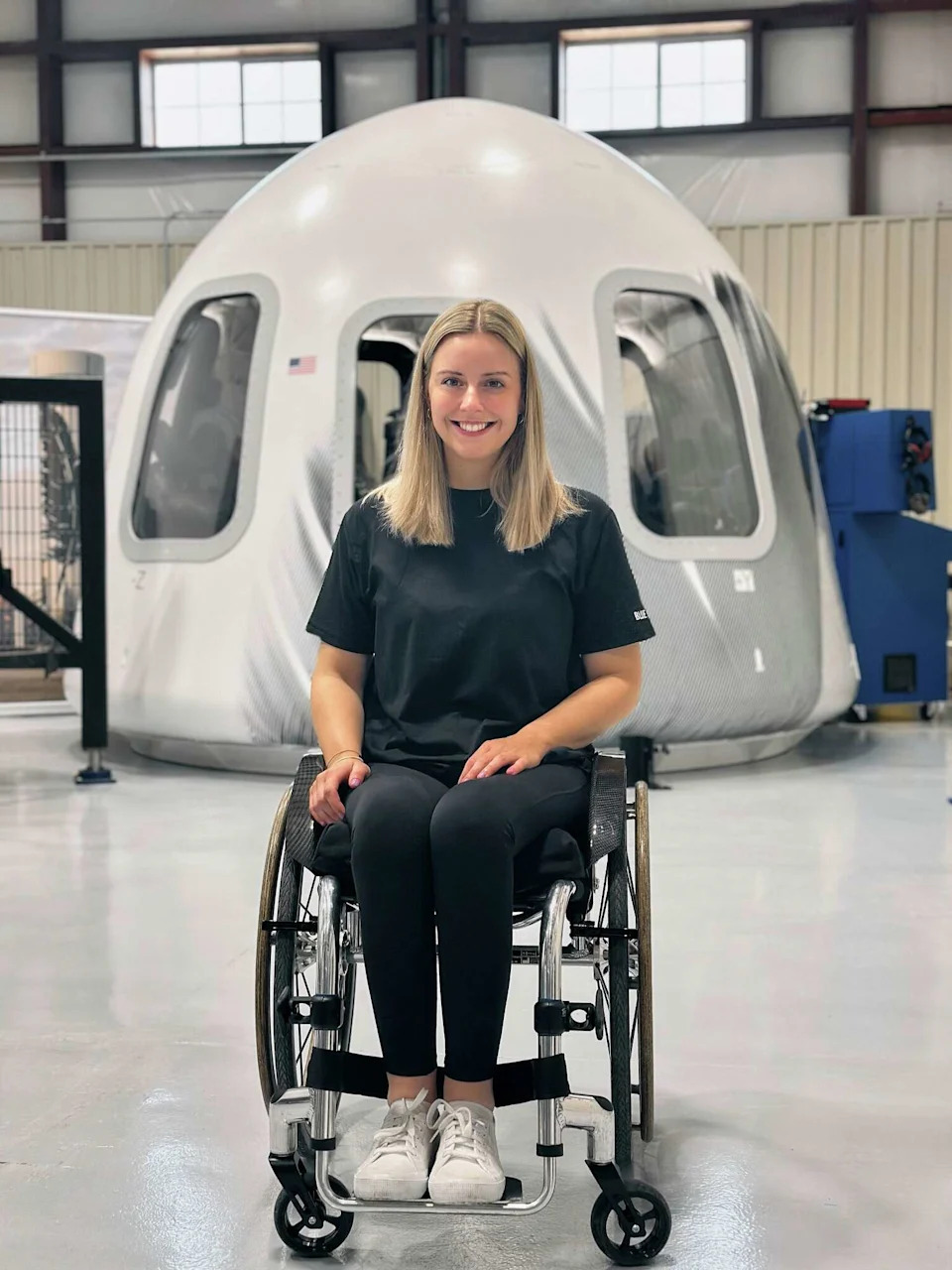
Michaela "Michi" Benthaus poses in front of a mockup of the New Shepard capsule. Benthaus is scheduled to launch on Blue Origin's next suborbital flight from West Texas. She will be the first person who uses a wheelchair to go to space. (Courtesy of Michaela Benthaus)
Vehicle And Mission Profile
Blue Origin's New Shepard is a 63-foot-tall suborbital vehicle that provides roughly a 10-minute flight experience, including several minutes of weightlessness and a view of Earth's curvature without entering orbit. Since 2021 New Shepard has carried about 80 passengers; Virgin Galactic has flown roughly 30 customers (excluding pilots) on suborbital missions, and non-NASA SpaceX missions have sent about 25 people into orbit.
Accessibility Modifications And Training
Blue Origin reviewed the entire customer experience to enable Benthaus to participate as independently as possible. Changes included lowering thresholds and adding an accessible shower in the Airstream trailers where crew sleep, building transfer benches to bridge the spacecraft hatch, and ensuring pad access (the launch pad already had an elevator). The company refined a leg restraint — originally tested by Benthaus with AstroAccess on a Zero-G airplane flight — so her legs remain comfortable and controlled in microgravity.
In-Flight Experience
During weightlessness, Benthaus will be able to unbuckle and float inside the capsule; the strap will stabilize her legs while she moves around. Crew trainer Jake Mills emphasized that fine hand control is preferable to using legs in zero gravity, which can propel someone unexpectedly across the cabin.
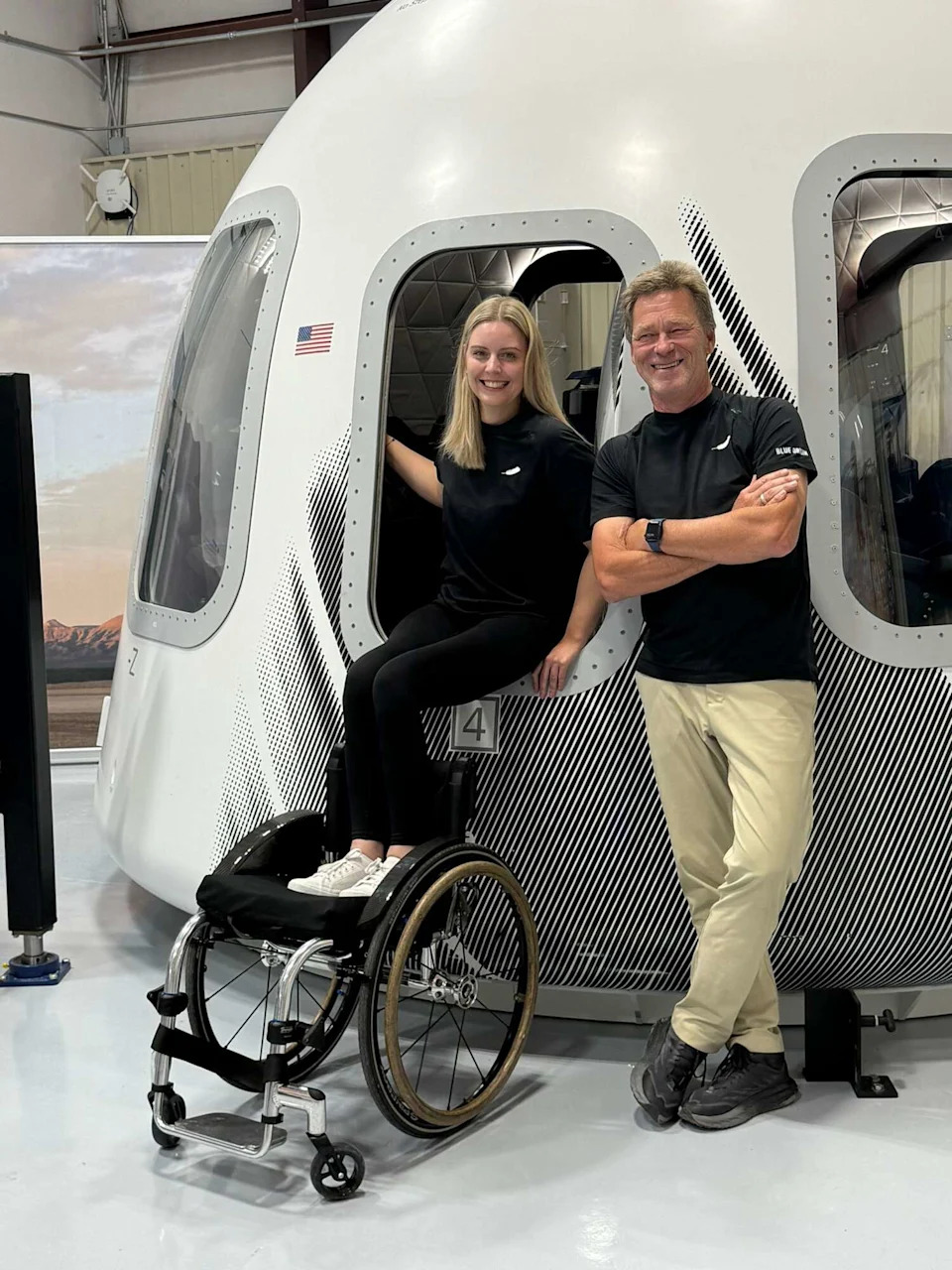
Michaela "Michi" Benthaus, left, and Hans Koenigsmann pose in front of a mockup of the New Shepard capsule. Benthaus and Koenigsmann are scheduled to launch on Blue Origin's next suborbital flight from West Texas. Benthaus will be the first person who uses a wheelchair to go to space. Koenigsmann, one of the earliest SpaceX employees who became the company's vice president of build and flight reliability, will fly with her. (Courtesy of Michaela Benthaus)
Safety, Evacuation And Research
Emergency egress is a primary concern for mission planners. Benthaus and Blue Origin rehearsed procedures for pad contingencies: she can slide to the hatch, be assisted into a wheelchair by a crewmate, or be moved with slings if elevators are unavailable. Independent research led by biomechanics professor Jesse Rhoades at the University of North Dakota timed able-bodied participants and veterans with prosthetic legs exiting capsule mockups at NASA's Johnson Space Center. Published this year in Acta Astronautica, the study found participants with below-knee amputations were only a few seconds slower than able-bodied peers; all tested participants exited in under a minute, indicating mobility impairments need not materially slow emergency egress.
Broader Impact
Blue Origin sees Benthaus' flight as a learning opportunity to expand functional requirements and accessibility for future customers. The company has collaborated with AstroAccess and sought feedback from employees with disabilities to improve procedures for a wider range of needs. Benthaus is also using the mission to raise funds and awareness for Wings for Life, a foundation supporting spinal cord injury research.
"Even as an able-bodied person, it's kind of out of reach to become an astronaut," Benthaus said. "So we're taking a first step here, which is a huge first step."
This mission represents a concrete step toward diversifying who can go to space, demonstrating that with thoughtful design and preparation, people with disabilities can safely participate in suborbital flights and help broaden the aerospace community.


