
The article tells the story of Mike Lawson’s 1993 plan to place a mile-long mylar billboard in low Earth orbit that would reflect sunlight to form a moon-sized advertisement visible worldwide. Strong opposition from astronomers, environmentalists, and the public — combined with technical limits and loss of advertiser funding — sank the project. U.S. policy and a U.N. resolution followed, but modern startups like StartRocket have revived the debate about space advertising, debris risk, and whether the night sky should remain free from commercial messages.
The Space Billboard That Almost Launched: How a 1993 Plan Nearly Turned the Night Sky Into Ad Space
02:00 AM, 12/11/2025

In the 1990s, space was for sale.
In 1993 aerospace entrepreneur Mike Lawson proposed a startling idea: a mile-long mylar billboard in low Earth orbit that would reflect sunlight to create a moon-sized advertisement visible around the globe. The plan captured headlines, provoked scientists and activists, and ultimately collapsed amid technical limits, public outrage, and the loss of advertiser support — but the debate it started continues today.
Lawson's Proposal
Lawson's company, Space Marketing Inc. (SMI), outlined a 1996 launch to place a tightly wound mylar package roughly 180 miles above Earth. Once deployed, the mylar would unfurl into a sheet up to a mile long and a quarter-mile tall, held taut by inflatable mylar tubes. Small mirrors attached to the rig would concentrate sunlight onto the sheet, producing a bright, moon-sized image in the sky. Lawson acknowledged the display would be low resolution — best suited to a single large logo — and said it would be visible for about 10 minutes per day over any given location.
Reaction From Scientists, Activists, And The Public
The Associated Press reported the proposal and said NASA found no obvious technical objection at the time. Lawson told a San Francisco Examiner reporter that 'it’s very feasible.' Still, the idea generated intense backlash. Astronomers such as Carl Sagan called the billboard 'an abomination,' warning it would add severe light pollution and could prevent ground-based optical astronomy in affected areas. Environmentalists and many members of the public objected to the commercialization of the night sky and the loss of shared cultural and natural heritage.
'A lot of people want to look at the night sky and not see an ad for soda,' said space-law scholar Joanne Irene Gabrynowicz.
SMI’s Defense And The Project’s Demise
SMI framed the project as primarily an environmental monitoring mission: the inflatable platform would carry instruments to track atmospheric ozone, they said, while advertising revenue would offset costs. The company estimated platform costs at $15–$30 million and reportedly proposed charging roughly $1 million per day for ad space. They also promised the banner would remain in orbit only about 30 days before burning up on reentry, while the science module would continue operating for months.
Despite these assurances, SMI faced technical and financial hurdles. Low-cost launch options were far less accessible in 1993 than today, and critics warned that existing orbital debris could quickly damage or destroy a thin reflective sheet. Public outrage and organized protests frightened off potential advertisers, and without funding the project could not proceed. Within a year the plan had collapsed.
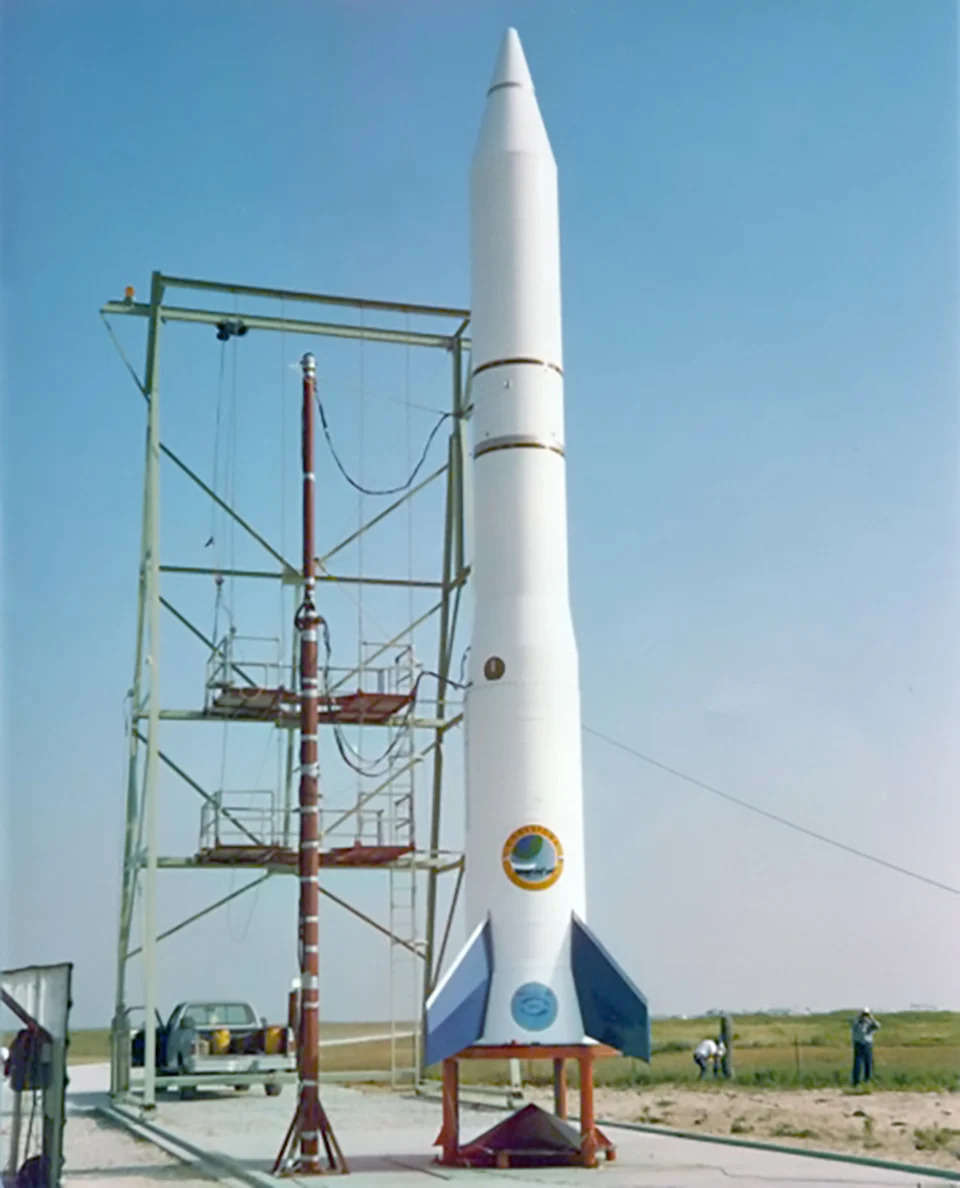
The Conestoga, shown here in a photo taken in Matagorda Island in Texas, was the first-ever privately-funded launch rocket model.Image:Eric Grabow – Space Vector Corporation/ CC BY-SA 3.0
Policy Response And Legal Limits
The controversy spurred lawmakers to act. During 1993 hearings Representative Susan Molinari quipped about the absurdity of ads beside the moon or sun and argued for restrictions. U.S. regulators adopted policies that effectively deny launch licenses for 'obtrusive' space advertising; President Bill Clinton signed a related law in 2000. A United Nations resolution expressing similar concerns followed in 2001, though international measures had less enforcement power. Legal experts note the term 'obtrusive' was never precisely defined, leaving some regulatory gaps.
Aftermath And Later Attempts
Lawson did not leave space promotion entirely. He later partnered on stunts and commercial efforts with Russian missions — most famously helping Pizza Hut deliver a six-inch pizza to the International Space Station in 2001 — and eventually moved into other ventures such as blimp technology.
The idea resurfaced in 2019 when Russian startup StartRocket proposed a modern approach using a constellation of CubeSats, each acting as a reflective 'pixel' to form simple images at dawn and dusk. StartRocket claimed it could offer orbital ad space at prices below a Super Bowl spot, and by 2022 published a feasibility study. Pepsi denied any planned campaign; geopolitical disruption slowed StartRocket’s timeline, but the company later said it was assembling satellites and seeking investors as of 2025.
Ongoing Debate
Lower launch costs and more commercial capital make billboard-like projects more technically and financially plausible today than in 1993. Critics — led by astronomers and environmental advocates — warn that increasing space traffic raises debris risks and that bright orbital displays would interfere with scientific observations and degrade the night sky for everyone. Proponents point to potential revenue and technical creativity, but many experts argue that space should be reserved for activities that uniquely benefit humanity.
Conclusion: The 1993 space-billboard episode remains a case study in how technology, law, public values, and commercial incentives collide. Although Lawson's mylar banner never launched, the ethical and regulatory questions it raised are increasingly urgent as private companies expand activities in low Earth orbit.
Similar Articles

Space Junk Could Trigger Global Communications Crisis, Experts Warn
Orbital debris threatens vital satellite networks. NASA counts more than 25,000 objects larger than 10 cm and roughly 500,000...

NASA Study Warns Satellite ‘Swarms’ Could Contaminate 1 in 3 Hubble Images
A NASA-led study led by Alejandro Serrano Borlaff warns that planned satellite constellations could contaminate roughly one i...

Space Junk Needs Systemic Fixes — Reuse, Repair and Recycle in Orbit
The University of Surrey urges a systemic approach to orbital debris: use less material, design satellites for repair or cont...

Surging Satellite Constellations Could Streak Up To 96% Of Space Telescope Images
Simulations indicate that planned satellite megaconstellations could leave streaks on 40–96% of images from some low-Earth-or...

NASA Warns: Satellite Constellations Could Spoil Nearly Half of Hubble’s Images
NASA simulations indicate that rising numbers of internet satellites in Low Earth Orbit could compromise a large share of spa...

Former NASA Chief: U.S. Should Restart Artemis Moon Plan or Risk Losing Lunar Leadership to China
Former NASA administrator Michael Griffin told a congressional hearing on Dec. 4 that the current Artemis lunar-landing archi...

Bezos: Move Heavy Industry to the Moon — "There Is No Plan B" for Earth
Jeff Bezos told the DealBook Summit that to save Earth we should eventually relocate heavy industry — including factories and...

560,000 Satellites Could Contaminate Most Space-Telescope Images, NASA Study Warns
A Nature study warns that if all current satellite plans proceed, about 560,000 satellites could be in orbit by the late 2030...

This Week In Space — Episode 188: Could Jared Isaacman Lead NASA?
Episode 188 of This Week In Space focuses on Jared Isaacman's second Senate confirmation hearing as President Trump's nominee...

From Debris to Design: Scientists Map a Circular, Self‑Sustaining Space Economy
Launches are rising — 2025 could see about 300 orbital missions — increasing both congestion and emissions. A paper in Chem C...

SpaceX Plans Post‑Midnight Falcon 9 Launch — How and Where to See It From Arizona
SpaceX plans a Falcon 9 launch from Vandenberg Space Force Base on Wednesday, Dec. 10, with a four‑hour window opening at 12:...

Scientists Urge a 'Circular' Space Economy — Reuse Materials, Recover Debris and Protect Orbits
Scientists call for a circular space economy to curb waste and protect Earth and orbit. Their report in Chem Circularity warn...

ESCAPADE’s Bold Gamble: How Low‑Cost Mars Missions Trade Safety for More Science
ESCAPADE, launched on Nov. 13, 2025 aboard Blue Origin’s New Glenn, sends twin small probes to map Mars’ magnetic field and s...

Google’s Project Suncatcher: Powering AI from Solar Satellites — But at What Cost?
Project Suncatcher proposes running data centers from fleets of solar-powered satellites to meet AI’s growing energy needs. W...

Mysterious Glow Over Texas Explained: SpaceX Launch Sparks UFO Reports From Houston to Dallas
Bright, cloud-softened light startled observers in Houston and beyond Monday evening. Witnesses reported a pulsing, foggy glo...