
V Sagittae is a luminous binary about 10,000 light-years away in Sagitta, composed of a white dwarf accreting mass from a companion every 12.3 hours. New 120-day spectral observations with the VLT's X-Shooter reveal chaotic accretion, supersoft X-ray emission, and a circumbinary gas disk. Researchers say a naked-eye nova could occur in the coming years, and a final merger may produce a daytime-visible supernova possibly as early as 2067 — though timing remains uncertain.
V Sagittae Could Explode Into a Daytime-Visible Supernova — What to Expect
01:38 PM, 12/10/2025

The star system GK Persei, home of an infamous nova explosion, seen by the Chandra X-ray telescope. An even brighter nova is due to erupt from V Sagittae in the next century. | Credit: NASA Goddard
An extraordinarily luminous binary star system, V Sagittae, may be headed for a spectacular ending: a thermonuclear explosion bright enough to be seen from Earth in daylight, according to recent research.
What V Sagittae Is
V Sagittae sits about 10,000 light-years away in the small constellation Sagitta. The system pairs a white dwarf — the dense remnant of a sun-like star — with a heavier stellar companion that is donating mass at an unusually high rate. The two stars orbit each other every 12.3 hours and are slowly spiraling together.
New Observations And What They Reveal
An international team led by the University of Turku used the X-Shooter spectrograph on the European Southern Observatory's Very Large Telescope (VLT) to collect spectra of V Sagittae over a 120-day campaign. Spectral analysis lets astronomers identify chemical signatures and measure velocities, helping to constrain the system's properties.
Earlier work from 1965 suggested component masses of roughly 0.7 and 2.8 solar masses, but the new study finds that conclusion controversial. Based on the short orbital period and current data, the team argues the total mass of the system may be below about 2.1 solar masses, with each star nearer to ~1 solar mass. However, the authors emphasize that the system's wildly variable light and fast outflows complicate direct measurements of the individual stars' orbital motions and masses.
Unusual Activity: Supersoft X-Rays, Chaotic Accretion, And A Gas Halo
V Sagittae has been identified as the brightest known supersoft X-ray source (SSS) in the Milky Way. In these systems, steady thermonuclear burning occurs on the white dwarf's surface as it accretes matter from its companion. V Sagittae is roughly 100 times brighter than comparable variable systems even in relatively faint phases.
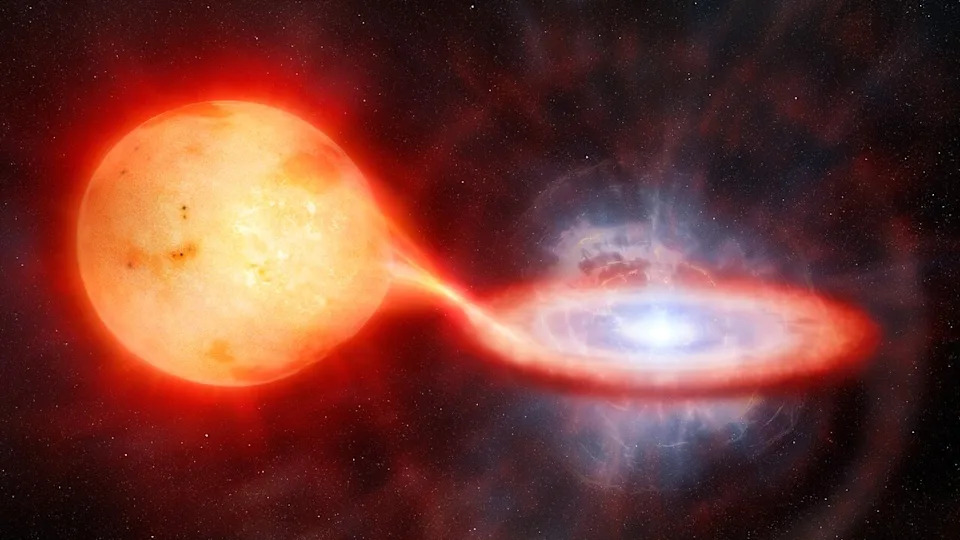
An illustration of a nova: an explosion that occurs when a white dwarf star siphons too much material from its larger stellar companion. | Credit: International Gemini Observatory/NOIRLab/NSF/AURA/M. Garlick, M. Zamani
Observers recorded dramatic, unpredictable changes in the speed of material in the white dwarf's accretion disk — sometimes shifting within days — and signs that some matter has been expelled to form a circumbinary ring or halo. The team estimates this circumbinary disk may extend roughly two to four times the stars' separation.
Nova First, Then Possibly A Supernova
The researchers forecast that a nova outburst could occur in the coming years: when a white dwarf accreting material ignites thermonuclear burning on its surface and ejects accumulated layers. Classical novae do not destroy the white dwarf and can recur on long timescales.
After one or more nova events, the ongoing orbital decay and extreme mass transfer may culminate in a merger and a final explosion. The team and previous studies suggest that this merger could produce a supernova luminous enough to be visible in daylight from Earth. A 2020 study from Louisiana State University extrapolating the system's shrinking orbital period estimated the merger could happen as early as 2067, though the timing is highly uncertain.
“If the [observed] period decline continues then it must happen, but stellar evolution is hard to predict exactly, so that might easily change,”
— Phil Charles, professor emeritus of astronomy, University of Southampton
What To Watch For
A naked-eye nova would be an exciting precursor and could arrive within years. Professional and amateur astronomers are advised to monitor Sagitta for brightening events and evolving spectral signatures. While a daytime-visible supernova would be rare and spectacular, the exact timeline and outcome remain uncertain because of complex accretion physics and observational ambiguities.
Bottom line: V Sagittae is one of the Milky Way's most intriguing binaries — bright, chaotic, and potentially on the verge of explosive changes that could produce an unforgettable celestial show within decades.
Similar Articles

Twin White Dwarf Eruptions Reveal Staged, Multi-Phase Novae — Challenging Long-Held Models
High-resolution interferometric images of two 2021 novae (V1674 Herculis and V1405 Cassiopeiae) reveal that white-dwarf erupt...

First-Ever View of a Supernova's Birth: VLT Captures Olive-Shaped Explosion
Quick summary: Using ESO’s Very Large Telescope, astronomers captured a supernova just 26 hours after discovery (29 hours aft...

Astronomers Capture a Supernova Shockwave Bursting Through a Star — Earliest Detailed View of Explosion Geometry
Using the VLT and spectropolarimetry, astronomers captured the earliest detailed view of a supernova shockwave as it burst th...

Astronomers Capture the First Moments of a Nearby Supernova — An Olive-Shaped Blast Reveals New Clues
Researchers rapidly mobilized the Very Large Telescope after the April 10, 2024 detection of supernova SN 2024ggi in a nearby...

Astronomers Catch a Newborn Supernova Just Hours After Its Explosion
A team observed supernova SN 2024ggi within hours of its explosion, using the ESO’s VLT about 26 hours after first detection ...

Two Stars in a Death Spiral Put Einstein’s Gravity to the Test
ZTF J2130 is a compact binary roughly 4,000 light-years away made up of a white dwarf and a subdwarf completing an orbit in u...

Astronomers Capture First Moments of a Supernova — Olive‑Shaped Explosion Sheds New Light
Key points: ESO's Very Large Telescope captured the earliest phase of a supernova from a 15‑solar‑mass red supergiant in NGC ...

SVOM Captures One of the Most Distant Star Explosions — A 13‑Billion‑Year Cosmic Flash
SVOM detected a powerful gamma‑ray burst on March 14 originating from a star roughly 100 times the Sun's mass that exploded a...

Astronomers Map a Supernova's Shock Breakout — First Direct Measurement of Explosion Geometry
Key discovery: For the first time, astronomers directly measured the shape of a supernova's shock front during shock breakout...

Faint X‑Ray 'Scream' From 3 Billion Years Ago May Be a Star Torn Apart by Two Black Holes
An international team reports decades of monitoring of XID 925 , a very faint X‑ray source first seen in 1999 in Chandra's De...

Black Hole Tears Apart a Star — And Triggers the Longest Gamma-Ray Burst Ever Recorded
On July 2 astronomers recorded GRB 250702B , a seven-hour gamma-ray burst preceded by an unusual X-ray brightening a day earl...

Astronomers Capture Star’s Final Seconds, Reveal Hidden Shape of Supernova SN 2024ggi
Key points: A team called the “Texas Mafia” directly observed the instant a blast broke through the surface of star SN 2024gg...

First Map of a Supernova’s Early Shape Reveals an Olive‑Shaped, Asymmetric Blast
Rapid VLT follow‑up captured the first light from supernova SN 2024ggi, allowing astronomers to measure the explosion’s early...

Supermassive Black Hole in NGC 3783 Launches Ultra‑Fast Winds After X‑ray Flare
A coordinated observation by ESA’s XMM‑Newton and the JAXA‑led XRISM captured an unprecedented ultra‑fast wind from the super...

Sharper Black-Hole Images Could Put Einstein to the Test — New Study Sets Percent-Level Targets
The Event Horizon Telescope's images of M87* (2019) and Sagittarius A* (2022) enable new tests of gravity at the event-horizo...