The New World screwworm—whose larvae feed on living flesh—has reappeared in parts of the U.S., with recent detections in Texas and New Mexico. UC San Diego and county partners created a restricted dashboard that combines confirmed detections, environmental indicators and news reports to map county-level risk. The USDA is leading eradication efforts using sterile-insect releases, pesticides and quarantines while evaluating a genetically modified all-male strain; researchers are developing additional genetic control tools.
Flesh‑Eating Screwworm Returns to U.S.; New Tracking Dashboard and Emergency Eradication Effort Launched
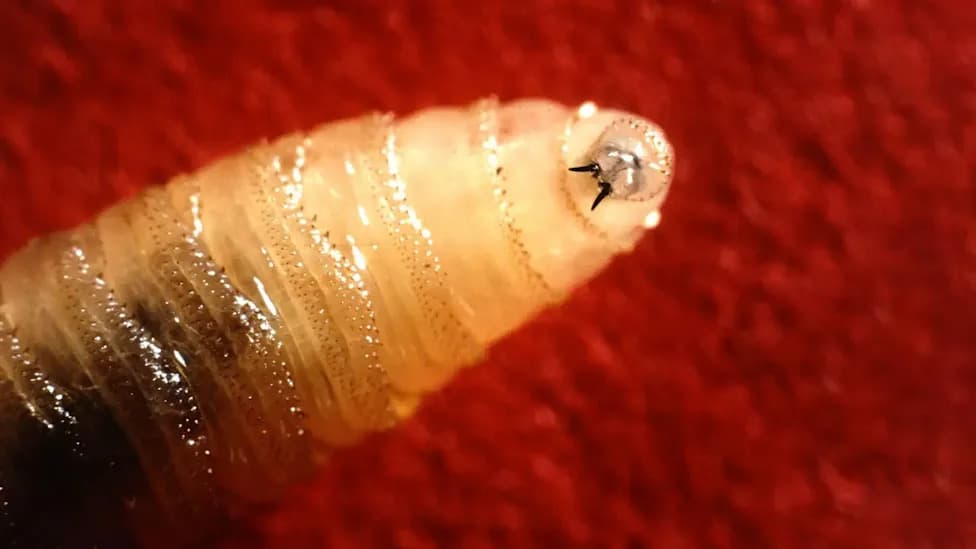
New World screwworm, a flesh-eating parasite once eradicated from the U.S., is moving north again | ©Image Credit: USDA
The New World screwworm— a parasitic fly whose larvae consume living flesh—has been detected again in parts of the United States after decades of absence. Recent confirmed finds in Texas and New Mexico have prompted coordinated surveillance and eradication efforts to protect livestock, wildlife, pets and, rarely, people.
What Is the New World Screwworm?
New World screwworm (Cochliomyia hominivorax) is a fly species whose larvae hatch from eggs deposited in open wounds or natural body openings and burrow into living tissue. Feeding larvae enlarge wounds, increase the risk of secondary infection, and can cause severe injury or death in untreated cases. Human infections are possible but uncommon.
Where It’s Been Detected
After being eliminated from the continental U.S. in the mid-20th century, the pest has been confirmed in border states including Texas and New Mexico. Adult flies can travel miles in search of hosts, and infected animals—livestock, pets, birds and wildlife—can also carry infestations into new areas.
How Officials Are Tracking It
Researchers at UC San Diego, in partnership with the County of San Diego Health and Human Services Agency, have developed a restricted dashboard that maps screwworm risk at the county level. Modeled like a weather map, the tool combines confirmed detections with environmental indicators that favor fly survival and larval development, and even incorporates vetted news reports as an auxiliary data stream. Access is currently limited to public health and animal-health partners, with a public version planned for the future.
Why It’s Dangerous
Unlike contagious respiratory infections, screwworm does not spread person-to-person. Infestation requires eggs or larvae to enter an open wound or mucous membrane. If larvae are not removed and wounds are not treated, tissue destruction and secondary bacterial infections can follow, sometimes with fatal outcomes in animals.
How the U.S. Eliminated Screwworm Before
In the 1950s and 1960s, screwworm caused severe economic losses—estimates for the U.S. Southwest ranged from roughly $50 million to $100 million per year at the time. The United States led a massive eradication campaign using the sterile insect technique (SIT): millions of male flies were sterilized with radiation and released so matings produced no offspring. Repeated releases drove populations to collapse, eventually confining the pest’s established range south of the Panama Canal.
Current Response and Next Steps
The U.S. Department of Agriculture (USDA) is coordinating current eradication work, combining renewed sterile-insect releases with targeted pesticides, quarantine measures to limit animal movement, and active surveillance. Officials are also pursuing Environmental Protection Agency review of a genetically modified, all-male strain currently in field trials. Meanwhile, UC San Diego teams are researching additional genetic tools that could expand control options if needed.
Practical Advice for Animal Owners
Animal owners and veterinarians are advised to routinely check animals for wounds or unusual behavior, promptly clean and treat any wounds, and report suspected screwworm cases to local animal-health authorities or the USDA. Rapid detection and treatment are critical to preventing spread and reducing harm.
Sources: UC San Diego, County of San Diego Health and Human Services Agency, U.S. Department of Agriculture, CDC-funded Resilient Shield initiative.
Help us improve.