
Iran's judiciary has executed a man accused of spying for Israel, the court-run Mizan news agency reported. Authorities say he passed intelligence on military facilities and personnel. Rights groups warn that vaguely worded charges like espionage and blasphemy are frequently used to justify executions, and monitors report a sharp rise in Iran's execution totals.
Iran Executes Man Accused of Spying for Israel as Rights Groups Sound Alarm on Rising Executions
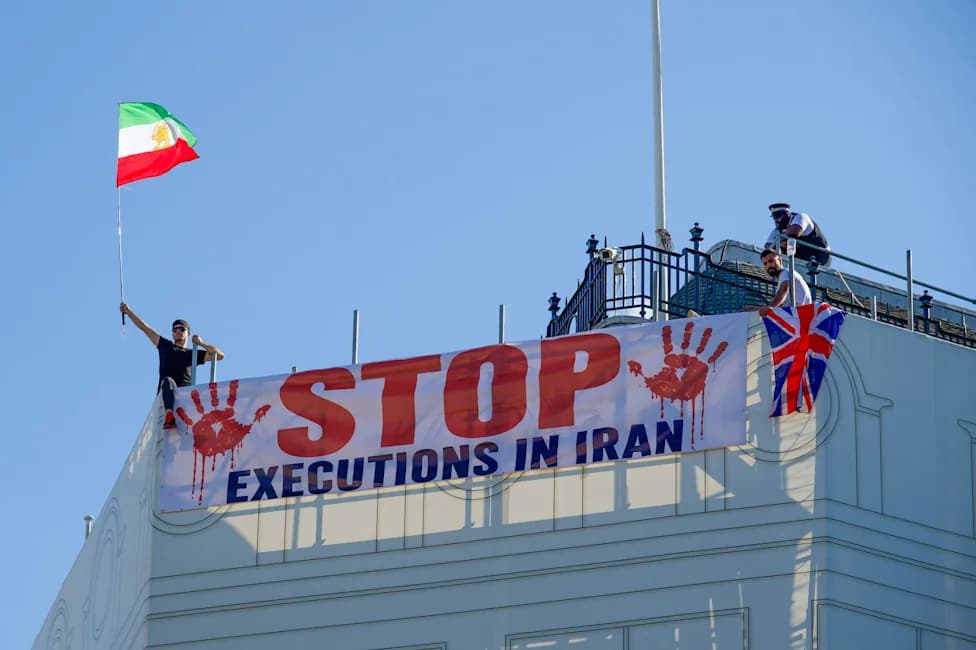
FILE PHOTO - Iranian protesters wave royal flags and hold banners on the roof of the Trocadero building overlooking London's Piccadilly Circus in July 2026. The activists scaled the landmark building in the city centre to demand an end to executions in Iran. (is associated with: «Iran reportedly executes suspected spy for Israel») James Willoughby/SOPA Images via ZUMA Press Wire/dpa
Iran's judiciary executed a man accused of spying for Israel, the court-affiliated Mizan news agency reported on Saturday.
The agency said a court found the convicted individual had transmitted intelligence about military facilities and personnel. The report did not provide further details on the alleged contacts, the evidence presented at trial, or whether the conviction was subject to appeal.
Human rights groups condemned the execution and reiterated long-standing concerns about Iran's use of the death penalty. They say authorities frequently rely on broadly worded charges—such as espionage, endangering national security, or blasphemy—in cases that can lack transparency and fair-trial safeguards.
Rights groups: Executions are often used as a tool of intimidation, and defendants may face trials that do not meet international due-process standards.
According to the Washington-based Abdorrahman Boroumand Center for Human Rights in Iran, more than 1,000 people have been executed by Iranian authorities so far this year; that figure has not been independently verified. Amnesty International reports at least 2,159 executions in Iran last year, the highest annual total recorded since 1981.
International monitors continue to call for greater transparency, independent investigations into capital cases, and full adherence to fair-trial norms before imposing the death penalty.
Help us improve.





















