The European Space Agency’s Swarm satellites and geological records were used to reconstruct and sonify the Laschamps magnetic excursion from about 41,000 years ago. During the event the field weakened to roughly 5% of modern strength and beryllium‑10 in ice and sediments roughly doubled, indicating increased cosmic radiation. The reversal took ~250 years to complete, the flipped field persisted for ~440 years at reduced strength, and scientists continue to monitor modern anomalies such as the South Atlantic Anomaly and a rapidly drifting magnetic North Pole.
You Can Now Hear Earth's Magnetic Field Collapse — The Laschamps Reversal Sonified
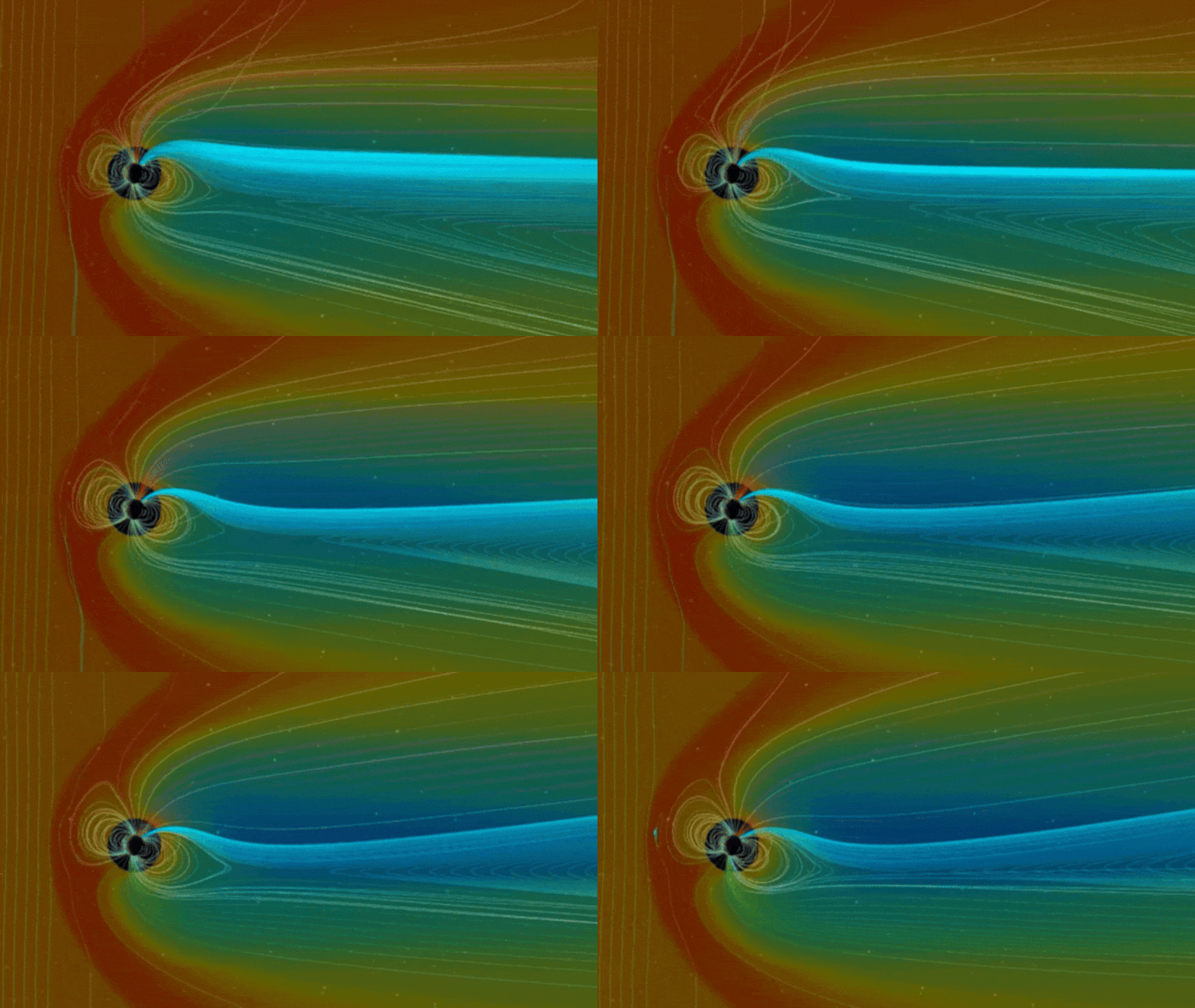
Earth's magnetosphere formed by the interaction between the planet's geomagnetic field and solar winds. (NASA's Scientific Visualization Studio)
Geoscientists have reconstructed the dramatic collapse and flip of Earth’s magnetic field from about 41,000 years ago and translated it into an eerie audio experience. Using measurements from the European Space Agency’s Swarm satellites together with magnetic signatures preserved in ancient lava flows and sediments, researchers mapped the event in time and then sonified those changes — layering natural sounds such as creaking wood and grinding rock to convey the field’s violent, disordered motion.
How the Sonification Was Made
The European Space Agency described the 2024 project as similar to "composing music from a score," except the score was written by the planet itself. Scientists combined modern satellite data with geological records (notably the Laschamps lava flows in France) to produce a continuous reconstruction of the excursion, then converted the magnetic variations into sound. The added ambient noises help listeners sense the instability and intensity of the event.
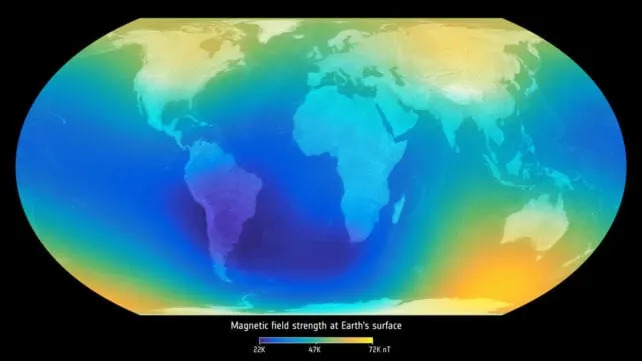
Strength of the magnetic field at Earth's surface. (ESA)
What the Laschamps Excursion Looked Like
Under normal conditions, Earth’s magnetic field — generated by convecting liquid iron in the outer core — forms organized loops that shield the atmosphere from energetic solar and cosmic particles. The reconstructed Laschamps excursion revealed a severe collapse: the field weakened to roughly 5% of its present strength and remained severely reduced for centuries before flipping orientation.
Ice cores and marine sediments from the period show beryllium-10 concentrations roughly doubled, a clear marker that more cosmic radiation reached the atmosphere while the field was weakened. Some modelling studies also suggest this increased radiation could have affected the ozone layer, with potential environmental consequences.
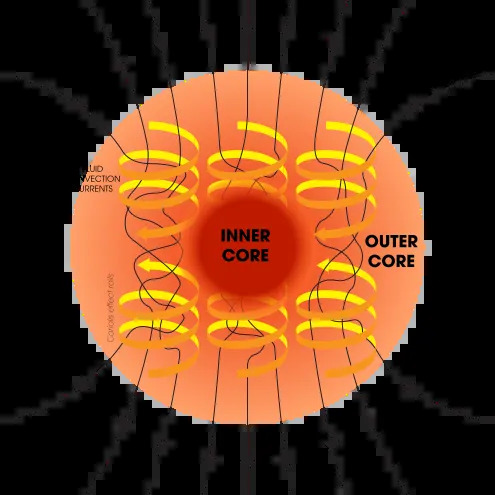
Convection currents of liquid metal in the outer core, driven by heat from the inner core, produce circulating electric currents that generate Earth's magnetic field. (Andrew Z. Colvin/CC BY-SA 4.0/Wikimedia Commons)
Timing and Duration
Researchers estimate the reversal took about 250 years to complete. During that interval the field may have briefly dipped to near zero to 6% of its typical intensity. After the flip, the reversed orientation persisted for roughly 440 years but never fully recovered to modern strength — at best lingering around one-quarter of today’s field intensity during that interval.
Why This Matters Today
The Laschamps event raises obvious questions about future magnetic behavior. Today, the magnetic North Pole is drifting from Canada toward Siberia fast enough to require official location updates, and ESA’s Swarm satellites have monitored a pronounced weakened region over the South Atlantic — the South Atlantic Anomaly — which expanded by an area approaching half the size of continental Europe between 2014 and 2025.

Subscribe to ScienceAlert's free fact-checked newsletter
Scientists, including Chris Finlay and Sanja Panovska, who led recent studies and the 2024 reconstruction respectively, emphasize that weak or wandering patches have appeared in the past without triggering a full global reversal. Current evidence suggests the anomaly does not guarantee an imminent flip, but the field’s unpredictability is exactly why continuous monitoring is essential for space-weather forecasting and assessing environmental impacts.
Context and Consequences
Some researchers have connected the timing of the Laschamps excursion to broader environmental and cultural signals: increased radiation markers coincide with climatic and ecological disturbances, the extinction of some megafauna in regions like Australia, and even the appearance of some of the oldest cave art. While causation remains debated, the overlap underscores how geomagnetic extremes can intersect with Earth's biosphere and human societies.
Bottom line: The sonified Laschamps reconstruction offers a chilling, visceral window into a time when Earth’s magnetic shield nearly vanished. It’s a powerful reminder of the dynamic processes beneath our feet — and why scientists keep watching the modern field closely.
Image credit: Andrew Z. Colvin/CC BY-SA 4.0/Wikimedia Commons
Help us improve.