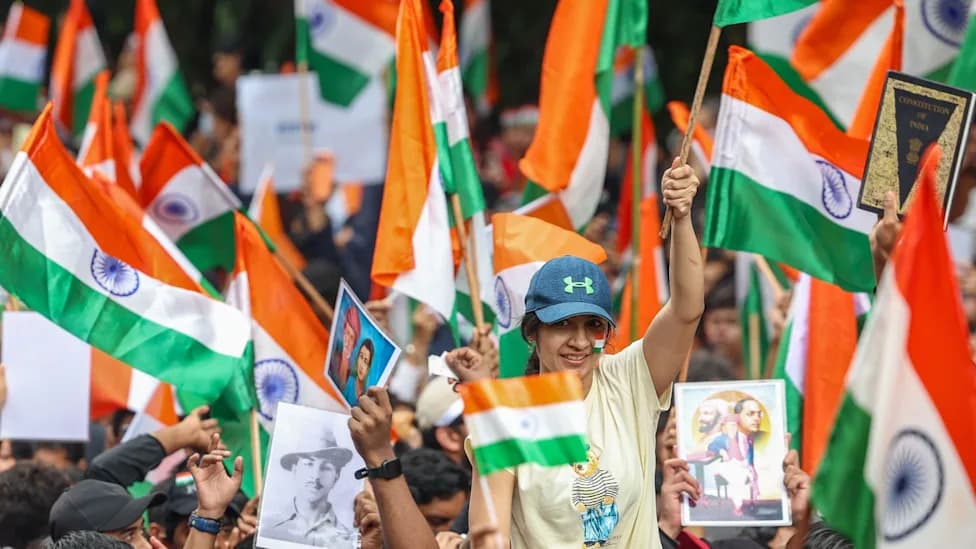
Vande Mataram, a 19th-century hymn by Bankim Chandra Chattopadhyay, resurfaced after a six-stanza rendition was played before the India–Afghanistan T20 in New Delhi. The full rendition — which invokes Hindu goddesses in later stanzas — has reignited debate over whether the song should represent patriotism in secular, multi-faith India. Government directives earlier this year and a July law penalising disruptions have intensified the dispute between the BJP and Congress over which stanzas are appropriate for public use.
Why 'Vande Mataram' Is Back In India's Spotlight — From Cricket Grounds To Political Debate
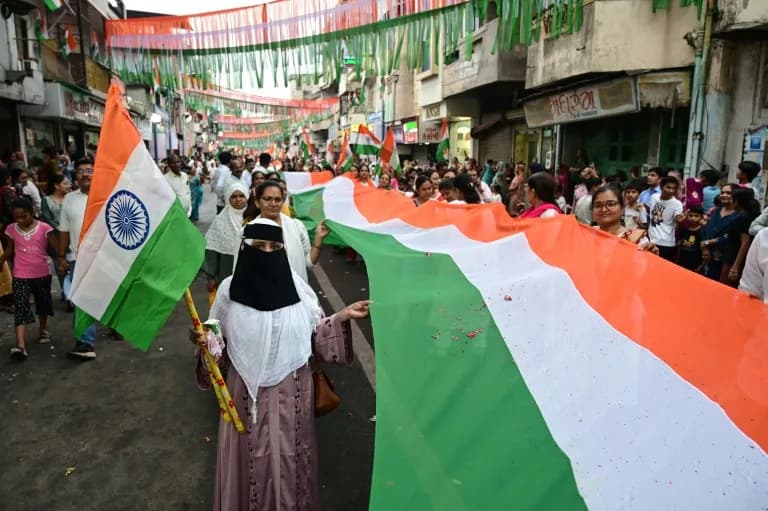
People take part in rally ahead of India's Independence Day celebrations in Ahmedabad in August (Shammi MEHRA)
Vande Mataram, a 19th-century hymn that helped rally Indians against British rule, has re-emerged at the centre of a heated national debate after a six-stanza rendition was played before an international cricket match in New Delhi.
Before a T20 game between India and Afghanistan, spectators and players stood as the full version of the song was sung — ahead of the national anthem. The six-stanza performance ran for more than three minutes and returned a historic composition to the centre of contemporary arguments about nationalism, religious identity and public ritual in secular India.
What Is "Vande Mataram"?
"Vande Mataram" (literally "Mother, I Bow To Thee") is a poem written by Bengali novelist Bankim Chandra Chattopadhyay and first published in 1875. Much of its language draws on Sanskrit, which can make parts difficult for many modern listeners to understand or sing.
In 1950 the Indian government formally designated "Vande Mataram" as the nation's National Song. It is distinct from the national anthem, "Jana Gana Mana", which was also adopted officially in 1950.
Why The Song Is Contentious
The controversy focuses on the later verses. While the opening stanzas praise the motherland in secular terms, subsequent lines invoke Hindu goddesses such as Durga, Lakshmi and Saraswati. Many Muslims and other non-Hindu citizens have long objected to portraying the nation as a goddess, arguing that such imagery conflicts with their religious beliefs.
In 1937, the Indian National Congress formally sanctioned only the first two stanzas for public use to accommodate the country's religious diversity.
Why The Debate Has Reignited
The issue returned to public attention after a series of government measures this year that raised the official profile of the song. In February the Home Ministry directed that a musical rendition of "Vande Mataram" be played or sung at the start of government functions, before the national anthem. In July Parliament passed legislation imposing fines or jail terms of up to three years for anyone who intentionally disrupts or obstructs its rendition.
For the first time, that directive was applied at an international cricket fixture in India, prompting renewed public discussion about whether singing the full six-stanza version is appropriate in a multi-faith democracy.
How The Political Debate Plays Out
The ruling Bharatiya Janata Party (BJP) frames the full hymn as an essential symbol of the independence struggle and national pride; it accuses opponents of having weakened the song. The opposition Indian National Congress insists the long-standing compromise — limiting public use to the opening two stanzas — should be honoured to preserve religious inclusivity.
Prime Minister Narendra Modi, marking the song's 150th anniversary on a special website, described "Vande Mataram" as giving a concrete expression to feelings of patriotism. Critics, however, warn that promoting the full hymn risks conflating patriotism with a single religious tradition in a constitutionally secular country.
Delhi University professor Apoorvanand told AFP the push to promote the whole song departs from the pre-independence consensus, saying: "With the ascendance of 'Hindutva', they want to break that consensus. And they want to create a new consensus... by the force of numbers."
Why It Matters
The debate is about more than a song: it touches on how India defines national identity, balances respect for its plural traditions, and manages the role of majoritarian politics in public life. Whether the full hymn becomes a regular feature of state events and national spectacles such as cricket will shape perceptions of inclusion — and exclusion — across the country's diverse population.
Sources: AFP reporting and official government statements.
Help us improve.