The U.S. has decertified Colombia, Bolivia and Venezuela for failing to meet international counternarcotics commitments, a move that can limit aid and multilateral financing. Washington cited record coca cultivation and missed eradication targets in Colombia, praised security forces but flagged gaps, and accused Venezuela of links to large cocaine networks. Bolivia showed progress in seizures and cooperation but still fell short. The White House also listed 23 major drug-transit or producing countries and called fentanyl trafficking a national emergency.
U.S. Decertifies Colombia, Bolivia and Venezuela Over Counternarcotics Shortfalls
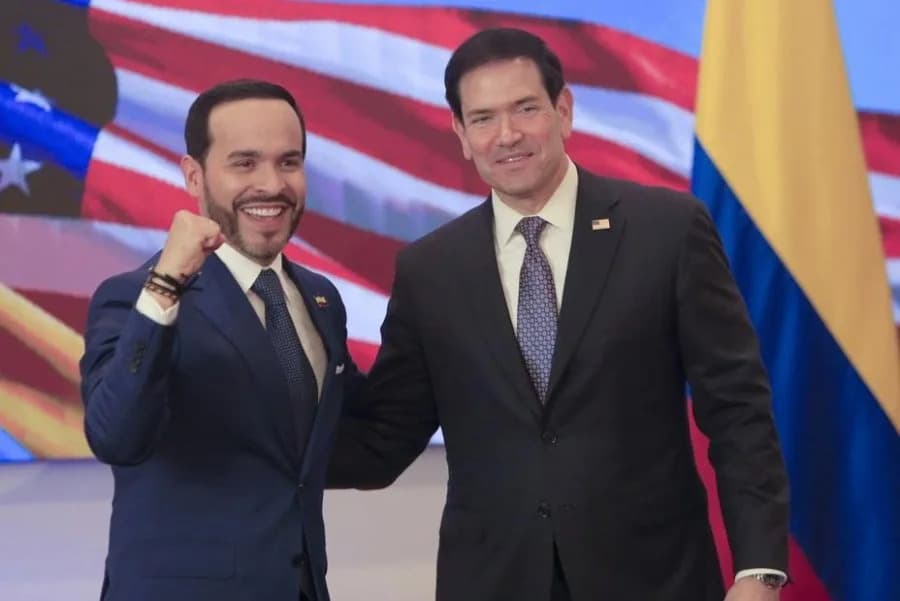
Colombian President Abelardo de la Espriella (R) poses with U,S, Secretary of State Marco Rubio in Barranquilla, Colombia, on September 8. Photo by Ricardo Maldonado Rozo/EPA
The United States has formally decertified Colombia, Bolivia and Venezuela, saying the three governments failed to meet international counternarcotics obligations over the past 12 months. The presidential determination—which was sent to Congress—can trigger suspension of most U.S. foreign assistance, restrictions on development financing and a U.S. obligation to oppose loans for those governments at multilateral institutions.
Which Countries Were Affected
The determination names Afghanistan, Bolivia, Burma, Colombia and Venezuela as states that did not fulfill their obligations under international counternarcotics agreements or take required actions under U.S. law during the reporting period.
Colombia
The U.S. said its decision on Colombia was based largely on its assessment of the previous administration under President Gustavo Petro, during which coca cultivation and cocaine production reached record levels. U.S. officials noted Colombia missed its own eradication targets—a shortfall Washington said undermined years of bilateral cooperation against drug trafficking.
At the same time, the U.S. praised Colombian security forces and local authorities for confronting criminal and armed groups. The statement also welcomed the election of Abelardo de la Espriella and cited his pledge to "lead an aggressive campaign against coca cultivation and cocaine production," signaling the U.S. could reconsider the designation if the new government takes stronger eradication, interdiction and judicial-cooperation measures.
Key figures: Colombian authorities report roughly 626,000 acres of coca cultivation. A U.N. report using 2024 data identified Colombia's Pacific region as severely affected by trafficking and recorded roughly 1.96 million pounds of cocaine seized in 2024 (up 19% from 2023). Authorities also dismantled 5,226 illicit labs and eradicated about 23,235 acres of coca—a 54% decline in eradication compared with the prior year.
Bolivia
Bolivia was decertified as well, though the U.S. acknowledged progress in cocaine seizures and cooperation with U.S. law enforcement. Washington said Bolivia still needs sustained and consistent measures to meet its counternarcotics commitments fully.
Venezuela
The U.S. determination accuses the government of Nicolás Maduro of involvement in one of the world’s largest cocaine trafficking networks and singled out criminal groups such as Tren de Aragua. The White House said it will continue efforts to hold Maduro and complicit regime members accountable.
Broader Context and Next Steps
The White House also listed 23 countries as major drug-transit or major illicit drug-producing nations. In Latin America and the Caribbean the list includes the Bahamas, Belize, Bolivia, Colombia, Costa Rica, the Dominican Republic, Ecuador, El Salvador, Guatemala, Haiti, Honduras, Jamaica, Mexico, Nicaragua, Panama, Peru and Venezuela. The administration clarified that placement on the broader list reflects geographic, commercial and economic factors that facilitate drug transit or precursor production and does not necessarily indicate the level of a government’s cooperation with the U.S.
Despite the decertifications, the White House concluded that continuing U.S. assistance to Bolivia, Colombia, Venezuela and Burma remains vital to U.S. national interests and permitted exceptions for continuing some aid where necessary.
“Transnational organized trafficking of fentanyl and other illicit drugs into the United States has created a national emergency,” the administration said, citing a public-health crisis and reporting an average of more than 200 deaths per day from illicit drugs in 2024.
The U.S. signaled that these designations could be revisited if the affected governments demonstrate measurable progress in eradication, interdiction and cooperation to bring criminal leaders to justice.
Help us improve.