The Office of the Inspector General found the California High-Speed Rail Authority reimbursed consultants $592,900 in travel expenses that appear to violate state rules or contract terms. Auditors reviewed about $1.15 million of travel claims and said $680,500 lacked documented pre-approval. Examples include a private plane claim, first-class flights paid without justification, and premium rideshare fares for nightlife and leisure destinations with no stated business purpose. The authority says it will tighten controls, seek reimbursements and cooperate with the OIG, which will reassess after a January–March 2027 implementation window.
Watchdog: California High-Speed Rail Reimbursed $592,900 in Questionable Consultant Travel
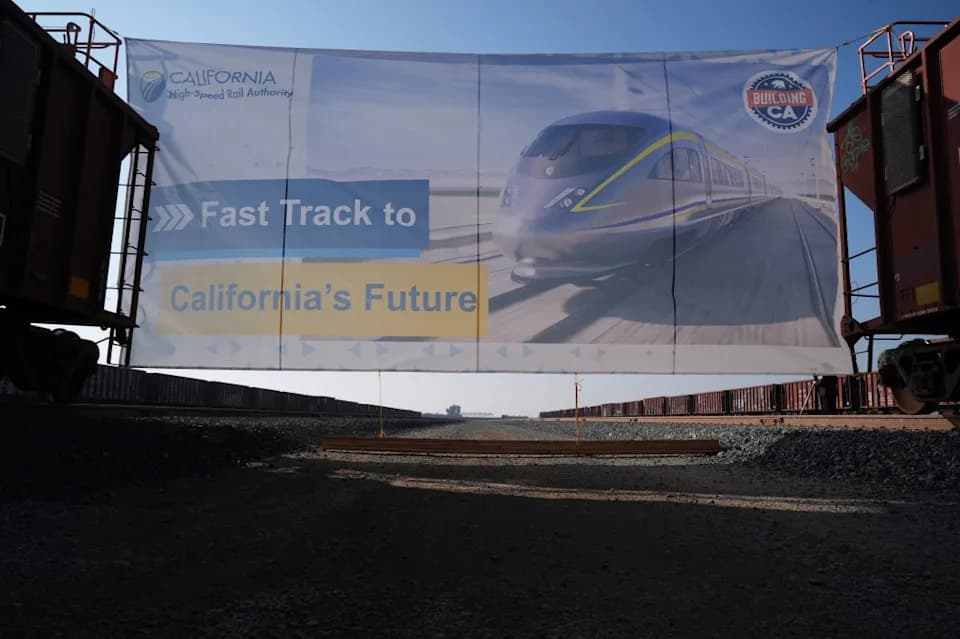
A banner reading "Fast Track to California's Future" is displayed at the California High-Speed Rail Authority's 150-acre Southern Railhead site in the Wasco/Shafter area in Wasco, California, Tuesday, February 3, 2026.
The Office of the Inspector General for High-Speed Rail says the California High-Speed Rail Authority reimbursed consultants a combined $592,900 in travel expenses that appear to violate state rules, contract terms, or both, according to a report released Tuesday.
Key Findings
Investigators examined travel-related costs recorded by the authority for four contracted consulting firms during fiscal years 2024–25 and 2025–26. The authority logged more than $2 million in consultant travel; auditors reviewed roughly $1.15 million of that total and found $680,500, about 60 percent, lacked documented approval before travel began.
The inspector general substantiated allegations of inappropriate reimbursements. The report breaks the questionable payments into two categories: roughly $81,000 that appeared unallowable under state travel regulations and $543,400 that were not permitted under consultants’ contracts. Because some charges fit both categories, the combined flagged total is $592,900.
Illustrative Examples
Among the specific examples cited by investigators:
- A consultant flew on a private plane from Washington, D.C., to California and sought reimbursement calculated from a premium commercial fare; the authority paid the claim despite no documentation of advance approval for private air travel or justification for the premium fare.
- First-class and other premium flight reimbursements were paid without explanations showing why upgrades were necessary.
- Premium rideshare fares were reimbursed, including a nearly $40 ride that covered less than one mile in downtown Sacramento. Other charges covered trips to Planet Fitness, an escape room, a tiki bar, a sushi restaurant in Denver, restaurants in Folsom, and a cigar lounge in Washington.
- One consultant billed rides to and from a restaurant, bar and nightclub between about 9:40 p.m. and 2:30 a.m.; records contained no stated business purpose for those late-night trips.
Other Contract and Process Problems
The review also identified more than $118,000 in travel costs billed under a track-and-systems design contract that explicitly prohibited international travel. In a separate example, a legal consultant submitted more than 30 travel claims over roughly a year, largely for trips between Denver and Sacramento; the authority paid about $40,800 in expenses plus $86,500 in paid travel time, yet only three of those trips had documented advance approval.
The inspector general noted many travel purpose descriptions were vague or insufficient, with entries such as project management, typical trip, or merely attendance at a rail board meeting. The report emphasized its review covered selected claims and was not an audit of every expense.
Agency Response and Next Steps
A spokesman for the California High-Speed Rail Authority told Newsweek the agency appreciates the OIG's oversight and is committed to transparency and continuous improvement. The authority said it will strengthen internal controls for consultant travel, impose stricter documentation and approval requirements, maintain a list of consultants' approved office locations, and seek to recover improper costs identified by the review.
The authority plans to enforce enhanced travel-expense requirements between January and March 2027. The inspector general said it will assess the authority's corrective actions after that implementation period.
Project Context
California voters approved the high-speed rail project in 2008 when estimated costs were about $33 billion. The authority's final 2026 Business Plan estimates roughly $126 billion for Phase 1, connecting San Francisco and Los Angeles/Anaheim, while initial Merced-to-Bakersfield service is budgeted at $35.7 billion.
Contact: Newsweek editors Ben Kelly and Gray R. Thomas.
Help us improve.