Thai and Cambodian foreign ministers met in Singapore for the first UNCLOS compulsory conciliation session to address a maritime boundary dispute over an area believed to contain substantial natural gas and hydrocarbons. Cambodia initiated the process in June after Thailand revoked a 25-year MOU amid deteriorating relations and armed clashes last year. The conciliation commission can offer recommendations but cannot issue a legally binding ruling; both sides said they are prepared to negotiate while a fragile ceasefire holds.
Thailand and Cambodia Begin UNCLOS Conciliation Over Gas-Rich Maritime Dispute
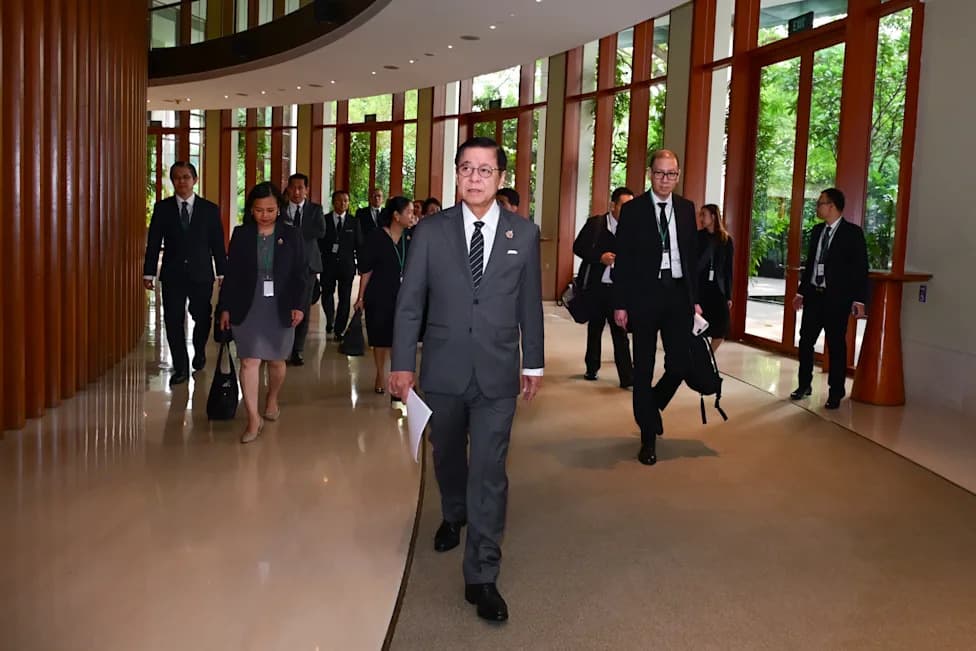
Thai Foreign Minister Sihasak Phuangketkeow, center, prepares to attend the first meeting of a conciliation commission between Thailand and Cambodia under the U.N. Convention on the Law of the Sea, in Singapore Tuesday, Sept. 15, 2026. (Thailand Foreign Ministry via AP)
Thai and Cambodian foreign ministers opened the first compulsory conciliation meeting under the U.N. Convention on the Law of the Sea (UNCLOS) in Singapore on Tuesday, seeking a peaceful way to resolve a contested maritime boundary believed to hold substantial natural gas and hydrocarbon reserves.
Background
The UNCLOS proceedings were initiated by Cambodia in June after Thailand unilaterally revoked a 25-year memorandum of understanding that had been intended to manage overlapping maritime claims. Thailand's move followed a sharp deterioration in bilateral relations and outbreaks of armed combat between the neighbors last year.
Conciliation Session
Thai Foreign Minister Sihasak Phuangketkeow and Cambodian Foreign Minister Prak Sokhonn led their delegations in the first conciliation session with a five-member UNCLOS commission that met in Singapore from Monday through Wednesday. The conciliation process is designed to facilitate negotiation and produce recommendations, but any outcome from the commission is not legally binding on the parties.
Positions From Both Sides
"Cambodia has pursued UNCLOS proceedings in keeping with its commitment to the rule of law and the peaceful settlement of disputes," Prak Sokhonn said, calling for a resolution that "serves the peoples of both nations and contributes to peace, cooperation and shared prosperity in the region."
Thai foreign minister Sihasak Phuangketkeow emphasized Thailand's commitment to international law and peaceful settlement. He argued the revoked memorandum "had produced no concrete progress," noting that only two meetings had been held over 25 years, and said Thailand had offered direct talks before moving the matter to UNCLOS conciliation.
Ceasefire, Security, and Outlook
A fragile ceasefire agreed in late December remains in effect, but tensions persist: sporadic incidents have been reported and both countries maintain large military deployments near the border. The neighbors clashed over land-border claims in July and December, episodes that together killed several dozen civilians and soldiers and displaced hundreds of thousands of people.
Thailand has historically preferred resolving territorial disputes bilaterally and has long expressed resentment over a 1962 International Court of Justice ruling awarding Cambodia the Preah Vihear temple, an issue that has contributed to recurring tensions. While the UNCLOS conciliation can guide negotiations and offer recommendations, it cannot impose a binding settlement—leaving a negotiated political solution as the most likely path forward.
What Comes Next
The UNCLOS commission will compile a report with findings and recommendations to assist negotiations. Both delegations said they are prepared to engage constructively, but a durable resolution will depend on diplomatic give-and-take and confidence-building measures to reduce the risk of renewed clashes.
Help us improve.