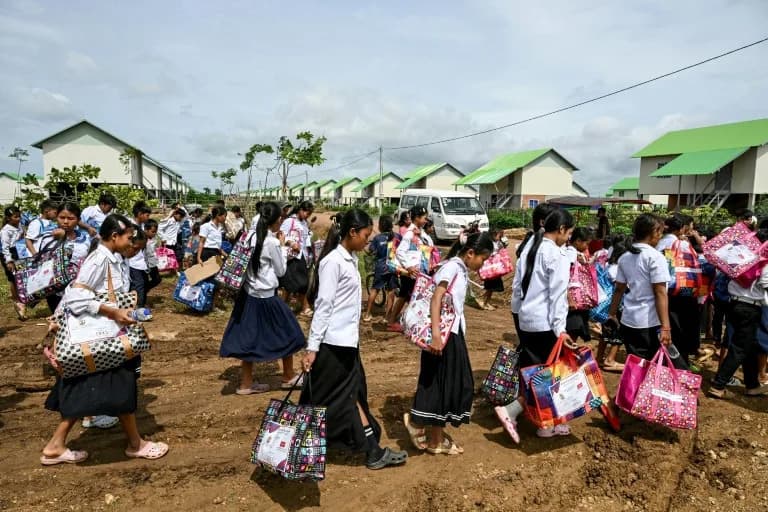
The Thai military has begun installing the first phase of an 8.4-kilometre border wall along the Thai-Cambodia frontier, with one kilometre already in place in Chanthaburi Province. The 3.6-metre-high barrier, made of reinforced concrete, galvanised mesh and barbed wire, is intended to curb smuggling and other illegal activity after deadly clashes last year. Villagers say the fence encroaches on farmland but many accept the trade-off for increased security; tensions and displacement persist despite a ceasefire.
Thailand Begins Erecting 8.4km Border Wall After Deadly Clashes With Cambodia
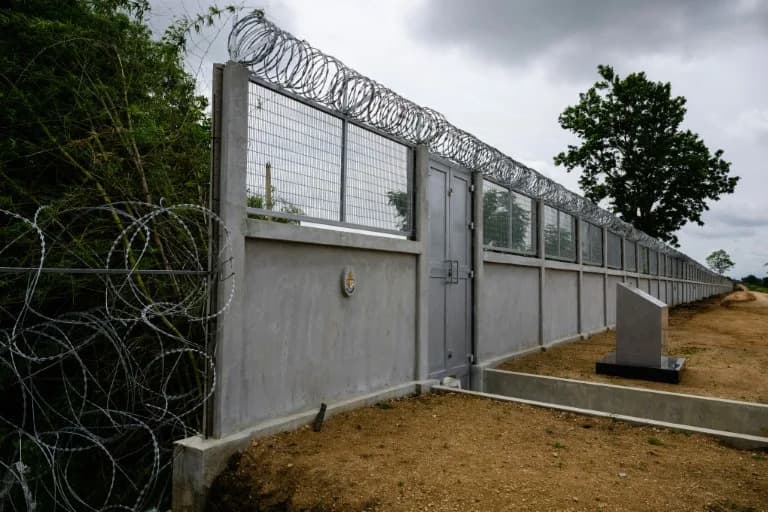
Thailand began building a wall along part of its border with Cambodia following deadly clashes last year (ANTHONY WALLACE)
A concrete barrier topped with coils of barbed wire now stretches for about one kilometre along the Thai-Cambodian frontier, marking the first phase of an 8.4-kilometre (5.2-mile) wall the Thai military is building in the east of the country.
The structure, installed across farmland in Chanthaburi province, stands 3.6 metres (11.8 feet) tall and combines reinforced concrete, a mesh of galvanised steel and rolls of barbed wire. Officials say the barrier aims to curb smuggling and other illegal cross-border activity after a series of deadly clashes last year.
What Officials Say
"We built the fence to prevent illegal activities," said Captain Prachya Hantiem, commander of the Royal Thai Navy Marine Task Force in Chanthaburi, singling out people- and goods-smuggling as key concerns. "Every single step follows the law and can be checked. In fact, Cambodian forces inspect our work at every stage."
Thai authorities insist the construction lies entirely within Thai sovereignty. Gates in the wall have been planned to accommodate multilingual stone markers from the French colonial era, some of which bear the words "Siam" and the French term "frontière" (border).
Local Impact and Reaction
The barrier runs close to a small Thai village of fewer than 200 residents who cultivate corn and fruit such as durian and longan. Villagers say the wall cuts into some farmland along the porous border, but many say they accept the loss in exchange for increased security.
"We accept it, we accept losing some land in order to gain security," said Suwin Muangmeung, who runs a village grocery. "It gives us a sense of security in our daily lives, since our plantations are along the border."
Village chief Itchira Aranchaiyasiri added: "We never really know when Thailand and Cambodia will reconcile, or when we'll be able to communicate with each other properly. But having this fence here helps."
The wall has changed daily routines: where villagers once crossed freely or visited neighbours on the other side, movement is now restricted by the barrier and its gates. Residents say they will have to adapt to the new reality.
Background
Thailand and Cambodia have long disputed parts of their roughly 800-kilometre boundary. Violent clashes broke out in July and again in December of last year, prompting Thailand to close border crossings and displacing hundreds of thousands of people.
Roughly 500,000 people fled their homes at the height of the fighting; most have returned but about 20,000 Cambodians remain displaced. The two countries signed a ceasefire in late December, though both sides have accused the other of violations.
Human Stories
Local residents recalled earlier waves of refugees after the fall of the Khmer Rouge in 1979 and said the recent conflicts have altered how they view security and risk. One villager, aged 62, said she now consults military customers on safety and has built a small bunker at her home as a precaution.
The new wall is a tangible sign of persistent tensions along the border: a security measure for some, an intrusion into farmland for others, and a reminder of unresolved disputes between neighbours.
Help us improve.