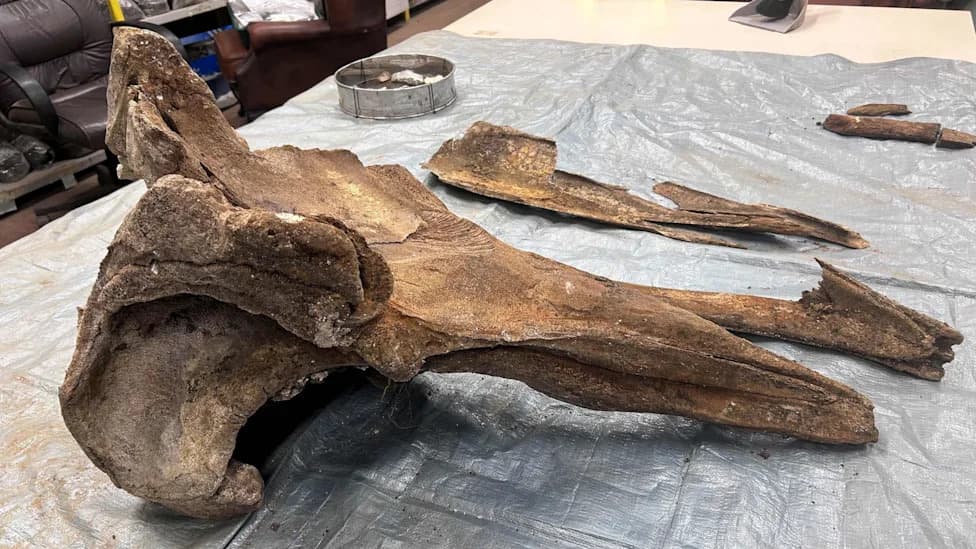
Wyoteuthis linsterorum is a newly described 160‑million‑year‑old belemnite identified after researchers noticed an unusually thick rostrum—nicknamed the “chunkiest squid butt.” Two specimens, found more than 30 years apart (the second in 2019 near Ten Sleep, Wyoming), were CT‑scanned and shown to belong to a lineage previously thought extinct. Scientists propose that larger body size helped W. linsterorum prey on smaller belemnites such as Pachyteuthis. The species is named in honor of fossil collector Cliff Linster (d. June 2026).
“Chunkiest Squid Butt” Leads to Discovery of New 160‑Million‑Year‑Old Belemnite
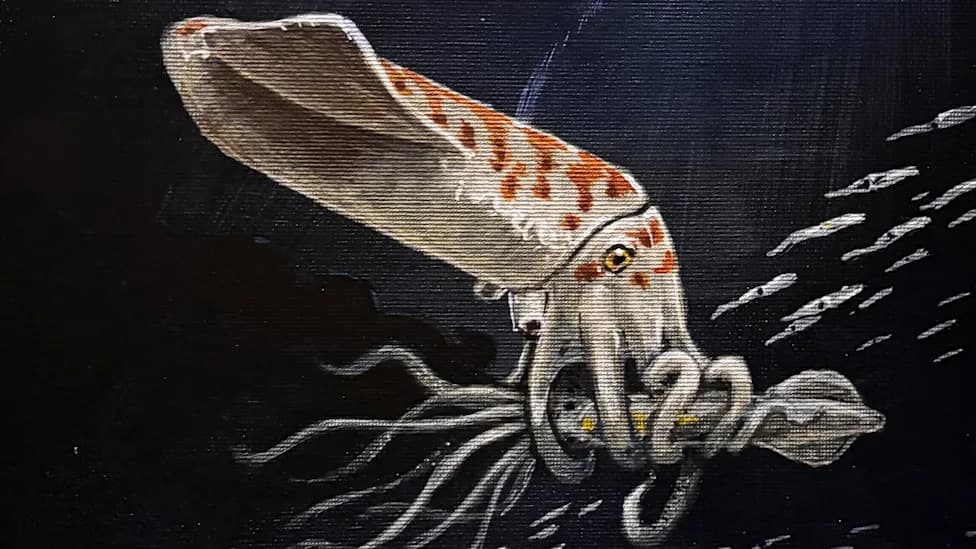
The first W. linsterorum fossil was discovered over 30 years ago, but remained in storage until recently.
Paleontologists have identified a previously unknown belemnite species after noticing an unusually thick rostrum—colloquially nicknamed the “chunkiest squid butt.” The fossils, described in Papers in Palaeontology, date to about 160 million years ago and shed new light on the diversity and ecology of Jurassic cephalopods.
Discovery and Geological Context
Belemnites were shelled cephalopods whose hard, bullet-shaped internal supports (rostra) are common in the fossil record. Many of the Wyoming specimens come from the Sundance Formation, an area that was covered by an inland sea during the Jurassic.
Unusually Thick Rostrum
Most belemnites recovered from Wyoming are relatively small—typically 2–4 inches long with rostra less than an inch across. About 30 years ago, Burkhard Pohl, founder of the Wyoming Dinosaur Center, uncovered a rostrum that “stuck out like a sore thumb,” according to study co-author Bill Wahl. That specimen’s rostrum measured about 2.4 inches wide—far broader than typical examples—so researchers estimated the animal’s full body may have approached two feet in length.
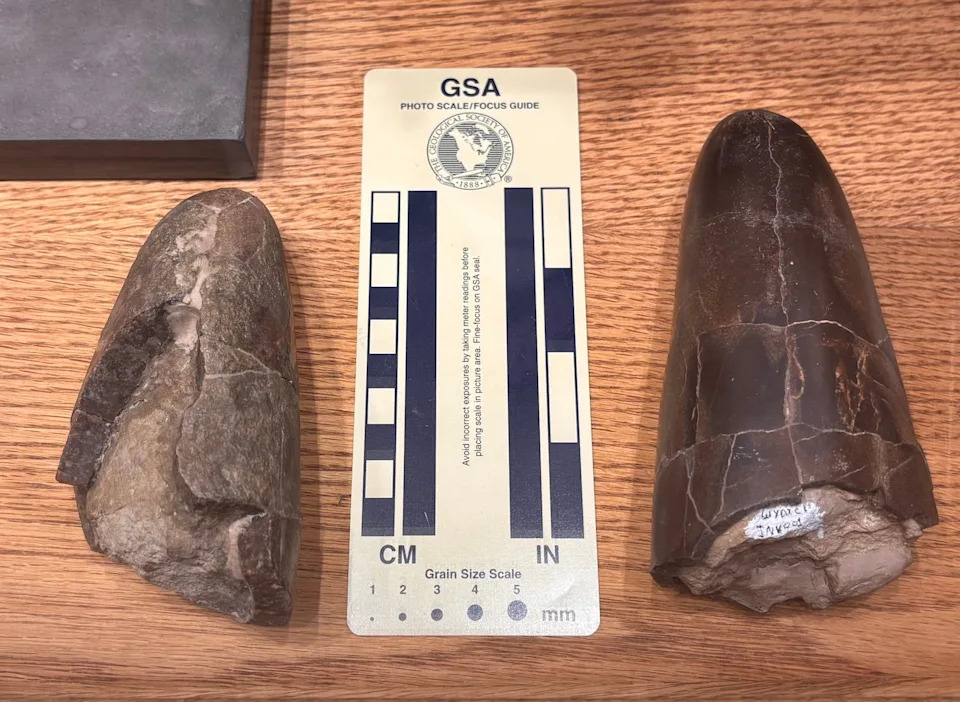
The two 'W. linsterorum' fossils were discovered over 30 years apart. Credit:Jessica Lippincott
A Second Specimen and Modern Analysis
For nearly three decades the thick rostrum remained in storage because no comparable specimens were known. In 2019 fossil collector Cliff Linster discovered a very similar fossil near Ten Sleep, Wyoming, and donated it to the Wyoming Dinosaur Center. Researchers used computed tomography (CT) scanning to examine the internal structure of both fossils without damaging them. The scans confirmed these remains represent a previously undescribed belemnite species, which the team named Wyoteuthis linsterorum.
“After spending years fossil hunting in Wyoming and collecting countless fossils of the common Pachyteuthis belemnites here in Wyoming, this one is unlike anything I have ever seen,” said Jessica Lippincott, a paleontologist and co-author of the study.
Ecological Implications
The team suggests that the species’ bulky proportions may reflect a feeding advantage. Larger size could have helped W. linsterorum prey on smaller, co-occurring belemnites such as Pachyteuthis. Modern squid are opportunistic predators known to feed on other cephalopods and sometimes on conspecifics, so similar behaviors may have shaped the evolution of Jurassic belemnites.
“A possible explanation is that their relatively large size gave them an advantage when hunting co-occurring smaller belemnites of the genus Pachyteuthis,” explained Alexey Ippolitov, a study co-author now at Victoria University of Wellington.
Naming and Legacy
The species name honors Cliff Linster, who discovered the second specimen and who died in June 2026. Although Linster did not live to see the formal naming, he was aware that researchers were preparing a description of the animal he helped uncover. The find highlights how amateur collectors and rockhounds can still make meaningful contributions to paleontology.
What This Means: The identification of Wyoteuthis linsterorum expands our understanding of belemnite diversity and suggests that ecological pressures such as predation and competition helped drive the evolution of larger body size in some Jurassic cephalopods.
Help us improve.