Brazilian crime syndicates PCC and Comando Vermelho have expanded operations across the Mamoré River, turning the Bolivian border town of Guayaramerín into a flashpoint in the cocaine trade. Between January and September 2025 Bolivia recorded a 138% rise in homicides (774 vs. 325), and locals report more robberies, kidnappings and public killings. President Rodrigo Paz has pledged additional border police, greater intelligence sharing with Brazil and has announced a controversial bridge project that residents fear may ease criminal movement.
Brazilian Drug Gangs Turn Bolivian River Port Into New Battleground
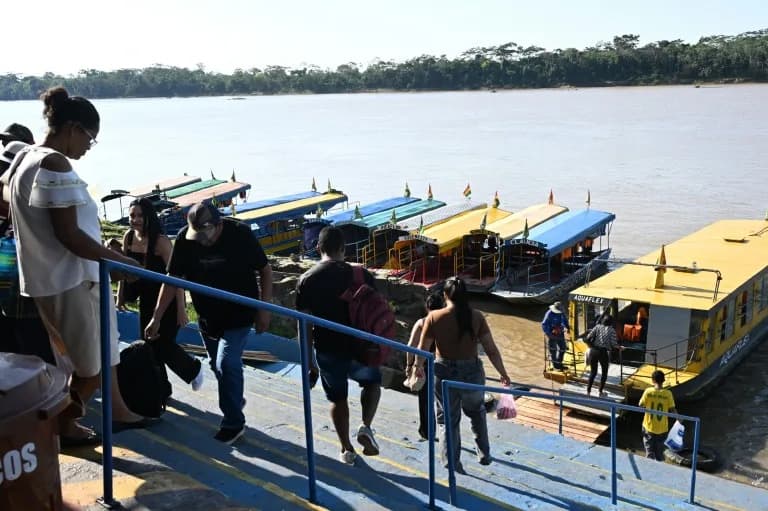
People arrive by boat across the Mamore river at the Bolivia-Brazil border in the Amazon jungle, a new battleground in the Latin American drug trade (AIZAR RALDES)
A river port on the Mamoré — one of the Amazon's largest tributaries — has become an unexpected frontline in South America's drug wars as Brazil's largest crime syndicates push across the border into Bolivia to control cocaine supply routes.
The Mamoré River forms a natural boundary between Bolivia, the world's third-largest cocaine producer, and Brazil, a major exit point for shipments to Europe. Boats ferry passengers from the Brazilian border city of Guajará-Mirim to the Bolivian town of Guayaramerín, where travelers often pass through the port terminal without routine checks.
"Nobody ever checks (papers),"said Donald Somoza, a 75-year-old retired bricklayer, as he rested in a nearby park.
A Quiet Town Under Siege
Guayaramerín, a town of roughly 40,000 with red-dust streets set against the deep green jungle, depends heavily on cross-border trade. By day it can appear calm, but residents say fear has spread as criminal groups infiltrate neighborhoods and public spaces.
Escalating Violence and High-Profile Crimes
Authorities say Bolivia's border communities have been penetrated by Brazil's two dominant organized crime groups — the Primeiro Comando da Capital (PCC) and Comando Vermelho (CV). In recent weeks, about a dozen murders on the Bolivian side of the Mamoré have been linked to those groups. Shocking incidents reported include the massacre of a family, decapitated bodies found in isolated areas, and the killing of a police officer.
Somoza said he witnessed the killing of a Brazilian man in Guayaramerín's main square, where the victim was reportedly fired on more than 80 times in what appeared to be retaliatory violence among traffickers.
Rising Homicide Rates and Everyday Crime
Official figures show a sharp rise in lethal violence: between January and September 2025 Bolivia recorded 774 homicides, up from 325 in the same period the previous year — an increase of 138 percent. Local merchants and residents also report spikes in armed robberies, kidnappings and extortion.
Currency trader Adhemar Zapata, who changes money near the port, said two men — one identified as Brazilian — held him at gunpoint and stole his takings, motorcycle and phone.
Government Response And Controversial Infrastructure
President Rodrigo Paz, whose center-right administration took office in November 2025, has blamed the previous two decades of socialist rule for allowing criminal networks to expand. Since taking office, his government says it has captured 17 international crime bosses, including Uruguayan trafficker Sebastián Marset and a top PCC commander identified as Gerson Palermo.
On a recent visit to Guayaramerín, Paz pledged to deploy more police to the border and expand intelligence sharing with Brazil. He also announced plans to build a bridge across the Mamoré as part of a road corridor linking Brazil to Peru's Pacific coast — a project that residents see as a double-edged sword.
"A bridge would boost trade, but gangsters and robbers can cross over more easily," said beverage vendor Yestin Duran. Guayaramerín's police chief, Johnny Rivas, warned the new crossing would likely require increased personnel and resources.
Experts Urge Following The Money
Investigators and analysts say police presence alone will not be enough. Joaquin Chacín, a specialist in organized crime, says effectively combating these networks requires tracing laundered funds, dismantling financial infrastructure and identifying the ultimate beneficiaries of the drug trade.
What Remains Clear: The spillover of Brazilian narco-violence into Bolivian border towns is reshaping local security dynamics and raising difficult policy choices about border control, regional cooperation and development projects that could both help and harm communities.
Help us improve.