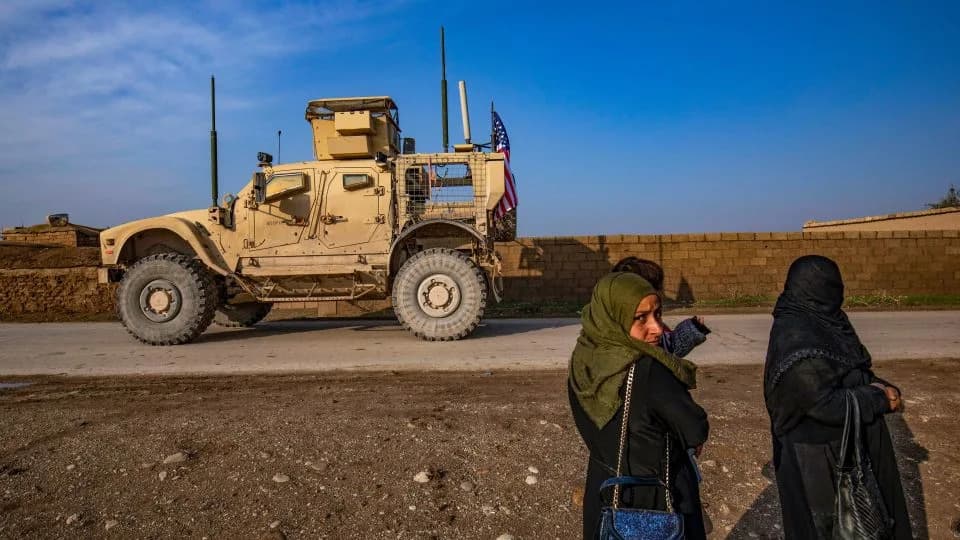
The Trump administration promised a strategic pivot to East Asia but has shifted resources back to the Middle East amid a major campaign against Iran. Key assets — including the USS George Washington — were redeployed, joint exercises with South Korea were scaled back, and weapons sales to Taiwan were paused due to ammunition shortages. Longstanding political ties and recent defense-integration laws entrenched U.S. commitments in the Middle East, making a true pivot difficult. Rebuilding stockpiles and restoring readiness will take years, leaving the U.S. at risk of being overstretched in both regions.
Pivot Paused: U.S. Forces Shift Back Toward the Middle East, Not East Asia
Photo: AdMedia/MEGA/JGLIT/Newscom. Illustration: Midjourney.
The Trump administration's promised strategic pivot to East Asia has been undercut by a renewed emphasis on the Middle East. Key assets and exercises meant to reassure partners in Asia have been scaled back as the United States reallocates resources to conflicts centered on Iran and its region.
What Happened
The carrier USS George Washington, the last U.S. aircraft carrier stationed in East Asia, was sent to relieve the USS Abraham Lincoln in the Middle East. President Donald Trump also announced plans to "substantially reduce" scheduled joint exercises with South Korea. In a related move, a Navy official recently told Congress that some weapons sales to Taiwan were paused because so much ammunition had been consumed in operations tied to Iran.
Trump said he asked South Korea's president if Seoul would join a U.S. push for Iran's denuclearization and was told, "No thanks!"
Policy Promises Versus Reality
The administration's 2025 National Security Strategy declared that the era of Middle East-dominated U.S. policy was ending, and senior strategists such as Elbridge Colby and Vice President J.D. Vance warned that sustained competition with China should be the priority. Yet, rather than consolidating a quieter regional balance when Trump took office—after a cease-fire in Gaza, relative calm in Yemen, and an Iranian government open to talks—the administration reopened conflicts in Gaza and Yemen in spring 2025 and, with Israeli Prime Minister Benjamin Netanyahu, launched a major strike campaign against Iran in February 2026.
Why The Pivot Stalled
The breakdown is both political and structural. Longstanding ties between the U.S., Israel, and Gulf states, plus legislation passed in 2022–2023 to integrate regional air defenses and navies, deepened operational entanglements. Political pressures and powerful regional constituencies repeatedly pulled U.S. policy back into Middle Eastern security commitments, even when officials argued publically for an Asia focus.
Operational Consequences
The Iran campaign consumed large quantities of ammunition and kept carriers deployed for record durations, producing maintenance backlogs and morale strains. Those are physical bottlenecks: rebuilding munitions stockpiles and restoring carrier readiness will take years. According to reporting, the Pentagon is preparing plans to reduce forces in the Persian Gulf after the conflict — a sign of reactive retrenchment rather than a carefully managed rebalancing.
Strategic Risks
While China and North Korea continued their military build-ups, the United States risks being overstretched. If munitions shortages persist and deployments remain extended, Washington may be forced to scale back commitments in both theaters at a moment when great-power competition is intensifying. Historians and commentators have drawn uneasy comparisons to past imperial turning points, warning that a costly Middle Eastern war could erode U.S. global standing.
Bottom line: The promised pivot to East Asia has been disrupted by renewed engagement in the Middle East. Fixing ammunition shortfalls, reducing sustained carrier deployments, and rebalancing alliances and capabilities will be essential to prevent the United States from losing influence in both regions.
Help us improve.