
Webb deep-field observations have revealed compact, red, star-like sources that appear to be dense gas envelopes glowing from energy released by an embedded black hole rather than nuclear fusion. Models that fit the data require a central black hole of roughly 100,000 solar masses and can produce luminosities on the order of 100 billion times a typical star. These "black hole stars" are observed only in the very early universe (when it was under one billion years old), suggesting an obscured growth phase for early supermassive black holes.
James Webb Reveals 'Black Hole Star' — A Star-Like Object Powered by an Enshrouded Black Hole
Jose-Luis Olivares, MIT
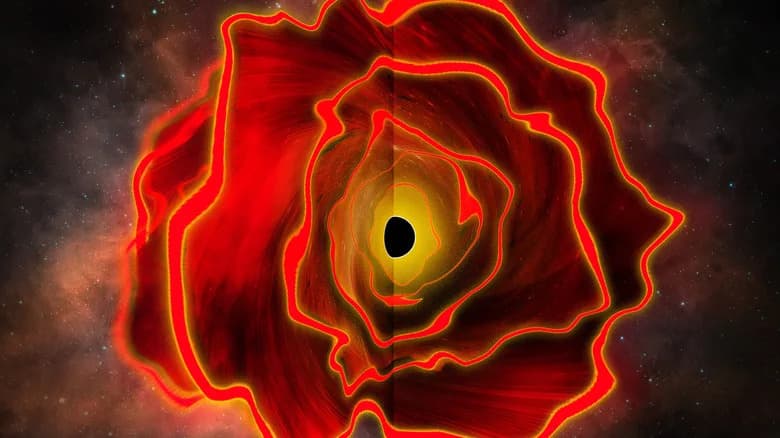
Astronomers using NASA's James Webb Space Telescope have identified a previously unrecognized class of luminous object: a dense, nearly spherical gas envelope surrounding a massive black hole that shines like a star — not from nuclear fusion, but from energy released by the black hole. Researchers are calling these objects "black hole stars" because they combine some observational traits of stars with the extreme energy output of accreting black holes.
Discovery and Observations
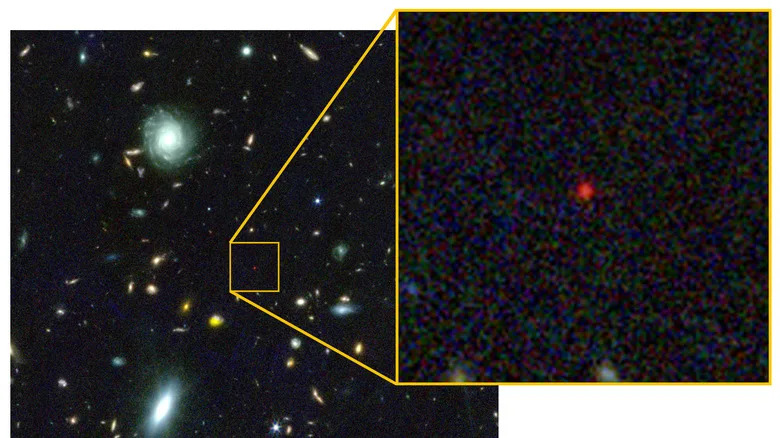
The finding emerged while a team searched Webb deep-field images for the most distant galaxies, including systems such as the galaxy labeled Mom-Z14. The researchers noticed unusually bright, tiny red point sources appearing repeatedly across Webb's deep exposures. One particularly intense red source prompted detailed follow-up analysis.
iStock; Jose-Luis Olivares, MIT
Modeling and Physical Picture
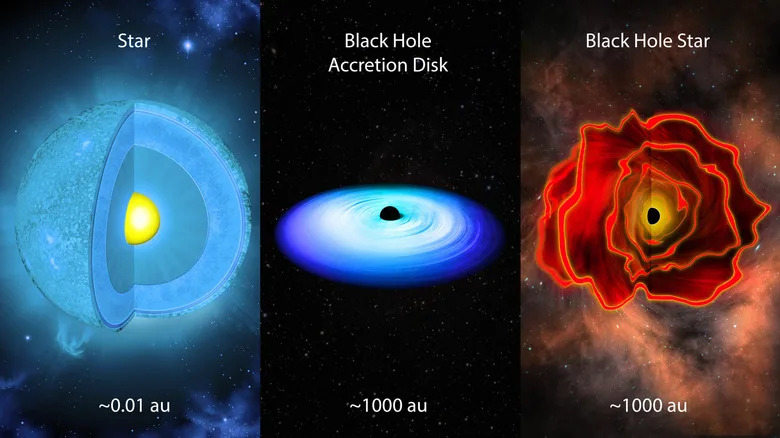
Extensive computer simulations matched the observations only when the model included a central black hole roughly 100,000 times the mass of the Sun surrounded by a thick, nearly complete gas envelope. This geometry differs from the familiar thin, disk-like accretion flows typically associated with active black holes: here, an accretion disk may still exist near the center, but the whole system is enshrouded by a dense cloud of gas that reprocesses and radiates the central energy.
According to the simulations, the enveloped structure can produce extraordinary apparent luminosities — on the order of 10^11 times that of a typical star — so bright that the object can outshine its host galaxy in Webb images. Energy from the accreting material pierces and heats the surrounding gas, producing the compact, red point-like emission detected by the telescope.
Courtesy of the researchers
Cosmic Context and Implications
All of the detected red point sources appear only in Webb observations that probe the very early universe. Because of light-travel time, Webb sees these objects as they existed when the universe was under one billion years old. No comparable enshrouded sources have been convincingly identified in the local, modern universe so far.
One plausible interpretation is that the "black hole star" phase represents an early evolutionary stage of some supermassive black holes: a heavily obscured growth period when the nascent hole rapidly accumulates mass while wrapped in a dense gas shroud. Over time the black hole may consume or expel the envelope and emerge as a more familiar unobscured active galactic nucleus. If confirmed, this scenario could help explain how very massive black holes formed so quickly after the Big Bang.
Next Steps
Because this is a newly proposed category, additional observations and modeling are required. Targeted Webb spectroscopy, deeper imaging, and complementary data from other telescopes will be needed to confirm the interpretation, measure distances and masses more precisely, and determine how common these objects were during cosmic dawn.
Bottom line: Webb's deep images may have uncovered an early, enshrouded phase of black hole growth — objects that look star-like but are powered by the enormous energy of accreting black holes rather than nuclear fusion.
Help us improve.





















