
The Artemis II crew celebrated a successful 10-day lunar mission at Red Rocks Amphitheatre on Aug. 3, greeting about 8,500 attendees and answering more than 1,300 questions. Crew members described habitability lessons from Orion (Integrity), a minor heat-shield issue under review, and a successful manual proximity-operations demonstration in which pilot Victor Glover said he flew Orion by hand using visual cues. NASA plans Artemis III for mid-2027 to demonstrate docking with Blue Origin and SpaceX lander demonstrators while debate continues over whether the lunar south pole should host the program’s first human landing.
Artemis II Crew Celebrated at Red Rocks — Pilot Victor Glover Says He ‘Flew Orion by Hand’

Credit: Lockheed Martin
Credit: Lockheed Martin
MORRISON, Colorado — The four members of the Artemis II mission returned to a standing-room crowd at Red Rocks Amphitheatre on Aug. 3, celebrating a 10-day voyage that launched April 1, orbited the Moon and splashed down April 10 — the first crewed flight beyond low Earth orbit in 53 years.
Homecoming at an Iconic Venue
About 8,500 people packed the open-air venue to greet commander Reid Wiseman, pilot Victor Glover and mission specialists Christina Koch and Jeremy Hansen. The event combined a post-flight celebration with a STEM festival and recognition of the Rocky Mountain region’s industrial contributions to the mission.

The Artemis II crew speaks at Red Rocks Amphitheatre in Morrison, Colorado on Aug. 3, 2026. | Credit: Lockheed Martin
Robert Lightfoot, president of Lockheed Martin Space, praised the region’s role in Artemis II and noted the hundreds of suppliers and more than 10,000 employees who supported the mission. Leaders from major contractors — including Lockheed Martin, Amentum, Boeing, L3Harris and Northrop Grumman — joined the celebration. Colorado Governor Jared Polis joked that "here in Colorado, we're a mile closer to space," urging continued ambition.
Lessons From Orion’s Flight
In a pre-event press gaggle, the crew discussed Orion — nicknamed Integrity — and the lessons learned that will inform Artemis III. Commander Reid Wiseman said the vehicle “handled incredibly well,” but emphasized that Artemis II’s most valuable returns were human-centered: how four people live, eat, work and sleep aboard Orion.
"Artemis I proved the machine could get to the Moon," Wiseman said. "Artemis II taught us about habitability and how the life-support systems perform with a crew onboard." He also noted the team addressed some heat-shield issues during post-flight analysis.

The Artemis II crew speaks to a crowd of 8,500 at Red Rocks Amphitheatre in Morrison, Colorado on Aug. 3, 2026. | Credit: Lockheed Martin
Manual Proximity Operations
Pilot Victor Glover described a highlight of the mission: proximity-operations demos using the interim cryogenic propulsion stage (the detached upper stage) as a visual reference. Without radar or a digital ranging system between Orion and the stage, the crew relied on visual cues through windows and cockpit cameras.
"That is when we had a chance to fly the spacecraft by hand, not just using the computers," Glover told Space.com. "The Artemis II team trusted us to fly like that. I'm still blown away by that trust. And it flew marvelously."
Glover said the exercise used all four crew members' observations and provided valuable piloting experience that will inform future missions.
Public Engagement and Moments of Joy
The program included footage of the Artemis I launch scored to Metallica's "Fuel," and organizers collected more than 1,300 audience questions. Christina Koch led a playful call-and-response — "I say moon, you say joy" — and asked attendees to hold up their thumbs to show how small Earth appeared from orbit. She also shared that she brought handwritten family letters and a tall cow figurine as personal mementos.
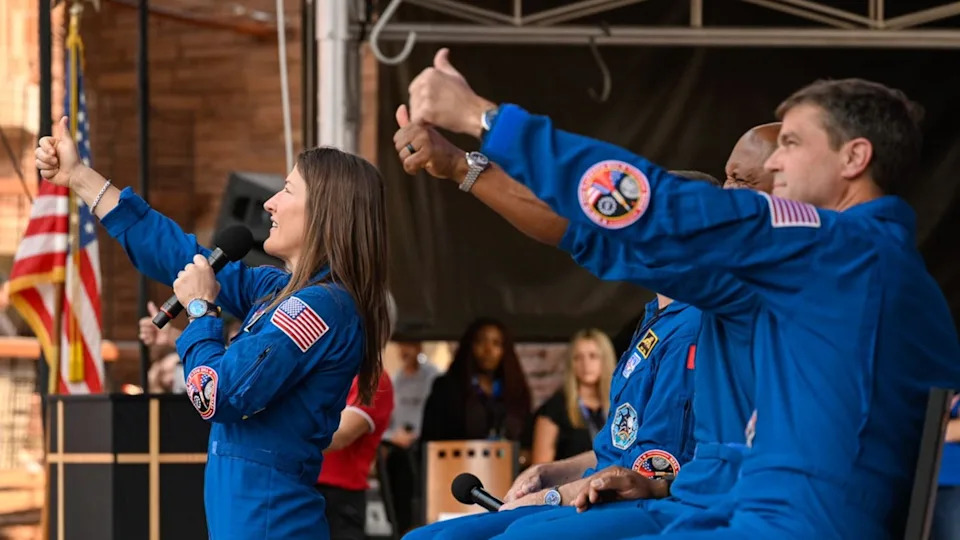
The Artemis II crew gives a thumbs-up to the crowd at Red Rocks Amphitheatre in Morrison, Colorado on Aug. 3, 2026. | Credit: Lockheed Martin
Canadian mission specialist Jeremy Hansen stressed the international and collaborative nature of Artemis II, calling for global cooperation in deep-space exploration.
Looking Ahead: Artemis III And Lander Demonstrations
Lori Glaze, NASA’s associate administrator for the Human Exploration and Operations Mission Directorate, said Artemis III is targeted for mid-2027. That mission will demonstrate docking with pathfinder versions of lunar landers from Blue Origin and SpaceX to validate docking systems and reduce risk ahead of a crewed landing.
Glaze emphasized that docking demonstrations are intended to "buy down" a key risk so teams can concentrate on landing-specific challenges. Sources indicate there is active discussion inside NASA about whether the lunar south pole should be the first landing site; mission planners and lander vendors remain focused on south-pole-capable designs, while some crew members have urged a progressive approach.
The Red Rocks event underscored both technical progress and public enthusiasm — and offered a reminder that the next chapter of Artemis will combine engineering milestones with international collaboration and public engagement.
Help us improve.





















